Showing posts with label libya. Show all posts

Friday, March 15, 2013

Christians in Libya face increase in persecution


Libya (ODM) ― An Open Doors field worker for Libya has expressed his deep concerns about the deteriorating situation for Christians in Libya.

He said, "Since Muammar Gaddafi's regime fell two years ago, there have been several reports of violence against Christians. But since February, dozens of Christians have faced hostilities, detainment, and deportation. Several of them have been severely mistreated, and one died while in detention."

Sherif Ramsis was arrested on Feb. 10. He is an Egyptian Christian living in Libya and had been running his business in Benghazi for 10 years. In the following week, a number of other Christians were arrested as well. Among them were four Egyptians and three non-Arab foreigners working in Libya. Some of them knew Sherif from a work-related or social context. It was reported that they were arrested based on the contacts on Sherif's mobile device.

While the non-Arabs are being treated comparatively well while being detained, local contacts report that the Egyptians are badly mistreated. There are reports of a lack of warm clothing and food, and the Egyptians being forced to sleep on the cold concrete floor in their cell. The Egyptians also sustained bruises due to torture in an attempt to extract information.

While suffering from the consequences of the mistreatment, the detained Egyptians were transferred from Benghazi to Tripoli on Feb. 25. In Tripoli, the lack of proper health care had fatal consequences for one of the detained, Ezzat Hakim Atallah, as confirmed by human rights organization Middle East Concern. Atallah was one of the transferred Coptic Christians.

The Open Doors field worker said: "Ezzat was running a cell phone repair shop in Benghazi and had been living in Libya for 10 years. People knew he was an Egyptian Copt, but that never led to serious trouble for him or his family."

During his imprisonment, he suffered severe chest pains. He was moved to a hospital March 6 for treatment, but was later returned and locked up again with the other Egyptian Copts. The medical treatment proved insufficient, and on Sunday March 10, Ezzat died in his cell. While reportedly still being kept in the same room, the other cell mates stood by helplessly and watched him die. Ezzat leaves behind his wife, and a daughter and son, 11 and 15 years old, respectively.

The other Egyptians are in still in detention. Earlier this week, all appeared before the public prosecutor. While it is difficult to have the official charges verified, the families were told that they will be charged with espionage. In February, a police officer told the press agency Reuters that they had been arrested on suspicion of distributing Christian books and proselytizing.

The Open Doors worker commented: "What really surprises me is that authorities claim the legal and judiciary framework from Gaddafi's regime has been put aside. But when it comes to the freedom of religion and situations like this, it seems that these former laws are still being upheld and used.

"To be honest, I had a sparkle of hope that the country could benefit from the regime change," the Open Doors field worker added. "But the developments of the past month are a big blow and a sobering setback. Still, I think it is possible that we will see positive responses from seekers of Christ in the country. I truly hope that more Libyans will stand up and cling to the freedom that was fought over so hard two years ago."

Libya is ranked No. 17 on the Open Doors 2013 World Watch List of the 50 worst persecutors of Christians.

Thursday, September 20, 2012

French publication fuels Muslim anger

(Story Photo by Rae Burnett)

Egypt (MNN) ― The last day or two have been without blaring headlines describing Muslim rioting, but that could all change. 

A French magazine this week published vulgar caricatures of the Prophet Muhammad, despite government entreaties not to publish the images. In response, the French government ordered embassies and schools to close Friday in about 20 countries.

The incident is likely to raise tensions that were already dangerously high. It follows days of violent protests from Asia to Africa against the U.S.-produced film "Innocence of Muslims" and turned France into a potential target of Muslim rage
But don't be fooled, says Rae Burnett with Christian Aid Mission. "The film was just a pretext for the violence." She goes on to explain that the event gave a cover story for lashing out at intended targets--a theory that's been substantiated by the Libyan government. Further, says Burnett, "Since the violence has subsided, nothing has gotten better because these believers are in grave danger. They're afraid of being slaughtered because everything is intensifying."

That concern is magnified by the feeling of isolation. "They [extremists] are overtly burning churches and persecuting Christians and kidnapping their children...just terrible things far surpassing what they used to experience, and the world is silent." 

Burnett says the real story is the uncertainty. Christian Aid supports indigenous ministries who seek to engage the lost people of Egypt through holding house meetings, setting up Bible training, and doing evangelistic outreach. She explains that "one of these guys called me the first day of the rioting in Egypt and said, ‘They're burning Bibles in front of the U.S. embassy.' They were doing those kinds of things just to show their hostility, and they were burning churches and things that weren't reported."

The threat plays out on the political stage, but Burnett says, "This is all spiritual warfare. We're seeing it in a political environment because that's the environment through which this takes place. But the point is to destroy the work of the Lord and to destroy those who might come into the Kingdom, to keep people in darkness."

Given that understanding, the workers supported by Christian Aid Mission haven't fled. "It hasn't diminished any of their efforts. The main group that we help just had a conference of their workers, training their workers and praying together to ask the Lord for direction. So they are going forward in the work, but they are really discouraged about the political situation and the future of Christianity in Egypt." 

They're careful, but they won't be intimidated. Burnett says the Coptic Church is targeted because they have a noticeable presence in Egypt. However, "The people that we're helping generally meet in homes. They might have an office somewhere if they can afford that, so they're less of a target. Of course, because of their evangelistic efforts, people know who they are."

The Gospel, as she's said multiple times, is still going forward. It's about standing shoulder-to-shoulder with the worn out believers of Egypt and advancing together. Burnett says, "We have to understand that and pray accordingly and act accordingly to be lights in the darkness." Pray for creative and effective approaches to spread God's Word in Egypt. Pray for open hearts. Pray for change in the chaos.

Friday, September 14, 2012

Turmoil in the Middle East spreads

(File photos courtesy SAT-7)

Middle East (MNN/SAT7) ―Egypt's Muslim Brotherhood has called for a nationwide peaceful demonstration today to condemn insults to Prophet Mohammad from an amateurish film.

The announcement followed the attacks against U.S. Embassies in Libya and Egypt. Demonstrators also attacked the U.S. embassies in Yemen and Egypt (again) on Thursday. The spreading turmoil was a response to a film they consider blasphemous to Islam.

An investigation has begun into the events surrounding Tuesday's attack on the U.S. embassy in Libya, which resulted in the death of the U.S. ambassador Christopher Stevens and three other Americans. Eight Libyans were injured in that violence.

Protests also erupted in Iraq and Iran, as students in Tehran protested outside the Swiss embassy. In Bangladesh, Islamists tried to march on the U.S. embassy in Dhaka but were turned back by police. There were also reported protests at U.S. missions in Tunisia, Sudan, and Morocco.

The film may have been the vehicle used to stir up tensions, especially in light of the September 11 anniversary. SAT-7 CEOTerry Ascott says, "That reaction is inflamed by people who have a vested interest, like Al Qaeda, in exploiting people's anger at the West. It's a bit of a coincidence, one might say, that this flared up all within hours in Egypt, in Yemen, in Libya, in other places. It seems somewhat orchestrated."

Security was being increased at U.S. diplomatic stations around the globe, but what about ministries? "There have been specific threats against, for example, Egyptian Christians in Yemen and churches and Christians, in general...anyone who is a ‘cross worshipper,' as they say in the street."

Ascott goes on to say, "It's not the people that are making the movies or the cartoons in the Western world that pay the price for their enjoyment of free speech. It is the Christians in the Middle East that bear the brunt of the reaction that inevitably comes."

Throughout the Middle East and North Africa, it's a common belief that Christianity is a Western religion. Therefore, when trouble occurs similar to what's happened this week, entities with Western connections are targeted, and that includes ministries.

SAT-7 has an office in Cairo. When asked if there was a contingency plan for the staff, Ascott first said, "We do have heavy fences and cameras and security people around our building, but it certainly would not be enough if a mob decided to attack the building."

However, Ascott went on to explain that they're also being vigilant. "If there are signs of trouble, we would try to evacuate our staff from the premises before that got out of hand. But we don't have armed guards on the building to protect it from a riot."

Still, the staff is putting together programs that will address much of what has happened this week in the region.

Interestingly, the SAT-7 ARABIC team had already begun a series of programs called Forbidden, which address issues relevant to North Africa. Presenter Emad D. is a Tunisian poet and pastor. The inspiration for the program comes from John 11:35, "Jesus wept." Emad wants to show the Arab world that Jesus cares about them and weeps over them.

Emad hopes to use testimonies to demonstrate that the Church is spreading all over the world, and longs to see equality between people of all religions--with more respect for new believers. Ascott states that the program aims to overcome negative perceptions of the Church.

Another team is doing a live show on Saturday. Ascott says, "In the situation with the Middle East where there are so many agendas, so many tensions between so many different groups, we're trying to bring reconciliation through better understanding, advocacy of forgiveness, and so on--some of the things that are unique in the Christian Gospel."

Pray wisdom for the production teams. Pray for safety for the staff. Pray for peace to return. Pray for open hearts.


Thursday, September 13, 2012

'Christians, they will pay for this,' says e3 Partners

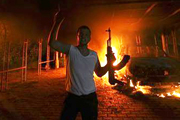
A protester reacts as the U.S. Consulate in Benghazi is seen in f
lames during a protest by an armed group said to have been protesting
a film being produced in the United States September 11, 2012.
 (REUTERS/Esam Al-Fetori)

International (MNN) ― The world is on alert in the aftermath of the attack on two United States embassies. First, protesters scaled the walls of the embassy in Cairo, tearing down the U.S. flag and replacing it with an Islamic one. 

Then, Islamist extremists attacked the embassy in Benghazi, Libya killing Ambassador Christopher Stevens and three other diplomats.

The attacks reignite an already volatile situation in the region. Tie that together with civil war in Syria and the region is unstable at best.

Vice President of e3 Partners Tom Doyle is puzzled about how quiet Egypt's president has been in all this. "As far as I've seen, there hasn't been an official statement for Mohammad Morsi."

On the other hand, Doyle says, "The Libyan government issued a statement of regret and sorrow about the things that happened. It is definitely gang warfare in Libya."

With Libya up for grabs politically, Christians in Egypt are concerned. "They were very concerned that this brotherhood sweep in Egypt would just flow over into Libya and take that over. If that happens, virtually the land space -- that's half of North Africa being led by the radicals."

This recent violence against the United States could be just a glimpse of things to come. "It seems to be in the Middle East a contest of who can outdo each other in their radical allegiance to the Quran and Mohammad."

What about Christians in this region? "There's always the tie from Muslims to believers in their country to the west -- to America, the great Satan. When you see these things, most people don't think about what that means for the Christians. They will pay a price for this."

While the tension is ratcheted up since the attacks, Doyle says many Muslims are sick of the violence. "They've been seeing Muslims kill Muslims. And many young people have had enough of that. You won't see that on the news."

Doyle says, "Isn't it amazing that today the countries of conflict--look at Iran--boast the fastest-growing church per capita in the world right now, according to Operation World. The hotspots in the world is where the church is thriving and flourishing and growing faster than in those countries than it probably ever has in 2,000 years."

With the commemoration of the 9/11 attacks and these recent attacks, Muslims in the west are being marginalized. 

Doyle says Christians should "reach out to them. Start a conversation about Jesus. You will be shocked at how open they are to receive your friendship and just your greeting. Jesus could use this to really reach out to a Muslim."


Christians in Egypt, Libya, Other Countries Could Face Increased Persecution

Coptic Christians hold up cross in the midst of protest.

SANTA ANA, Calif., Sept. 12, 2012 /Christian Newswire/ -- The Tuesday attacks on U.S. embassies in Libya and Egypt could have severe consequences for already marginalized Christians in the Middle East and northern Africa.

The violence, including the death of four American embassy staff members in Benghazi, Libya, was allegedly sparked by a film produced in the U.S. that insulted the Prophet Mohammad.

"It illustrates how hot the fuel is that one spark ignites it so suddenly," says Open Doors spokesman Michael Wood. "At some point we heard that people were protesting because of a film not even knowing what movie this was all about. And as was the case with the publishing of the Danish cartoon several years ago, the movie has been on the Internet several months.

"But it is the unpredictable momentum that suddenly creates a wave of protests and anger. Many of the Muslim fanatics link the U.S. with Christianity. So that puts believers in these hot spots such as Libya and Egypt directly in the line of fire."

Angry protests over the film have already spread in the Middle East with new demonstrations reported late today in Tunisia, Morocco and Sudan. Egypt's powerful Muslim Brotherhood on Wednesday called for nationwide protests on Friday.

Wood adds that Christians in Egypt, who compose 10 percent of the population, and the small community of believers in Libya need our prayers now more than ever before. "Pray that the violence over this film does not spread to other countries...that is the No. 1 prayer request," he says.

An estimated 100 million Christians worldwide suffer interrogation, arrest and even death for their faith in Christ, with millions more facing discrimination and alienation. Open Doors supports and strengthens believers in the world's most difficult areas through Bible and Christian literature distribution, leadership training and assistance, Christian community development, prayer and presence ministry and advocacy on behalf of suffering believers. To partner with Open Doors USA, call toll free at 888-5-BIBLE-5 (888-524-2535) or go to our Website atwww.OpenDoorsUSA.org.
Christian Newswire

Thursday, March 8, 2012

Libyan Islamists Destroy 150 British Graves From WWII, Tear Down Crosses One Year After Begging For Their Help…

How and why did they do it?

By Lisa Gibson
Special to ASSIST News Service


COLORADO SPRINGS, CO (ANS) -- I was saddened when I heard the news about the Islamists in Libya who destroyed the graves of British soldiers at a World War II cemetery in Libya. In my culture it is wrong to desecrate a grave. I would imagine it is wrong in Islam as well, which is why they did it. But even more scandalous was the desecration of the cross that hung above the graves of the soldiers who died there. As Christians, that speaks a very clear and hate filled message.

When I saw the copy of the self- promotional video (www.youtube.com/watch?v=E49R8zMJb5s&feature=youtu.be) created by the vandals that was so brazenly aired on YouTube, I was caught off guard. The vandals wore no masks to cover their faces while committing the crime. Instead, they openly and unabashedly engaged in the crime and destruction while all along chanting “Allahu Akbar”, God is great.

Tearing down a cross in the cemetery
The reason for the act was simple, revenge. It was in response to the US burning of the Koran in Afghanistan. Perhaps the Libyan’s hadn’t gotten the whole story of the secret spy codes in Koran’s that were burned, or even heard that the US and even President Obama himself apologized for burning their holy books. But either way, I am confident God wasn’t behind either act of destruction so rather than chanting “God is great” while committing the crime, let’s keep his name out of it.

What saddened me most about this act, is that the actions don’t reflect the sentiment of the majority of Libyans. In fact, many of the progressive leaders I have worked with in Libya in recent months also have concern about the growing fundamentalist influence and the propaganda that is being spread among the Libyan people, especially as the June elections approach.
Lisa teaching conflict resolution
in Libya in January


I was just in Libya in January. We held a two-week leadership training course for 100 medical, business and governmental leaders in Benghazi in ethics, leadership, conflict resolution, and administration. It was the first of many trainings to come, in civil society and capacity building. It was all very new information and designed to help transform wrong patterns of thought that were indoctrinated into the minds of the people during 42 years of tyranny. The leaders were challenged, but greatly appreciated the material and were given concrete skills to apply immediately in their workplaces and lives.

In my experience, the majority of Libyans are peace-loving people who want change and prosperity. They aren’t looking for another civil war, or to continue fighting. But just like you have the Taliban in Afghanistan and Al Qaeda in Iraq, you have militant leaders in Libya who are trying to seize power for their own agenda and purposes. They use hate rhetoric and half-truths to stir up discontent among the poor people in the country who are still struggling and not seeing the life altering changes that they believed the revolution would bring. Change doesn’t happen overnight. This breads discontent. Discontent can lead to hate and abuse. We have seen this play out time and again through history.

I haven’t given up on Libya. Despite the lopsided articles I read in the media, I don’t believe it is imploding or bound for ultimate demise. I have a great deal of hope for the future of Libya. They are a people dearly loved by God, who have gone through 42 years of abuse by a brutal regime and they need to learn there is a better way of doing things. They need the western world to go and help them develop, transform and become peaceful and prosperous.

Even though the vengeful acts of destruction make me angry. I refuse to fight with the enemy’s weapons. I want to see the vandals brought to justice, so it creates deterrence of future bad behavior. But more than that, I want to see forgiveness and reconciliation reign. Matthew 5:9 says “Blessed are the peacemakers, for they will be called children of God.” The reason is simple. The only way to effectively fight hate, is through love!


Lisa Gibson is the Founder and Director of the Peace and Prosperity Alliance (www.peaceandprosperityalliance.org). She is an ambassador of forgiveness and reconciliation, also an attorney, mediator, public speaker and author of the Award Winning book “Life in Death: A Journey From Terrorism To Triumph.” Lisa has a unique voice on global terrorism having lost her brother on the 1988 terrorist bombing of Pan Am flight 103 over Lockerbie, Scotland. As a result of this tragedy she is overcoming evil with good by serving the people of Libya, the country found responsible for her brother’s death. Her story of forgiveness made the headlines when she met with and forgave Libyan Leader Muammar Gaddafi, the world’s most notorious terrorist and the man responsible for her brother’s death. She can be contacted by e-mail at: Lisa@peaceandprosperityalliance.org

** You may republish this story with proper attribution.

Monday, March 5, 2012

Libya's reform comes slowly; believers sense freedom

(Photo by Crethi Plethi)

Libya (ODM/MNN) ― On February 20, the first elections since the overthrow of Muammar Gaddaffi were held in Misrata, Libya's third-largest city.

Reform is coming slower than the revolutionaries want, but the National Transitional Council says elections served as a model for the June vote that will usher in a 200-member national assembly. The assembly will name a new government and select a panel to write a constitution.

In the meantime, there is a sense of freedom in Libya, which seems to be giving Christians new determination. An Open Doorsworker, who wants to stay anonymous, says, "The Christians in Libya are more open right now; they have more courage to share about their faith. But of course the freedom is still minimal."

At the beginning of 2011, before the revolution, Open Doors estimates there were about 180,000 expatriate Christians living in the country and just 180 indigenous believers. The vast majority of the Libyans are Sunni Muslim. However, as the dust settles post-revolution, it seems that many expatriates left the country, significantly reducing the numbers of believers.

The hostilities some Christians are reporting stem from racism connected to politics. "Sub-Saharan Africans have said that they are discriminated more openly. On the streets they hear people saying bad words to dark-skinned people, for example. Before the revolution, this didn't happen so strong and open", the Open Doors worker says. According to him, the racism has partly to do with the fact that Gaddaffi used sub-Saharan Africans to fight for him. As a result, members of the churches for the sub-Saharan Africans are trying to survive in an increasingly unfriendly environment.

Skepticism about the politics isn't helping. "Politicians are having a hard time at the moment. Nobody trusts them, and they can't do anything right in the view of the majority of the people. Nobody has any respect for them, and every decision is being criticized," the Open Doors worker says. "This might be understandable after so many years of oppression, but for the long run, this might be not a very constructive way of thinking for rebuilding the country."

Pray for all the Muslims that might be open to the Gospel, that they will meet Christians to help them. Pray for the expat churches that exist in Libya that they, even though it is forbidden, will find ways to reach out to locals.

Monday, October 31, 2011

NATO pulls out of Libya; Christians dig in

Mission Network News: "Libya (ODM/MNN) ― NATO decided to end its Libya mission October 31, even though members of the National Transition Council asked that forces stay on two more months to provide security for its borders.

However, while it doesn't want to provide personnel on the ground, the alliance has not rejected a long-term "security cooperation." It's just one more part of dealing with issues surrounding the new Libya."

Read more...

Thursday, October 27, 2011

NATO presence requested in Libya through end of 2011

Mission Network News: "Libya (MNN) ― Although NATO seems poised to bring its Libya mission to an end, the transitional government has asked it to remain through the end of 2011 to help ensure security."

Read more...

Wednesday, October 26, 2011

'New' Libya to follow Sharia law, says interim government

Mission Network News: "Libya (MNN) ― After months of fighting an oppressive dictator, Libyan rejoiced in Moammar Gaddafi's death last week. The death not just of the man but seemingly of the symbol of oppression represented change and ultimately freedom."

Read more...

Tuesday, October 25, 2011

Monday, October 24, 2011

Who will run the new Libya now?

Mission Network News: "Libya (MNN) ― With Libya united to topple Muammar Gaddafi, the question upon his death is: Whose revolution was it?

There were multiple heavily-armed militias fighting together to remove the regime, and now that the smoke is clearing, they've laid claim on a territory and cause."

Read more...

Tuesday, August 23, 2011

Libya advances on freedom


Libya (MNN) ― Now that rebels have stormed Tripoli, there are growing rumors hinting that Libyan leader Colonel Muammar Gaddafi could flee to Venezuela or Cuba.

In the meantime, the European Union welcomed the advance and called for Gaddafi to step down. Whether or not the state of Libya will remain the same over the next 72 hours is yet to be seen.

What makes this advance particularly significant in the six months of civil war is the absence of key leaders who defected over the last few weeks, leaving Gaddafi increasingly isolated. Could another assault force a reset of the conflict? That's unknown.

However, says Todd Nettleton with Voice of the Martyrs, change is likely to favor those seeking freedom, specifically, the Christians. Libya is ranked 25th on the Open Doors World Watch List, a spot earned because "there was heavy persecution, particularly of Muslim converts. There were some churches in the city of Tripoli that were allowed to be open, allowed to operate, but primarily they dealt with foreigners."

Libya adheres to Islamic law, and all citizens are Sunni Muslims "by definition." Conversion to Christianity is forbidden, and there are few native Libyan believers. Nettleton explains that "where you run into persecution is where a Muslim changes [his or her] faith and comes to Jesus Christ. Those are the people who face really heavy persecution."

The National Transitional Council is urging Libya to start an "all-inclusive" dialogue leading to democratic elections.

Watchdog groups warn that the transition could bring more violence with it. Nettleton says, "There's just a lot of questions at this point, and we need to pray that Christians will be protected, that whoever ends up in government authority will provide protection, will recognize the rights of minority groups like Christians."
Currently, most Libyan Christians are forced to believe in secret and are afraid to meet with other believers. Small

Christian communities do exist, mostly consisting of sub-Saharan migrants and Western expatriate workers. They've remained active throughout the longest periods of oppression. Nettleton says because of this, "In some cases, Bibles have been able to be delivered into Libya because of some of the upheaval. Maybe the border is not being as tightly monitored as in previous years. "

That's nothing new. With Gaddafi's strict control of the country, evangelism has been difficult and any Christian literature that got into the country was smuggled in. At the crossroad of change, could there be more freedom? Nettleton indicates it's too early to know yet, but "we can pray about that as well, that Scriptures will go in and that Christian work can fill some of the voids."

Given the significance of the persecution and harassment in Libya, just 3% of the population is believers.  That begs the question: Is Libya home to a remnant church? Nettleton replies, "There is a vibrant group of believers that are there, that are sharing the Gospel. So while I would say a 'remnant' is a fair description, don't be confused into thinking that there aren't really bold, on-fire believers there, because there absolutely are."

As Libya looks forward to a new beginning, Christians are encouraged to "pray first, pray second, and pray third. I think at this point, because there's so much upheaval, I think prayer really is the frontline of the spiritual battle for the nation of Libya."