Throughout the Middle East, long-standing dictators just ousted in the Arab Spring are being replaced by more oppressive forms of governance, even in the Arab world’s most liberal country, TunisiaBy Aidan ClaySpecial to ASSIST News Service
TUNIS, TUNISIA (ANS) -- Widely seen as the most secular country that recently deposed long-standing leaders, many believed that Tunisia had the greatest opportunity to elect a moderate government concerned with democratic principles and human rights. However, the hopes of secularists, Christians, and other minorities were crippled in October when the Islamist Ennahda party won 41 percent of the votes for a national constitutional assembly, a one-year body charged with writing a constitution.
 |
Uprising in Tunis that ousted President
Zine El Abedine Ben Ali |
Along with other Islamist movements, Ennahda – at the time called the Movement of the Islamic Tendency – had been outlawed under former President Zine El Abedine Ben Ali. Robin Wright, an American foreign affairs analyst and author of Sacred Rage, described the Islamic Tendency as “the single most threatening opposition force [to Ben Ali’s regime] in Tunis.”
Ennahda’s founder and chairman is Rashid Ghannouchi. He considers himself a pupil of Iranian Ayatollah Khomeini, defended the takeover of the U.S. Embassy in Tehran in 1979, and supported Saddam Hussein’s invasion and annexation of Kuwait in 1990. In a speech given in Khartoum just before the Gulf War erupted, Ghannouchi said, “We must wage unceasing war against the Americans until they leave the land of Islam, or we will burn and destroy all their interests across the entire Islamic world,” The Brussels Journal reported.
Martin Kramer, the renowned Middle East scholar at the Washington Institute for Near East Policy, labeled Ghannouchi “the most prominent Islamist in the West” during his 22-year exile in the U.K. At an Islamic Conference on Palestine attended by leaders of Lebanon’s Hezbollah and the Palestinian Islamic Jihad in 1990, Ghannouchi said, “The greatest danger to civilization, religion and world peace is the United States Administration. It is the Great Satan.”
The international community has ignored this extremist rhetoric and extolled Tunisia’s revolutionary motives for ‘greater freedoms.’ However, Ennahda is beginning to show its true colors by attacking freedom of speech and tacitly disregarding violent Islamist movements calling for an Islamic state.
Death of Free Speech
Nabil Karoui, the owner of Tunisian channel Nessma TV, is currently on trial for blasphemy after airing the French-Iranian animated film Persepolis which features a cartoon depiction of God and is considered sacrilege to some Muslims. Nearly 140 lawyers filed lawsuits against Karoui for “violating sacred values” and “disturbing public order,” Tunisia Live reported. Following the release of the film in Tunisia, a Salifist-led mob damaged Karoui’s house with Molotov cocktails on October 14. If convicted, Karoui could face three to five years in prison. His trial has been adjourned until April 19, 2012.
“I am very sad when I see that the people that burned my house are free while I am here because I broadcast a film which was authorized,” Karoui told reporters outside the courtroom. He described the trial as the “death of freedom of expression [in Tunisia],” AP reported.
While Human Rights Watch called the trial “a disturbing turn for the nascent Tunisian democracy,” Ghannouchi, the voice of the Ennahda party, backed the trial, saying, “I support the Tunisians’ right to denounce this attack on their religion,” reported The New York Times.
On February 15, in a second disturbing attack on free speech in Tunisia, a publisher and two editors of Tunisia’s Attounissia newspaper were arrested on charges of violating public morals for publishing a revealing photograph of a German-Tunisian football player with his girlfriend.
The arrests raised further concerns among secularists that the Islamist-led government will increasingly seek to censor material it deems offensive to Islam.
Mongi Khadraoui, a senior member of the Tunisian journalists’ union, told The Independent that article 121 of Tunisia’s penal code, which was used to detain the three journalists, was introduced to arrest opponents of Ben Ali’s 23-year-old regime, and that, while the publication of the photograph was a mistake, it “should be treated as a professional error rather than a crime.”
“This issue is political and aims to quell the voice of the media and stop it [from] criticizing the government,” Jihen Lagmari, a journalist at Attounissia, told Reuters. Lagmari also said she received telephone calls threatening to burn down the paper’s headquarters.
Islamists vs. Secularists
On February 17, hundreds of Salafis – who follow the strict Wahhabi doctrine of Islam – protested in the streets of Tunis with signs calling for Islamic law and shouting “Allah Akbar” after Friday prayers, AP reported.
Thus, Islamists have used their newly gained freedoms to threaten the very freedoms and values of secularists. If Islamists continue to gain power, violations against the rights of non-Muslims and liberals will inevitably continue. However, some believe the elections – that brought the Islamist Ennahda party to power – do not accurately represent the voice of the population’s majority.
“In October 2011, when Tunisia’s first post-revolutionary national elections took place… the turnout was 80 percent; but not, as was deceptively reported by the Western media, 80 percent of the total Tunisian population, but rather 80 percent of the 50 percent who had bothered to register to vote,” British author and journalist John R. Bradley wrote in his book After the Arab Spring. “In other words: Ennahda won despite the fact that more than 80 percent of all voting-age Tunisians did not actually vote for the party.”
Tunis witnessed the secularists’ response when over 6,000 demonstrators chanted slogans “No to extremism” and “No niqab, no to Salafism” in a march for freedom of expression on January 28, Tunisia Live reported. Protestors also called for the government to stop the rise of an Islamist-based society, which would derail Tunisia’s transition to democracy and threaten the gains made by the revolution.
Mustapha Tlili, the founder of the New York-based Center for Dialogues, views the recent actions taken by Islamists as an indicator that Islamists are hijacking the revolution. “Those that staged the revolution see it being stolen and hijacked,” Tlili told Middle East Online. “The Islamists’ discourse is to withdraw Tunisia from its natural environment and make it adopt Islamist values that are not those of the majority of Tunisians. They reject these values because they are not part of their daily life or vision of Islam.”
“We’ve become the ahl al-dhimma,” Abdelhalim Messaoudi, a journalist at Nessma TV, told The New York Times in reference to the second-class status minorities have historically been subjected to in Muslim states. “It’s like the Middle Ages.”
What’s Next? An Islamic State?
On February 20, Aridha Chaabia, or Popular List, the third-largest party in Tunisia's constituent assembly, proposed drafting a constitution based on Islamic law, Reuters reported. If the proposal wins the support of more than 60 percent of parliamentarians, it could pass without a referendum. Rashid Ghannouchi’s Ennahda party, which will have the strongest voice in the vote, has already alluded to its endorsement of an Islamic-based constitution.
 |
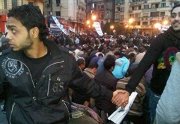
Protestors in Tunis |
Hamadi Jebali, the Prime Minister of the Ennahda party, implied in mid-November that he sought a return of the Muslim caliphate. He further stated at a rally near his hometown of Sousse, standing side-by-side with a lawmaker from the Islamic Palestinian movement Hamas, that “the liberation of Tunisia will, God willing, bring about the liberation of Jerusalem,” The Jerusalem Post reported.
“[Ghannouchi’s] only condition for Muslim democracy to flourish is the sharing of the immutable principles of Islam as a shared set of values,” Larbi Sadiki, a senior lecturer in Middle East Politics at the University of Exeter, wrote in an editorial for Al Jazeera.
Samir Dilou, spokesman for the Ennahdha Party, tried to ease secularists’ concerns in an interview in May: “We do not want a theocracy. We want a democratic state that is characterized by the idea of freedom. The people must decide for themselves how they live…We are not an Islamist party, we are an Islamic party, which gets its direction from the principles of the Quran.”
But, can an Islamic party governed by the principles of the Quran value the freedoms of the country’s secularists, including its religious minorities? Katharine Cornell Gorka, the Executive Director of The Westminster Institute, does not think so.
“Of all the people in the world, Americans first and foremost should recognize the absurdity of [Dilou’s] statement,” Gorka wrote. “All the evidence is there to suggest that Tunisia’s new government will prove antagonistic both to American interests and to the values America is built on. That is not to suggest we should have intervened to create a different outcome. Tunisia’s fate is its own. But neither should we be at the front of the cheering section, applauding what will likely be a long and brutal lesson for Tunisia on what happens when religion is enchained with politics.”
Recent indicators in Tunisia suggest that Islam and democracy are not and cannot be compatible. John R. Bradley, in his book After the Arab Spring, offers an alarming glimpse into Tunisia’s future governance: “[Ghannouchi] is for democracy ‘as a system of government and a method of change’ but – and here comes the conversation stopper – only insofar as it is compatible with Islam. The Quran remains the sole authoritative bases for legislation, whose earthly manifestation are the scholars… who interpret it so that the state’s function is essentially executive in nature. To put it in a nutshell: Islam is the answer to everything, the final authority, and the sole source of legitimacy of government.”
Aidan Clay is the Middle East Regional Manager for International Christian Concern (ICC), a Washington, DC-based human rights organization that exists to support persecuted Christians worldwide by providing awareness, advocacy, and assistance (
www.persecution.org). Aidan is a graduate from Biola University in Southern California. Prior to joining ICC, Aidan worked with Samaritan’s Purse in South Sudan and has traveled extensively throughout the Middle East, Africa and Europe. He and his wife currently live in Nairobi, Kenya. For more information, contact Aidan Clay at
clay@persecution.org
** You may republish this story with proper attribution.