Showing posts with label apostasy. Show all posts

Friday, May 24, 2013

Accusations could carry serious consequences for believers

In Sudan, an Islamic leader is telling
the government to take action against
 Christians who share the Good News. (Image courtesy Open Doors)
Sudan (MNN) ― An Islamic leader is telling Sudan's government to take action against Christians.

Ammar Saleh, the chairman of the Islamic Centre for Preaching and Comparative Studies, slammed his government last week for not taking decisive action against Christian missionaries, who he claims were operating "boldly" in Sudan.

According to independent media agency The Sudan Tribune, Saleh appealed to local authorities and the community to take a stand against "Christianisation" and find a long-term solution to what he views as a massive problem.

He says his government's efforts in this regard are timid compared to missionaries' efforts and claims 109 people have converted from Islam to Christianity in Khartoum. Saleh says these figures are growing in a "continuous" and "scary" fashion.

Dykstra says there are two sides to this coin.

"The bad news is that he wants to put more pressure on the government and the army to crack down on the Christians there," he explains. "But the good news is that many there are coming to Christ."

Despite persecution, Open Doors is seeing the Body of Christ in Sudan grow.

"It's been difficult for them obviously, but they are growing in numbers," states Dykstra.

In addition, a member of Sudan's ruling National Congress Party (NCP), Adam Mudawi, claims the NCP has information indicating that the Orthodox Church in Ombadda is hiding a large cache of weapons.

Mudawi also accuses the church of exploiting poor people by giving them financial support and assistance if they convert to Christianity.

According to Open Doors, Sudanese Christians have seen a dramatic increase in pressure over the past few months. Churches are being forced to close, and foreign workers are being kicked out of the country.

Given this tense atmosphere, Mudawi's accusations may have serious consequences for Christians in Sudan.

"We need to pray for Christians, especially those that are being marginalized around Khartoum," says Dykstra. "We also need to pray that there will be peace."

To help Sudanese Christians cope with growing persecution, Open Doors recently held two Standing Strong Through the Storm seminars. These seminars teach Christians how to relate to persecution and how to pray for one another.

A total of 13 different denominations were represented at the two seminars.

"The focus was to advance church unity, and many of the people who attended really appreciated the seminars," Dykstra says.

"It was a blessing that nobody was targeted or they weren't broken up."

Persecution in Sudan has moved the country from #16 on the Open Doors 2012 World Watch List to #12 in 2013.

Keep praying for Christ-followers in Sudan. Pray that their faith will remain strong. Praythat  the Gospel goes forth no matter what.

Tuesday, March 12, 2013

Debunking rumor re: Youcef Nadarkhani

(Images courtesy Present Truth Ministries)

Iran (MNN) ― You know how internet rumors run. They get started from some misinformation and sometimes runs for months.

That's the case surrounding the erroneous story of the execution of Iranian Pastor Youcef Nadarkhani. There were fears that the Iranian pastor had been killed after Facebook messages surfaced last week.

Jason Demars of Present Truth Ministries who was very involved in the Pastor Youcef case explains: "The Anglican vicar in Baghdad is a reliable person. I'm not sure where he got the information from, but they were basically reporting...the status he put on his Facebook page."

When Demars heard that story, "I began to reach out to some of my contacts to see if they could get in touch with the family to verify whether that was the case or not." Demars and Present Truth Ministries were very involved in the Pastor Youcef case. Soon, he heard back from his contacts. "They did reach the family and were able to confirm that he's alive and doing fine."

Last September, an Iranian court acquitted him on apostasy charges, a charge which carries the death-sentence. Instead, the court sentenced him to three years for "evangelizing Muslims." Since he had already spent nearly three years in Lakan Prison, he posted bail and was released on January 7.

Misinformation is common in stories from closed or creative access nations, so sometimes it's hard to know what's really happening. Demars says credibility is really important when communicating security -sensitive information. It's important "when we're asked about situations, to follow through and get direct confirmation of the news."

Even though this story was proven false, there are other Iranian Christians who are serving long prison terms. Iranian-born American Pastor Saeed Abedini is serving an eight-year prison term in Tehran's notorious Evin Prison on charges linked to his Christian faith.

Both the Voice of the Martyrs and Open Doors have noted the uptick in harassment against Christians. Iranian authorities seem to be targeting the growing number of Muslim-background believers who often worship in underground house churches.

Iran ranks 8th on the Open Doors World Watch list, a compilation of the top 50 countries around the world known for their persecution of Christians. Evangelism, Bible training, and publishing Scriptures in Farsi are illegal.

However, Open Doors notes that many disillusioned Iranian Muslims are becoming curious about Christianity. Demars says for those who can provide answers from the Gospel, "Pray for their safety, pray that they have wisdom in their dealings from day to day and that they would continue doing what God has called them to do with strength and faith."

The problem is: rumors like this one sometimes take a while to die down. They can be distracting. Be part of the solution. Demars says, "As these things come up, learn more about them and be an advocate for the persecuted, as well."

Tuesday, September 11, 2012

Apostasy, Fitna and abuse of Interpol

Saudi Arabia does not allow the public
 practice of any un-Islamic religion
If a 2 September report in the Saudi Gazette is true, then it may well be the first time Interpol as been abused by an Islamic State for the purpose of retrieving an apostate. 

------------------------------------------

APOSTASY

On 28 July 2012, the Saudi Gazette reported: "A Saudi girl who recently embraced Christianity and fled the country for refuge in Lebanon told the host of a religious program on an Arabic TV channel that she was tired of performing prayers and fasting during Ramadan. 

"The girl, who said her name was Maryam, said praying and fasting did not bring her any benefits. She also criticized the Commission for the Promotion of Virtue and Prevention of Vice (Hai'a) and claimed that she was raised to hate Judaism and Christianity but fell in love with the religions after she found peace in Christianity.

"She said she became a Christian after she had a dream one night. In it, she climbed to the skies and heard God telling her that Jesus is His son." 

According to reports, Maryam (28) was working in an insurance firm in Al-Khobar when she became interested in Christianity through the influence of her Christian boss, Lebanese expatriate, Mr Henna Sarkees (50). An unnamed male Saudi national with links to the firm then secured false travel documents that allowed her to leave the country for Lebanon, then for Sweden. 

Henna Sarkees and the unnamed Saudi national will stand trial in Al-Khobar, in Saudi Arabia's Eastern Province, on Saturday 15 September. Maryam's parents have charged the two men with coercing Maryam into converting to Christianity and then convincing her to leave the country without the consent of her male guardian. They have even suggested it may all be part of a conspiracy to get their daughter into the hands of international people-traffickers. 

Saudi media asserts that Maryam regrets her conversion, maintains she is still Muslim, denies ever talking to Arabic TV, desires to return home and is accusing Christians of taking her to Sweden against her will. 

For more background, details and links see: 
Religious Liberty Prayer Bulletin | RLPB 175 | Wed 05 Sep 2012
SAUDI ARABIA: convert flees; helpers to face court 
-- Interpol and Swedish authorities aid Saudi Embassy to hunt convert.
By Elizabeth Kendal

On 2 September, the following news report appeared in the Saudi Gazette: 
(copied in full; emphasis mine)
---------------------------------------------------------------------------
Efforts on to bring back ‘Al-Khobar girl’ from Sweden
Sunday, September 02, 2012 

AL-KHOBAR —The Al-Khobar girl who fled the Kingdom after allegedly converting to Christianity will be brought home from Sweden in a matter of few days, Al-Yaum newspaper reported Saturday quoting informed sources.

The Interpol is coordinating with the Saudi Embassy in Stockholm and Swedish authorities to return the girl to her homeland before her 'kidnappers' move her to another country, the sources said.

The girl's father received phone calls from unknown people who threatened to kill his daughter or move her to another European country if the main suspect in her case, a Lebanese man named Henna Sarkess, was not released from jail in the Kingdom. 

Sources said it is highly likely that a global human trafficking network was involved in the kidnapping of the girl, who was persuaded by her Lebanese manager to embrace Christianity and leave the country without the knowledge of her family.

A Saudi was arrested for faking a travel permit, which the girl used to leave the Kingdom and go to Lebanon. There, she stayed with a Christian group inside a church for a while. When she told the group that she wanted to return to the Kingdom and that she regretted what she had done, the group decided to take her to Sweden because it did not want her to return to the Kingdom. 

The girl’s father has called upon the authorities to help him bring back his daughter. He said his daughter still talks to them over the phone and she is currently in Sweden. The father is worried that his daughter might get brainwashed. 

The Saudi Embassy in Stockholm said it received a letter from the girl’s father requesting it to help her return to the Kingdom. The [Saudi] embassy has started a search with the Swedish authorities.

--------------------------------------------

INTERPOL

The information in this section of the posting has mostly been gleaned from the following sources:

Interpol's Red Notices Used by Some to Pursue Political Dissenters, Opponents.
Investigative report by Libby Lewis, for The Cutting Edge, 25 July 2011 

GLOBAL ADMINISTRATIVE LAW MEETS “SOFT” POWERS:THE UNCOMFORTABLE CASE OF INTERPOL RED NOTICES
Journal article (91 pages) by Mario Savino, March 2010
Journal of International Law and Politics, New York University

The website of Fair Trials International / Interpol 

Interpol's official website 

INTERPOL: WHAT IS IT?

With 190 member countries, Interpol is the world's second largest international entity after the United Nations. As in the United Nations, Interpol's member countries span from totalitarian dictatorship to liberal democracies. While Interpol possesses many attributes of an international organisation, many would say it is really more of an international network, linking police globally for the purpose of facilitating police cooperation and law enforcement across the globe.

INTERPOL: HOW IT WORKS 

Interpol operates "a closed communications system linking police via vast international databases". (Lewis) Normally, police in member countries send Interpol a domestic arrest notice, which Interpol then sends out as a global Red Notice. On the basis of a Red Notice, police in other member countries may arrest suspects for extradition. 

While Interpol's Constitution mandates neutrality and prohibits "any intervention or activities of a political, military, religious or racial character," cooperation is based on trust -- i.e. Interpol trusts member countries not to abuse the system. 

WHERE IS THE PROBLEM?

While Interpol has doubtless made the world a safer place by facilitating the arrest of numerous transnational terrorists, traffickers and other criminals, there is nothing to prevent human rights-abusing, non-free, totalitarian states from abusing the system and using Interpol to extend their own repressive arms internationally. Indeed, dictatorial regimes have been known to abuse the system and use it to track down and capture, or even just drive underground, their most troublesome dissidents. 

And because Interpol is neither transparent nor accountable, it is extremely easy to abuse.

"Interpol is not entrusted with any significant investigative or operational powers. Those powers are still located at national level. . . Interpol's core business is the administration of information." (Savino, p26)

Fair Trials International reports: "Even though some of Interpol's member countries are known human rights abusers and notoriously corrupt, Interpol has no effective mechanisms to prevent countries, or even individual prosecutors, abusing the red notice system. As a result, even though most red notices may be perfectly valid, abuses of Interpol are also affecting human rights campaigners, journalists and businessmen, in countries all over the world.

"People in this situation have no independent court they can turn to for redress. Your only option is to request a review by a Commission, funded by Interpol and serviced by Interpol staff. You have no right to a hearing, no opportunity to respond to allegations against you and will be given no reasons for the decision reached. Even if the Commission concludes that a red notice is inaccurate or abusive, it cannot require its removal or amendment. It can only make non-binding recommendations."

According to Interpol's Chief Lawyer, Joël Sollier, the agency does try to ferret out dubious requests. His instruction to Interpol is that a Red Notice should be cancelled if there is any doubt. (Lewis)

According to Lewis, Interpol's issuance of Red Notices has increased markedly in recent years, from 2,343 Red Notices in 2005, to 6,344 in 2010. "Partly to deal with that increased workload, Interpol is putting more power into the hands of its police members.

"Two years ago," writes Lewis, "police had to apply directly to Interpol for a Red Notice. Today, every Red Notice request is entered into the system directly by the police themselves—not by Interpol. Police around the world instantly see those notices—before Interpol even reviews them.

"Police can also bypass the formal Red Notice system altogether—and just type an informal notice of arrest in an email—and post it on Interpol’s communications system. Those email notices—Interpol calls them 'diffusions'—go out instantly, with no automatic Interpol review."

And as Lewis notes, "these informal email notices are linked to far more arrests than arrests linked to the Red Notices Interpol vets for political concerns". In fact, according to Lewis, in 2010, at least 1,858 arrests were made of people named in email notices while only 663 arrests were made of people named in Red Notices.

This might explain why in February of this year, while Malaysian police were claiming that they had arrested the Saudi tweeter Hamza Kashgari (23) "following a request made to us by Interpol" on behalf of the Saudi authorities, Interpol was strongly denying that it had anything to do with it. 

See: Interpol accused after Malaysia arrests journalist over Muhammad tweet
Police agency strongly denies its system used by Saudi Arabia to get journalist detained for insulting the Prophet Muhammad on Twitter
By Own Bowcott, The Guardian, 10 February 2012

Kashgari had fled Saudi Arabia after his tweeted imaginary conversation with the prophet Mohammad was deemed blasphemous. After being arrested in Malaysia and extradited, he was imprisoned in Saudi Arabia.He remains in prison to this day, still offering up apologies, but to no avail. Voices are still calling for him to be executed. 

There have also been some really obvious and undeniable abuses of Interpol.

One such case involves Indonesia's call for a Red Notice to be issued against Papuan independence advocate Benny Wenda (36). The Red Notice was issued despite the fact that the persecuted, tortured, now Oxford-based Wenda had been granted asylum in the UK. Only in August of this year was the Red Notice against Wenda dropped. 

See: Benny Wenda's plight has highlighted the misuse of Interpol
Interpol must act to stop its red notice system being abused by countries to persecute refugees and exiled political activists
By Alex Tinsley, The Guardian, 6 Aug 2012.

In an article published by CNN, Libby Lewis raises the case of Iranian dissident Shahram Homayoun (57). "After fleeing Iran in 1992 and moving to Los Angeles, Homayoun started a satellite television station, Channel One, to beam a message of civil resistance into the homes of Iranians.

"Over the years, his audience has scribbled his slogan, Ma Hastim ("We exist" in Farsi) on Iranian walls and bridges to promote democracy in the country. He has also called on his listeners to show their solidarity in creative ways, such as gathering at the tomb of Cyrus the Great or showing up at their local bakery on the same day -- every Thursday -- and asking for bread. 

"At the request of Iran, which charged Homayoun with inciting terrorism, Interpol issued a Red Notice in December 2009 requesting Homayoun's arrest."

Regarding Maryam, all the Saudi authorities would have had to do was to report through Interpol channels that a Saudi Arabian girl was being held in Sweden against her will, possibly by international traffickers, and request help to retrieve her and return her to her family. And with that, Maryam's hopes of liberty are dashed.  

FITNA

As I said in my opening remarks, if the 2 Sept 2012 report in the Saudi Gazette is true, then it may well be the first time Interpol has been abused by an Islamic State for the purpose of retrieving an apostate. 

In the past, Islamic states have generally been content to let apostates flee, for at least then they are not be around to spread fitna (temptation / doubt) amongst the locals. However, in these days of global communications -- satellite TV, YouTube, Facebook, Twitter etc -- the apostate can generate far more fitna from a safe-haven in the West than they ever could at home. And "fitna is worse than killing". (Qur'an Sura2:191).

Christian advocacy groups that have excelled at speaking into political power must quickly learn how to speak into international law enforcement so that Interpol and national police forces do not become unwitting extensions of Islamic religious police. 

Monday, July 9, 2012

New charges may be coming in apostasy case


Lakan Prison, where Pastor Nadarkhani is being held.
 (Photo courtesy of Present Truth Ministries)

Iran (CSW/MNN) ― Sunday July 8 marked 1,000 days since Pastor Youcef Nadarkhani was imprisoned in Iran for apostasy.

According to a report from Christian Solidarity Worldwide (CSW), Iranian Pastor Youcef Nadarkhani may face fresh charges in September.

The report makes note of new charges that may concern crimes against national security and possibly blasphemy in order to make his death sentence appear more acceptable. September 8, 2012 appears to be the new date for trial, according to CSW sources.

Nadarkhani faces the death penalty. Without the intervention of Supreme Leader or the Head of the Iranian Judiciary, authorities will carry out the Supreme Court ruling, which upheld the conviction.

It means Nadarkhani could be executed if he refuses to recant. Voice of the Martyrs says he has been pressured consistently--offered freedom in exchange for renouncing his faith on at least four occasions--but refuses to do so.

In a public statement, CSW's Advocacy Director Andrew Johnston said, "CSW is deeply concerned at reports that Pastor Nadarkhani may face fresh charges in September. The Iranian government is increasingly bringing charges against Christians on political grounds to mask the fact that like Pastor Nadarkhani and Pastor Fathi Malayeri, they have been arrested and imprisoned solely on account of their faith.

"We are also concerned by the lack of due process in these cases and continue to call for the immediate and unconditional release of Pastor Nadarkhani, Pastor Fathi Malayeri, and others who are unjustly imprisoned or facing execution following flawed judicial processes. CSW urges the Iranian authorities to ensure respect for the right to freedom of religion, which is guaranteed in the international covenants to which Iran is a signatory, including the International Covenant on Civil and Political Rights (ICCPR)."

Please continue to pray for wisdom and strength for Pastor Nadarkhani and for those trying to help him. Ask God to change hearts, and pray for open doors.

CSW is a Christian organization working for religious freedom through advocacy and human rights in the pursuit of justice.

Monday, June 18, 2012

Iran tightens the screws on church leaders


Central Assembly of God, Tehran
 (Photo courtesy Farsi Christian Network)

Iran (MNN) ― Concerns over church growth prompted Iran's Revolutionary Guard to crack down on a government-sanctioned church earlier this month. 

In a country where almost all Christian activity is illegal--especially when it occurs in Persian languages, President and CEO of Open Doors USACarl Moeller says, "Our work in the Persian-speaking world is very involved in supporting churches. The reality is that this church in Tehran--an Assembly of God church--was closed. It's one of the few legally Farsi-speaking churches in all of Iran."

Christian Solidarity Worldwide (CSW) says that until the order is reversed, no services will be held at the Janat-Abad area church.

Islam is the official religion in Iran, and everything falls under the interpretation of Sharia law. Moeller adds, "There are religious minorities that have historically been granted permission to worship in Iran: primarily Armenians, who are ethnically Armenian but living in Iran as Iranian citizens. They've been given certain limited permissions to meet." However, over the last year or so, many Christians have reported imprisonment, physical abuse, harassment, and discrimination because of their faith.

Moeller goes on to say that the most disconcerting part of the closure is: "There are few legally-protected Farsi-speaking churches, and yet those few now are coming under extreme pressure, and this one church has been ordered to be closed."  

Last month the leadership of the AOG Central Church of Tehran asked its members to volunteer their names and national ID numbers. Compass Direct News reports that the government move was aimed at limiting attendance by converts from Islam to Christianity, as well as to better monitor its members.

It's more than keeping an eye on Christians, though, explains Moeller. "In much of the country, Christians are being labeled by the government as 'agents of foreign governments' and so forth, and simply as 'spies to the regime.'" 

It's a consistent line of thinking when the Islamic regime's desire is to eliminate Christianity from Iran. "The way in which it seems to make sense, from their perspective, is that Christians, by their definition, are 'foreign agents.' Again, [with] the pressure that they're feeling globally on scrutiny about their nuclear program and the various other pressure that the Iranian government feels it's under, the first easy target for them to go after are Christians."

Disillusionment coupled with fear and social pressure are widening the crack in the regime's façade. Moeller says that their harsh treatment of Christians only further fuels the flames of the Gospel. "Increasingly, the government has to resort to stronger and stronger tactics to control the population. We see this happen as the influence of Christians in the country grows. And as people are more and more emboldened by their Christian faith to stand up against the government, the government is going to crack down even more. "

Open Doors UK/Ireland estimates that are roughly 460,000 Christians (from an Islamic and Assyrian/Armenian background) in Iran. Pray for boldness for believers there. Check our Featured Links Section for more prayer needs around the world.

Tuesday, May 15, 2012

Iran tightens the screws on church leaders

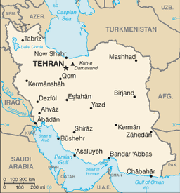
(Tehran images courtesy Wikipedia)
Mission Network News: "ran (MNN) ― The Iranian government is tightening control on a Farsi-speaking Church, says a report from Compass Direct News.

Todd Nettleton with Voice of the Martyrs USA says he's met with members of the Assemblies of God (AOG) Central Church of Tehran before. He notes that the AOG church holds two Sunday services, both conducted in Farsi. In fact, since 2009, it has been the only church remaining in Tehran that offers Farsi-language worship on Sundays in a dedicated building."

Read more...

Wednesday, February 29, 2012

Conflicting reports coming out of Iran over condemned pastor

(Photos by Present Truth Ministries)

Iran (MNN) ― Reports of the imminent execution of Christian pastor Youcef Nadarkhani are now being countered by news of delay.

Spokesman with the Voice of the Martyrs USA Todd Nettleton says the latest information he's heard is still being confirmed. "There is a report from an Israeli media outlet saying that the execution has been postponed. It's unclear when it will happen. The other part of this report that has new information to me is that it was scheduled to take place today (February 28), but it was postponed indefinitely."

There are other stories indicating there was actually no execution order and that Nadarkhani was being held for rape and "other crimes," not apostasy. (Article 225 of the Iranian penal code states, "Punishment for an Innate Apostate is death," and "Punishment for a Parental Apostate is death.") Naturally, the changing details beg the question, "Is this a campaign of misinformation?"

"There are so many different pieces of information coming from different directions, that it's hard to know what is real and what is not real," Nettleton notes. It could discredit future reports coming out of Iran. Who benefits from discrediting the stories? The bigger question, says Nettleton, is: "What role does the Iranian government play in this? They have a history of not being transparent with the rest of the world as far as what's going on inside Iran. So it is interesting to wonder if they are perhaps playing with this information as a way to try to gauge: 'How is the world going to respond if we do this?'"

However, delay could be a response to the international scrutiny, too. "When it comes to some of the European countries, those countries can have sway on Iranian public policy. The Iranian government does tend to pay attention to what they're saying. In this case, many of them are also sounding the chorus that a person should not be executed for their religious beliefs."

The American Center for Law and Justice added their voice the chorus of concern. "If a human being becomes a bargaining chip for the ayatollah, that's not a situation that will lead to anything positive," says ACLJ's executive director, Jordan Sekulow.

Nettleton says the lack of movement could also signal an acknowledgement of the conundrum Iran's judiciary faces. If the court releases the pastor, it denies Sharia law, risking the wrath of Muslims in Iran. If they execute him, they face the displeasure of the international community, which includes dozens of human rights groups, the White House, members of Congress, leaders from the European Union, France, Great Britain, Mexico and Germany.

Trying to find a way out of the dilemma, the court gave Nadarkhani a chance to recant and return to Islam, but he refused. His story reveals a distress the government can't ignore. Nettleton explains, "The government is responding with lethal force in this particular situation because the church is growing in a way that the government can't understand and can't control. They see putting someone to death as saying, 'This will put a stop to Muslims leaving Islam to follow Christ.'"

The paradox of persecution, says Nettleton, is met by prayer. "There is an incredible hunger for the Gospel. There is an incredible openness to hear about Jesus Christ. We need to pray that there will be ministries and people and workers who will work in those harvest fields."

Check our Featured Links Section for more about the work of the Voice of the Martyr with the persecuted church.

Thursday, February 23, 2012

Iranian pastor's execution could come at any time

Pastor Youcef Nadarkhani (Photos
courtesy of Present Truth Ministries)

Iran (MNN) ― Sources in Iran say an execution order for Christian Pastor Youcef Nadarkhani has been signed.

According to Present Truth Ministries (closely connected with Nadarkhani), this is grim news. Todd Nettleton, a spokesman for Voice of the Martyrs USA, confirms the news.  "Apparently, that execution order has not been delivered to his family or his attorneys, but the report is that it has been signed. That means that at any time, he could be executed."

Often the government will execute people without any prior notice to attorneys or family. It's also unclear whether it has been approved by the Ayatollah who is the head of the Judiciary Sadegh Larijani.

Nadarkhani was born to a Muslim family and admits that he was introduced to the teachings of Islam, but he claims he never accepted the faith. That was the basis of his appeal to the High Court on the apostasy verdict.  

Nettleton explains, "His reply to that is: 'Well no. I wasn't a practicing Muslim.' This execution order being signed says that the court has not approved that logic. They are saying: 'Yes in fact, you were a Muslim. Because you're a Christian now, you're an apostate, and you'll be executed for that apostasy.'"

Pastor Youcef has refused to recant his faith during the three years he's been separated from his wife and two sons. His conviction and sentence has been delayed due to international pressure, according to other reports from Present Truth Ministries. 

Meanwhile, on February 17, Rep. Joseph Pitts (R-PA) introduced a resolution denouncing Iran for its leaders' ruling of apostasy against Youcef Nadarkhani and calling for his immediate release. So far, it has the support of seven other members. Nearly 90 members of Congress previously signed a letter supporting Nadarkhani.

When asked if international pressure would be enough to intervene again, Nettleton responded, "The most important thing we can do is to pray. There are petitions you can sign. We have Pastor Youcef on PrisonerAlert.com. They can also send e-mails to Iranian authorities asking that he not be executed."

Given the application of the apostasy law, one would think it would have a severe "chilling effect" on evangelism. Quite the opposite, says Nettleton. The Arab Spring and Iran's Revolution played a big role in that. 

Ruthless government oppression of the protestors shook many Muslims' faith. To them, the government is the mullah, and the mullah is the government. That means, Nettleton goes on to say, that "when there is disappointment with the government or frustration with the government, it translates in people's minds to disappointment and frustration with Islam."

People are looking for an anchored Truth, "so there's hunger for the Gospel. There's an openness for the Gospel. And the Church is growing at a rate that is really mind-boggling."   

Ask the Lord to uphold and sustain Youcef, his wife, and their two children. Pray that this family may soon be reunited. Pray for Youcef's legal team and all those in authority connected with this case.

Pray that the Body of Christ will continue to multiply and mature despite persecution.

Wednesday, January 4, 2012

Islamic countries dominate list of persecutors

(Photo by Quinn Dombrowski)

International (ODM/MNN) ―The Open Doors 2012 World Watch List has a familiar look to it.

North Korea tops the list for the 10th straight year as the country where Christians face the most severe persecution, while Islamic-majority countries represent 9 of the top 10, and 38 of the 50 countries on the annual ranking.

Open Doors USA President/CEO Dr. Carl Moeller said this year's report also reveals an interesting, but not surprising, reality. "Islamic extremism is on the rise. Nine out of the top ten countries on our list of the worst persecutors of Christians around the world are Islamic. 38 out of the top 50 that we've ranked are Islamic extremist situations."

Afghanistan (2), Saudi Arabia (3), Somalia (4), Iran (5) and the Maldives (6) form a bloc where indigenous Christians have almost no freedom to openly worship. For the first time, Pakistan (10) entered the top 10, after a tumultuous year during which the nation's highest-ranking Christian politician, Cabinet Minister Shahbaz Bhatti, was assassinated for his attempts to change the blasphemy law.

Moeller says, "I was told by an Egyptian brother who was with me just last week: 'The situation for Christians in Egypt and all of North Africa is not an 'Arab Spring' at all, but a 'cold winter' of threat and increased persecution.'" He adds, "The pressure on the church is causing, literally, hundreds of thousands of Christians every year to flee these countries. That will devastate the Christian populations in the Middle East."

In 2011, remnant churches are becoming the norm in many countries where Islamic hardliners are in power. "There is a Muslim-background believer (MBB) church that is growing remarkably during these very chaotic times. We can attribute that to the work of the Holy Spirit. We can attribute that to the spiritual emptiness that is still present amidst the political and social upheaval."

There are significant moves on the World Watch List, including Sudan moving up 19 spots to No. 16 - the biggest leap of any country from 2011. Nigeria jumped 10 spots to No. 13. Egypt, wracked by violent protests and upheaval during the Arab Spring, rose four positions to No. 15. Increased Islamic extremism triggered the upward movement of Sudan, Nigeria and Egypt.

However, it's not only the Middle East and North Africa that are topping the list. The rest of the top 10 is composed of Uzbekistan (7), Yemen (8), and Iraq (9). Laos was the lone country to drop from the top 10 list, falling to No. 12 from No. 10.

"Persecution globally is increasing dramatically," says Moeller. "It's coming from a number of new sources. One of the megatrends that we noticed is that more and more countries, particularly in the Islamic world, are becoming unstable and close to becoming Failed States--or are indeed Failed States."

For example, Somalia, Afghanistan and Pakistan could be considered Failed States. "That's producing untold hardship on the Christian communities in these places, because in a Failed State, there are no vehicles for Christians to address their concerns politically. They can only address them spiritually through prayer and through the encouragement of God's Word."

While persecution has worsened due to persecution by Muslim extremists, without question North Korea once again deserves its No. 1 ranking. Defiantly Communist, North Korea built a bizarre quasi-religion around the founder of the country, Kim Il-Sung. Anyone with "another god" is automatically persecuted. The estimated 200,000 to 400,000 Christians in this country must remain deeply underground. An estimated 50,000 to 70,000 Christians are held in ghastly prison camps.

"How the death of Kim Jong-Il last month and the coming to power of his son, Kim Jong-Un, will affect the status of Christians in North Korea is hard to determine at this early stage," Moeller said. "Certainly the situation for believers remains perilous. Please pray with me that the Lord will open up North Korea and there will be religious freedom to worship the One, true God, not the gods of Kim Jong-Il and Kim Il-Sung."

In July 2011 southern Sudan, which is mostly Christian, seceded to become an independent country, called South Sudan, leaving the Christians of North Sudan much more isolated under President Omar al-Bashir. In response to the loss of the south, al-Bashir vowed to make constitutional changes to make his country even more Islamic. On the ground the military has attacked Christian communities in battles over resources with many being killed.

Nigeria remains the country with the worst atrocities in terms of lives lost. More than 300 Christians were martyred last year in Nigeria, though the actual number is believed to be double or triple that number. The total is probably greater in North Korea, but impossible to confirm due to its isolation. Since 2009 the extreme Islamic group Boko Haram has destroyed more than 50 churches and killed 10 pastors in Nigeria.

Egyptian Christians experienced a disastrous start to 2011 when a bombing at the Coptic Orthodox Church of Saint Mark and Pope Peter in Alexandria killed 21 Christians on New Year's Day. After the ouster of President Hosni Mubarak in February, hopes soared for new freedoms for all Egyptians. But on Oct. 9, the military turned on its own citizens in the Maspero massacre in Cairo, killing 27 Coptic Christian demonstrators. At the close of 2011, Islamist parties flourished in the November elections, prompting some to speak of an Arab Winter instead of an Arab Spring for Christians.

China still has the world's largest persecuted church of 80 million, but it dropped out of the top 20 this year to No. 21. Last year China ranked No. 16. This is due in large part to the house church pastors learning how to play "cat and mouse" with the government.

The good news behind the bad news of rising persecution is an increase in church growth. "Muslims are turning to faith in Christ, so we see both things happening: the visible church being incredibly pressured and many Christians fleeing the region, and also the growth of Muslim-Background Believer churches and cell groups despite the persecution."

Through the upheaval, Moeller says, "Open Doors is committed to being on the ground, shoulder-to-shoulder with our brothers and sisters throughout North Africa, providing Bibles, providing spiritual encouragement, training."

The WWL is based on a questionnaire devised by Open Doors to measure the degree of persecution in over 60 countries. The questionnaires are filled out by Open Doors field personnel working in the countries and cross-checked with independent experts to arrive at a quantitative score per country. Countries are then ranked according to points received.   

Thursday, December 29, 2011

Iran's posturing spells trouble for believers in 2012

File footage Iran briefing (Cover
 photo by Associated Press)

Iran (MNN) ― The upcoming New Year hasn't even begun, and it has already been marked by globally heightened tensions with Iran.

The United States and Iran got into a spate over trade routes, sanctions, oil, and nuclear weapons as 2011 drew to a close. The Islamic Republic then launched 10-day war games in which they tested advanced missiles and torpedoes. In addition, an American federal judge this week declared that Iran, Hezbollah and al Qaeda were liable in the Sept. 11, 2001 terrorist attacks. 

The judgment came as the result of a $100 billion lawsuit brought by family members of victims of the attacks. With District Judge George Daniels' ruling, the 2001 attacks were caused by the support the defendants provided to al Qaeda. The findings also said Iran still supports al Qaeda by providing a safe haven for al Qaeda leadership and lesser members.

Evangelist Sammy Tippit says, "To see the specific [evidence] that they had, and hear the testimonies that they had, was just absolutely shocking as to the role that Iran played in it. It's really heart-breaking especially for the families."

Shocking, but not surprising. What's more, Tippit is sobered by another aspect of this case. "To know that there was an actual government, and not just a group of renegade Islamic fundamentalists that were doing this, but there was an actual government participating in this, this has to be heart-breaking."

Iran has been taking rogue action since efforts for revolution failed. As the government grows increasingly suspicious and hostile, Tippit notes that there is a big difference between the government and the people of Iran. "There is a huge portion of the population that does not want to go this route, and they are turned off with the way that their government is behaving--and they want freedom. I believe that's where, if anything is going to change Iran, that's what's going to change Iran is a people movement from within."

Efforts for change have created a backlash effect, though. Iran has been cracking down on dissidents, protestors, and anyone deemed dangerous to the regime. This includes Christians.

The Iranian Christian News Agency reports raids from different cities of Iran indicate that security authorities are expanding their anti-Christian projects to exercise tighter surveillance of churches. Tippit says, "The government has cracked down on believers. It has become very difficult for them. Many have been thrown in prison. What we have been told is that the television broadcasts have become very important because it's dangerous for them to meet together."

Prior to Christmas, the intelligence minister of the Islamic Republic called the house church movement a threat to Iranian youth. He warned of a new series of broad actions against the spread of house churches. The mayor of Tehran has gone on record with an objection to evangelical Christianity.

"More than likely, it's going to get worse for them," says Tippit, adding, "We just really need to pray for them, lift them up to the Lord because what has happened in the past year has gotten much more difficult for them."

Sammy Tippit Ministries has long had presence in Iran's Church. Their Gospel work caught the attention of the government resulting in a declaration of their ministry as an "Enemy of the State." However, "We developed a Web site and started doing some leadership training with Iranian believers outside of the country. We actually started a television broadcast which went for several years, and we discontinued it last year."

Due to the changes sweeping across the country, Tippit's team is retooling the broadcast to meet the current needs. 

"We're starting it up this year with a whole new emphasis because there's been just incredible numbers of people who've come to Christ. We've been trying to help disciple them. The television broadcast has become very important because there's  revival that has taken place within Iran."

It's a Gospel grassroots movement igniting at a time when Iran is tinder-dry. Tippit urges prayer. "That type of a thing can reach right into the hearts and the homes of the people. We're really excited about the broadcasts that we'll be having. It will be primetime and with a new station that is starting satellite."