Showing posts with label central asia. Show all posts

Friday, October 11, 2013

Christian man prays for the men stoning him

Global Advance provides many opportunities to get involved
 with spreading the gospel. (Photo by Global Advance)
Central Asia (MNN) ― In a country that stresses religious freedom, it is often difficult for Americans to understand what it means to live and die for faith. Global Advance reports about pastor Ibrahím, a man who knows first-hand the dangers of pursuing God.

Ibrahím lives in a community of radical Muslims. His country, unnamed for security reasons, is one of the "Stan-Nations," all of which are Islamic countries in which the persecution of Christians is not uncommon. The region, in general, is charged with violence.

When Ibrahím converted to Christianity, his Muslim friends decided that it was necessary to kill him. It was their "sacred duty" to stop the spread of Christianity, and this was the way to do it.

His friends informed him that he could say goodbye to his wife before they stoned him. Ibrahím chose to keep the situation from his wife, and told her he would be right back. He did not want to risk her life or alarm her.

The friends took the new Christian to the local dump. There they began beating him. One man picked up a large rock to complete the act of murder by hitting Ibrahím in the head. At this, Ibrahím launched aloud into prayer for his abusers and their children. His prayer was not in vain.

The man holding the rock dropped it and yelled, "I cannot kill the man that is proclaiming blessing over my children!" God was watching over His faithful child.

Many Christians around the world experience similar situations every day. Unfortunately, their stories don't always end the way Ibrahím's did.

According to one of Global Advance's sources, February 2012 saw a 309% growth in Christian-targeted terrorist attacks in Africa, the Middle East, and Asia.

You can help. Though there is not always a direct solution to this violence, there are ways to strengthen, encourage, and support Christians who are undergoing persecution. One of ministries of Global Advance is the Persecuted Church Fund. The money raised will go to support these efforts. For more information on this and other Global Advance ministries, click here.

Pray for continued strength for Christians who are persecuted, and for the increase of their faith. Pray for the success of the gospel in these countries so resistant to it. 


Thursday, August 15, 2013

Children's camps raided, threatened in Uzbekistan

Each summer, hundreds of children have the opportunity
 to attend church-run Christian camps across
 Central Asia. (Image, caption courtesy SGA)
Uzbekistan (MNN) ― Religious freedom is hitting a new low in Uzbekistan. According to Forum 18 News, police raided one children's camp and is trying to take the property of another.

Local Protestants were holding an unregistered children's camp recently when four buses carrying 80 officials arrived carrying 30 police and 20 riot police. Brandishing rubber batons, a source told Forum 18, they began questioning everyone-- including small children.

After collecting statements for six hours, the officials took everyone at the camp--9 adults and 22 children--back to the police station for further questioning.

And in another region, a children's camp is at risk of seizure. "Camp Joy" sits on property purchased in 2000 by the Union of Evangelical Christians-Baptist (UECB), a registered group of congregations supported by Slavic Gospel Association.

"The state does not want to buy the land back from the UECB. Instead, they want to confiscate it. The intention then is to turn around and sell the land to somebody else," says SGA's Joel Griffith.

Although the property's intended purpose is for hosting children's summer camps and activities, it hasn't been able to since 2009. That's when UECB had to change their leadership as a result of a police raid on Camp Joy.

"They actually have not used that for children's camps since then because it does carry a risk of arrest with it," Griffith states. "Whatever children's activities [UECB has] are held at different locations around the country."

Baptists told Forum 18 that officials have no legal ground to stand on. Under Uzbek law, actions like this have to be done within three years of the land purchase. The UECB bought the Camp Joy property in 2000.

Believers told Forum 18 that they don't understand why authorities waited 13 years to raise an issue like this. However, the case will go before a judge tomorrow.

"Once this court hearing gets held on August 15, we'll have a clearer idea of where things stand," says Griffith.

Pray for justice in tomorrow's court hearing.

While Uzbekistan's constitution guarantees religious freedom, Griffith says it's basically non-existent in everyday life.

"Whatever the churches do, they try to do it as quietly as possible; but it's always at great risk," he says. "[Uzbekistan is] supposed to have a very secular government; but again, you have the government cracking down on people of all faiths."

The battle over Camp Joy is only one challenge the UECB faces. Griffith says they also have a hard time registering new churches with the government: another state requirement.

"All religious faiths encounter difficulty," he explains. "Freedom of religion and freedom of thought, freedom of conscience, freedom of practice: they all encounter difficulties."

It's a problem noted in Forum 18's religious freedom survey, published last week, as well as the U.S. International Religious Freedom Report for 2012. Open Doors USA puts Uzbekistan at #16 on their World Watch List, a compilation of the world's 50 worst persecutors of the Christian faith.

"Pray that the Lord would move in the hearts of the authorities to change the situation on the ground in Uzbekistan," Griffith states.

Will you also ask the Lord to protect Gospel workers in Uzbekistan? Pray, too, for the Gospel to go forth unhindered.

"The Church is determined and committed to carrying out the Great Commission, no matter what man may do, and they've certainly proven that through the years," says Griffith.

"Despite the opposition, they're going to go on proclaiming the Gospel."

See how SGA supports the church in this mission.

Friday, July 26, 2013

Protestant churches feel the heat in Kazakhstan

Police arrest a group of young people for an unsanctioned religious meeting.
(Image, caption courtesy Christian Aid)
Kazakhstan (CAM) ― Is religious freedom a reality in Kazakhstan? The answer depends on who you ask.

While the constitution of this Central Asian country provides for freedom to worship, in truth it is adherents of traditionally recognized faiths and denominations who enjoy that privilege.

Ironically, says Christian Aid Mission, more restrictive laws were enacted to stem the tide of growing Islamic radicalism in Kazakhstan. In the process, intense government scrutiny of all minority religious groups has led to persecution of Christians, particularly evangelicals.

A law passed in 2011 requires churches and religious organizations to apply for state registration. The process is not that simple, however, as official registration is restricted to groups of 50 people or more. Most Christian congregations in Kazakhstan are small and meet in private homes.

To comply with the new regulations, a group of believers can only gather for worship or prayer in a state-approved location, such as a church building. Since the purchase or construction of building costs anywhere from $12,000 to $18,000 on average, congregations find themselves facing a great dilemma.

Even believers who are members of government-sanctioned churches sometimes encounter harassment from local authorities and have to prove their case in court.

The crackdown has resulted in arrests, steep fines, and imprisonment. According to the Forum 18 News Service Web site, fines were imposed on at least 62 Council of Churches Baptists since the start of 2013. The denomination refuses to pay the fines on principle, considering them in violation of human rights.

In response, the government has reportedly imposed a new set of restrictions on the Baptist churches, banning the members from traveling outside of the country until the fines are satisfied.

The following report was taken verbatim from a Christian Aid-assisted ministry in Kazakhstan. It reveals the extreme measures taken by local authorities to try to stamp out unregistered churches.

On March 31 in a town in eastern Kazakhstan, nine Christians (mainly elderly people) gathered to celebrate Easter, to pray, communicate, and have some tea. After a while, seven police officers came into the apartment. They brought two drunken men with them as witnesses.

Without presenting any documents, the police began to take a video and do a search of the apartment. The senior captain offered to take the Christians to the police station for questioning, but the Christians refused, demanding a good reason for why they should. The answer was that they were engaged in unregistered religious activities.

On April 3, this group of Christians was called to the police station. After police kept them in the office from 12 p.m. to 6 p.m., they were given the interrogation report to sign. The report stated they were engaged in illegal religious activities and storage and sale of drugs. Some of the elderly people signed the report without reading it. But after one woman pointed out the information about drugs, all of them refused to sign it. The authorities threatened to place the group in jail overnight. The Christians sent a statement to the regional prosecutor’s office, including a copy of the document that accused them of storage and sale of drugs.

An administrative court proceeding took place April 18, where four of the Kazakhs were each fined $577 to be paid within one month. The next day, a trial was held for three more of the Christians. Two were fined a penalty of $577 each, and the other individual was fined $1154. Two more people are in the hospital at the present time and haven’t been given a summons to the court. The total sum of fines was $4616.

Before the “law of religious activity,” this small group of Christians was without any need of registration. With the introduction of new rules, the legal features were established. They applied for registration a couple of times since September of last year and were rejected because there were less than 50 people.

Despite opposition, the Kazakh churches continue to grow. About 25% of the country’s population is Christian, most of whom are from the accepted Russian Orthodox denomination. Protestants, making up 0.8%, are viewed with suspicion as dangerous sects that may pose a threat to the government.

Christian Aid assists ministries in Kazakhstan that have planted more than 120 churches and comprise some 12,000 believers. Donors have also provided funding for a Bible school that graduates over 100 students each year and an orphanage that provides compassionate care in the name of Christ to some 300 youngsters.

Sunday, July 14, 2013

Religious freedom a stuttering pulse in Central Asia

(Cover photo courtesy of Stefan Krasowski/Flickr.
 Story photo courtesy of SGA.)
Central Asia (MNN) ― There are 12 nations either in Central Asia or sometimes included in listings of Central Asia. Of those 12 countries, 10 of them are on the World Watch List for worst persecution of Christians.

That means Central Asia makes up 20% of the World Watch List.

Countries on the World Watch List located completely or partially in Central Asian include Uzbekistan, Kazakhstan, and China.

Islam is the prominent religion in Central Asia, and restrictions on Christians make ministry difficult.

Slavic Gospel Association (SGA) is currently holding children’s summer camps to share the Gospel in Russia and the surrounding Central Asian countries with heavy Muslim presence. Last weekend, SGA President Bob Provost received a disturbing e-mail from one camp’s church leaders.

15 agents including law enforcement and alleged medical personnel swept into an SGA-sponsored children’s camp. The authorities took several photographs, arrested the camp leaders, and heavily fined them. Some of the frightened kids were even interrogated. When parents heard about the incident, they were alarmed.

Joel Griffith with SGA says, “The specific wording of the charge was ‘holding an unsanctioned religious gathering,’ and even that can be very difficult. I mean the church is trying to follow the law there, and the law says that they have to register their churches; so they do everything they can possibly do to follow the law, and then the authorities throw obstacles in their way to make it impossible for them to register their churches.”

They’re seeing a step-up in persecution of Christians in Central Asia. Even for security concerns, SGA was unable to share the specific nation and needed to protect the identities of the church leaders.

“We know of situations in this same country where there are churches that have to meet discreetly, even going out in the woods sometimes,” says Griffith. “They circulate the word of the services by word of mouth and try not to communicate it electronically or by telephone because they’re watched carefully. That’s basically the reality of how Christians in this particular country have to operate.”

Even the requirement that churches register in Muslim-dominated countries is difficult. Griffith states, “These laws that these countries are passing can be very arbitrary. Sometimes the provisions in these laws can be very contradictory. I know that some of them at times have been appealed to places like the International Court of Human Rights. I know that a lot of religious rights and human freedom watchdog organizations keep an eye on this sort of thing to see when new legislation comes out that could potentially impact the freedom of the churches.”

Now the church leaders from the SGA children’s camp could face property confiscation if they can’t pay the fines in a short amount of time.

“These church members and church leaders do not have a whole lot of resources. The fines, if I were to give them in American dollars, would not sound necessarily like a whole lot of money,” says Griffith. “But to these people who are largely very poverty stricken, these fines are sometimes insurmountable. It is a serious situation.”

Despite the oppression, believers in the Central Asian country are pressing on, says Griffith. “They lived under the communist system, and they know what it’s like to have to operate under these restrictions--and even worse. They’re certainly going to keep proclaiming the Gospel as they always have.”

Griffith goes on to share, “The purpose of our ministry at SGA is basically to come alongside them and serve them however they need us. First we help by getting the word out for intercessory prayer, and then we do our best to help sponsor in terms of some of the financial resources they need for the children’s Bibles, materials, supplies.... Yet, as I say, we have to do it very discreetly because of the issues that get raised.”

When SGA was founded around 80 years ago, founder Peter Deyneka's motto was, “Much prayer; much power.” Please pray for the church leaders to be able to pay the fines and to continue in ministry somehow. Pray for the kids and their families, and for religious freedom in Central Asia.

If you’d like to support SGA’s ongoing ministry with churches and children’s summer camps, click here.


Tuesday, March 19, 2013

Court orders destruction of religious literature


Kazakhstan (MNN) ― Religious freedom is losing even more ground in Kazakhstan, says Forum 18 News.

For the first time since the country gained independence in 1991, a court ordered religious literature to be destroyed. According to Forum 18, 121 pieces of religious literature--mostly in the Kazakh language--were taken from a believer in northern Kazakhstan.

Vyacheslav Cherkasov was reportedly handing out religious literature on the city streets when police arrested him. He was fined a month's wages, and a suitcase full of religious books--Bibles, children's Bibles, books and tracts on the Christian faith--were confiscated.

Earlier this month, a judge ordered the literature to be destroyed.

"Most likely the books would be burnt," an official told Forum 18.

Authorities accused Cherkasov of violating Kazkahstan's Religion Law, which was rewritten in 2011 to include more things as "religious offenses." Right now, Cherkasov is appealing the case.

"We know that religious literature has frequently been confiscated since the new Religion Law came into force in 2011," human rights defender Yevgeni Zhovtis told Forum 18. "But I've never heard that religious literature is being destroyed, unless it is extremist.

"This is terrible, terrible!"

Pray that Cherkasov will not lose his appeal and that the Gospel won't be held back in Kazakhstan.

This case seems to highlight the fact Kazakhstan is moving back toward its Soviet roots. It now joins neighboring Russia and Uzbekistan as a country where courts order the destruction of religious literature.

When Kazakhstan's government signed a new Religion Law in 2011, its restrictions were seemingly intended to curb extremism. However, most of its resulting consequences fell on the shoulders of minority Christians.

For example, in early 2012, AsiaNews.it reported the ban of 579 religious groups if they had less than 50 registered members. This forced many unregistered Protestant congregations to go "underground," meeting in members' homes. But even there they weren't safe. Forum 18 frequently reports on Kazakh police raiding homes, the latest incidents occurring in January.

Furthermore, a third of all religious groups in Kazakhstan were reportedly shut down in October 2012--another step in the crackdown on religious freedom.

The rapidly-declining situation calls for much prayer. Pray that the government will release pressure on Christians so Gospel work could continue. Ask the Lord to protect His followers in this country and give them boldness.

Pray that the crackdown on religion in Kazakhstan will end.

Monday, March 18, 2013

The conference topic: Religious freedom

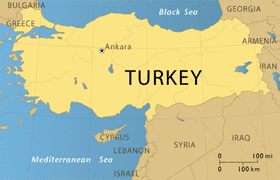
Turkey

Turkey (MNN) ― The past couple of months have been filled with reports of pastors being thrown in jail, churches being shut down, and Christians being persecuted for their beliefs. Kazakhstan, for example, just passed a new law that will affect over 500 different churches. "If they don't reach the number of membership of more then 50, they have to be liquidated within this year," says Sergey Rakhuba of Russian Ministries.

With religious freedom in mind, a conference is being held in Turkey, where over 50 organizations are coming together. Their goal? They are "concentrating on the evangelical church and helping evangelicals fight for their freedom--especially in those countries where Christianity is under pressure," according to Rakhuba.
This year, the conference is focusing on the area of Eurasia, which is made up of countries from the former Soviet Union. Says Rakhuba, "There are lots of issues today with sharp rise of religious freedom issues and persecution specifically in the countries of Central Asia."

Russian Ministries is "spearheading the initiatives" in terms of religious freedom. They are creating an awareness of the problem, educating pastors, and showing them how to lead their congregation in this situation.

"We are equipping the Evangelical church in those countries to fight for their freedom, to value their freedom, to educate their congregations about freedom, how to be careful with freedom. We believe that freedom is a gift of God we have to be careful with it, but at the same time everyone has a right to it," explains Rakhuba.

"Going to this consultation we will be presenting all these cases that represent Eurasia, Eurasian territories, and specifically evangelical churches that experience pressure, experience persecution," explains Rakhuba. "We will developing some policies and will be developing some letters that we will be sending to some of those oppressive governments, just making a statement on behalf of the entire evangelical global community in support of those who are persecuted."

Prayer is vital to the work that Russian Ministries and the 50 other organizations are going to be doing in Turkey. "I would greatly appreciate the evangelical family...to pray that God would give us guidance, God would give us wisdom."

Rakhuba also asks that you "continue praying for the evangelical church, that God would equip the church to not just survive but to be productive, be progressive in those situations, and continue reaching their communities with the Gospel. "

Thursday, January 31, 2013

More people punished for their faith


Kazakhstan (MNN) ― It's been a year since Kazakhstan expanded its Religion Law, and more people are being punished for their faith.

According to Forum 18 News, several large fines have been handed out since August, and two more are pending for local Baptists. Forum 18 says believers are being punished for "illegal missionary activity," and the fines are equal to seven months' wages, or $1,150 USD.

A few of the seven people punished for "illegal missionary activity" were sharing their faith on the street, while others were leading religious meetings within their communities. Forum 18 says prosecuted individuals include four Jehovah's Witnesses, two Muslims, and a Christian.

The two believers awaiting trial are part of Almaty's Council of Churches Baptist congregation, reports Forum 18. Along with accusing Yuri Bronitsky and Fedor Karabeinikov of violating Kazakhstan's new religion law, officials visited another Baptist church in the region.

"[Police] came during worship and photographed us," congregants complained to Forum 18. "They said they had an order…that now the new law has been adopted, they will close us down."

Elsewhere in Kazakhstan, reports Forum 18, courts fined a believer for handing out Christian books to people on the streets. The man expected a hearing for his case, but instead was taken directly to the court after work.

These are the latest cases in a series of crackdowns since Kazakhstan passed two new religion laws in October 2011. It was thought to be one of the freer countries in Central Asia, but with more and more cases surfacing, Kazakhstan is starting to look very similar to the other restrictive "Stan" countries.

Thursday, January 10, 2013

More religious activities proposed for legal chopping block


Kyrgyzstan (MNN) ― Throughout 2012, government officials tookone step after another, trying to keep extremist ideology from spreading throughout Kyrgyzstan.

Now, it appears they're moving beyond censorship to punishment. According to Forum 18 News, officials are trying to get more activities to be considered as "violations" of the nation's Religion Law.

Forum 18 says the proposed administrative code is much longer than the current one, Article 395. This article punishes youth ministry and the refusal by church leadership to register with the government.

Article 395 would expand dramatically if the new amendments are passed.

Sharing the Gospel openly or trying to lead kids to Christ would result in fines. Activities like praying outside the walls of a registered church building, teaching Christianity without personal registration, and conducting unregistered religious activity would be regarded as "violations" of the Religion Law.

Missionaries to Kyrgyzstan and missionary groups would also be subject to legal heat.

"Any religious activity without state registration by foreign organizations and individuals," reports Forum 18, "would be punished by fines…deportation…and a ban on the activity of the organizations, including local branches."
Multiple religious groups expressed concern about the new amendments, a source told Forum 18.

"All of the religious leaders present without exception were very worried about the amendments," said Galina Kolodzinskaia of the Inter-Religious Council in the Kyrgyz Republic. "If adopted, the punishments will definitely be used.
"We regard them as a way for the authorities to collect money from religious communities."

Representatives of Muslim, Protestant Christian, Jewish, and Buddhist communities participate in the Council. 

Kolodzinskaia spoke to Forum 18 after the council's meeting earlier this week and said members plan to make their opposition known to government officials.

Forum 18 says the new amendments would need approval from the Committee of Ministers Department before it can be considered by parliament. However, the drafts were returned "for further work" on December 31, 2012.
Pray that additional punishments would not be added.

Kyrgyzstan's Religion Law, which passed in 2009, requires all religious organizations to be registered with the state. Since the inception of the Religion Law, officials have repeatedly tried to make the code harsher.

New censorship amendments were added last month and increased state control over all religious literature. Additional draft amendments appeared before parliament in October 2012 and, if adopted, would impose the following restrictions: 

  •   • Government permission would be required for students to attend foreign religious colleges.
  •   • Each religious group would need 200 Kyrgyzstani founders in one location.
  •   • Foreigners would need a state license to proclaim their faith.

Pray that Kyrgyzstani believers would share their faith boldly, despite governmental restrictions.

Thursday, December 20, 2012

Crackdown on religious freedom continues

(Image courtesy of Wikipedia)

Central Asia (MNN) ― Like the steady drip of a leaky faucet, authorities are slowly but surely draining religious freedom from Central Asia.

According to Forum 18, Kyrgyzstan leaders flew under the public radar in recent days, adding new censorship amendments to the country's Religion Law.

While authorities were unable to tell Forum 18 what censorship categories like "extremism," "separatism" and "fundamentalism" meant under the new amendments, a political analyst said it could spell trouble for Protestant Christians.

"No one will check Muslim Board or Russian orthodox literature, but faiths deemed 'non-traditional' could face problems," the analyst said.

Joel Griffith with Slavic Gospel Association says, "It's apparently going to increase state control over religious literature and other materials. It really remains to be seen, though, exactly how this is going to be implemented and carried out.

"This is all part and parcel of something larger that's actually been going on in the so-called 'Stan' countries for some time."

Central Asia consists of five countries that once belonged to the Soviet Union: Kazakhstan, Kyrgyzstan, Tajikistan, Turkmenistan and Uzbekistan. While Kyrgyzstan is tightening the collar on its Religion Law, church registration is a challenge in Kazakhstan and having more than a Bible in Uzbekistan could send you directly to jail.

"The interesting thing is: in the former Soviet days, you had atheistic Communism that was against religion in general," Griffith states. "Nowadays what we're seeing, even though the governments of these nations are…considered secular: [Islam is becoming] predominant. Because of that, other religious groups tend to receive some pressure.

"But…and this is an interesting thing to watch," Griffith continues. "The governments are also concerned about Islamic extremism and terrorist activity."

He cites last year's attacks as an example.

"That had not happened in Kazakhstan before," Griffith explains. "Even though Islam is the predominant religion inside these Central Asian countries, you're going to have the secular government scrutinizing very closely what's going on."
Could the region possibly be returning to its atheistic Soviet roots?

"It really is a mixed bag of what governments are doing and the reasons they're giving for doing i. But in the sense of religious freedom in general, the trend is not promising, and we need to make that a matter of prayer," Griffith says.
Pray for wisdom and discernment for God's people in Central Asia.

"We need to pray that as [believers] share the Gospel, the Lord would grant them open doors to be able to do that," says Griffith. "We also need to remember that God is not stopped by human governments from accomplishing His purpose."

Tuesday, September 11, 2012

Officials to return Uzbek pastor, a religious refugee since 2007


Kazakhstan (MNN) ― According to the Forum 18 News Service, officials are sending Pastor Makset Djabbarbergenov and his family back to neighboring Uzbekistan, the nation they fled to escape religious persecution. Forum 18 says Uzbek authorities put the Protestant pastor on a wanted list for illegal teaching of religion and literature distribution, religious "crimes" he had committed in 2007.

The charges against Djabbarbergenov each carries a maximum of three years' imprisonment. Pray for the pastor and his family as they endure this persecution. The Djabbarbergenovs are expecting their fifth child in April. Pray that their faith remains steadfast.

An assistant working in the District Prosecutor's Office told Forum 18 that "Uzbek authorities are seeking to imprison Djabbarbergenov because he led an unregistered Protestant church in his home town.

"As a person, I can say this is not right," he added. "But we have to follow the rules. We just collect the documentation."

Kazakhstan has a reputation for returning religious refugees in order to maintain political favor with China and Uzbekistan. Forum 18 points out that in June, the United Nations Committee against Torture (CAT) criticized Kazakhstan for extraditing 29 Uzbek Muslim refugees in 2011. Though the men sought asylum and religious refuge, Kazak officials accused them of being terrorists and sent them back to Uzbekistan, where intense persecution is routine.

Uzbekistan has steadily moved higher on Open Doors USA's World Watch List, a compilation of the world's most heavily-persecuted nations. The Central Asia nation ranked #10 on the list two years ago but has since moved to #7 following increased governmental suspicion, police attacks, and raids. Common cruelty used by Uzbek authorities includes electric shock, beatings, rape, asphyxiation, and psychological abuse.

A report issued earlier this month from the human rights group International Federation for Human Rights (FIDH) says religious persecution is to be expected from Shanghai Cooperation Organization (SCO) member nations. Created in 2001, the SCO includes Russia, China, Kazakhstan, Kyrgyzstan, Tajikstan and Uzbekistan. The FIDH says the Shanghai convention is used as a "vehicle for human rights violations," because members are expected to accept any accusations made by another SCO member, no questions asked.

Richard Wild, a law professor who worked on the FIDH report, told Radio Free Europe/Radio Liberty that member states essentially use the SCO as front to hide human rights violations.

"The threat in terms of human rights comes from the SCO because, on the one hand, it is playing the international game of speaking a human rights language -- using 'human rights' within their charter," said Wild. "At the same time, it actually results in a coordinated regional form of extradition on the basis of suspicion rather than evidence.
"And it lacks any kind of transparency or international oversight."