Showing posts with label uzbekistan. Show all posts

Sunday, February 10, 2013

Religious freedom policies forthcoming following briefing

President of Russian Ministries
Sergey Rakhuba addresses briefing in Washington, D.C..

USA (MNN) ― Christians from all over the former Soviet Union were in Washington, D.C. Wednesday for a briefing on Religious Freedom issues in that part of the world. It was hosted by Russian Ministries and their partnering organizations.

President of Russian Ministries Sergey Rakhuba says 90 people attended: more than anticipated. "It shows that a lot more people--many different leaders, even people from the State Departmen--are very much interested in discussing the issue of religious freedom in the former Soviet Union."

Some of the leading evangelical Christians in the region made presentations. "We brought some experts from Russia and Belarus, and we read some reports from Uzbekistan about all the freedoms that have been stripped from people there," says Rakhuba.

It's like going back to the days of the cold war, he says. "Evangelical churches are not allowed to do anything outside of their homes, even inside their homes. If they gather together for prayer meetings they are punished and are penalized. Many pastors have already been thrown into prison there."

While it's reminiscent of the days of communism, Rakhuba says, "This is a new wave of persecution that's based on radical Islamism, on nationalism, and even mainline churches like the Orthodox church...is the reason for persecution of local believers in Russia and Ukraine or other Slavic countries."

The information presented will help create a policy guide for Christians in the region to help fight laws that are meant to fight terrorism. "Based on those laws, evangelical Christians--for their most humble actions--are punished just for having prayer in their own home. So, we'd like to create some policies and to encourage governments to change it."

Rakhuba is hoping politicians will use the policies to help press for those changes so the Gospel can be shared freely.

Monday, December 10, 2012

Uzbek pastor released from Kazakhstan, in hiding

Uzbekistan (MNN) ―According to Open Doors USA, Uzbek pastor Makset Djabbarbergenov has been released from prison in Almaty, Kazakhstan.

He was reunited with his wife and four children when he was released on Tuesday and immediately taken to the airport. According to Forum 18, they were flown to Germany. After their arrival in Frankfurt, the family was taken to a safe location in an unnamed European country.

Makset's friends told Forum 18, "We need to thank the Kazakh government; they did the right thing."

The pastor was told by border guards that he was banned from re-entering Kazakhstan until 2017.

Pastor Makset's release and asylum in Europe was facilitated by the United Nations High Commissioner for Refugees (UNHCR). Commissioner representatives met him on release from prison and took him directly to the airport. They were ensuring that there were no last minute problems.

Almost 3,800 supporters sent e-mails on behalf of Makset through an advocacy campaign by Open Doors.

Open Doors Advocacy Director Lindsay Vessey said, "We are incredibly grateful for Makset's release and thank all our supporters who advocated on his behalf by sending e-mails to the Kazakh ambassador to the United States."

"It is good to hear that the UNHCR played a critical role in securing his release as well as in ensuring Makset's safe departure from Kazakhstan with his family," she said.

Pastor Makset was arrested in Almaty on September 5 on the request of his native Uzbekistan. They wanted him to be returned to face charges that he practices religion outside state regulation.

He became a Christian in 2000 and soon became an active church leader in Nukus, the capital of Karakalpakstan. There is no Protestant church in Karakalpakstan that has an official registration, as they are considered illegal.

Pastor Makset was arrested six times. Following a police raid on his apartment in 2007, he and his family fled to Tashkent, the Uzbek capitol. He then crossed into Kazakhstan the following month. His family followed a few months later, according to Open Doors News.

He applied for asylum in Kazakhstan. Despite the fact that the commissioner for refugees said he would face prosecution in Uzbekistan because of his Christian faith, the Kazakh government ruled against Makset at several turns.

Finally he was arrested in September and held in prison, pending deportation.

His wife, Aigul, spoke to Open Doors during that time. "Pray that we can follow God, and He'll lead us to be where He wants us to be. We want Him to solve and resolve the situation and tell us what to do."

Thursday, September 20, 2012

Pastor awaits extradition in Kazakhstan

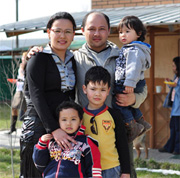
Makset Djabbarbergenov with his wife, Aigul, and three sons in 2010.
The family now has four boys and is expecting a fifth child.

Kazakhstan (MNN/ODN) ―Last week we told you about a former Uzbek house church pastor facing deportation from Kazakhstan. We now have received an update from Open Doors News.

32-year-old Makset Djabbarbergenow is in a Kazakhstan jail, awaiting a ruling on whether or not he will be returned to his native country, even as Kazakhstan's Supreme Court considers whether to declare him a refugee from almost-certain persecution.

Kazakhstan is in Central Asia and Eastern Europe.

According to a story by Open Doors News, Djabbarbergenov was arrested Sept. 5 in Almaty, Kazakhstan's financial center and largest city. Uzbekistan wants to issue back-to-face charges that he practiced religion outside state regulation.

Open Doors News said it's not the first time Djabbarbergenov, 32, and the father of four--soon to be five--has been detained by authorities who have frowned on his leadership of unregistered Christian communities. But he told a friend he has been shaken by this arrest.

Speaking from his jail cell, Djabbarbergenov told the friend that he was too disturbed to eat during the first few days of his incarceration, according to Open Doors News. To shield his identity, Open Doors News is not reporting the name of Djabbarbergenov's friend. Djabbarbergenov initially told his friend that he told God he did not want this cross. Now, he said, "I pray that if this is from You, Lord, I will accept whatever You say. Just help me carry it."

He has carried a cross for more than a decade. Open Doors reported that born in Uzbekistan in the small town of Symbai, Djabbarbergenov became a Christian in 2000 and soon became an active church leader in Nukus, the capital of Karakalpakstan, the autonomous republic of Uzbekistan.

Currently, no Protestant church in Karakalpakstan has an official registration. They are considered illegal.

Open Doors News said Djabbarbergenov was hauled into court six times. Police raided the family's apartment in Aug. 2007, prompting Djabbarbergenov and his wife, Aigul, then pregnant with their third child, to flee to Tashkent, the Uzbek capital. He crossed into Kazakhstan the following month, his family following a few months later.

Their time since then has been spent seeking asylum in Kazakhstan. Open Doors News said while the Office of the United Nations High Commissioner for Refugees determined the family to be refugees who would face prosecution in Uzbekistan because of their Christian faith, the Kazakh government disagreed and has ruled against Djabbarbergenov at several turns. His case now rests before the country's highest court, which has yet to set a hearing date.

Even as Djabbarbergenov's refugee status hangs in the balance, Open Doors News said prosecutors have moved ahead in response to Uzbekistan's request to return him to face charges.

In a detailed account of the lengths to which Kazakh investigators have gone, Open Doors News said the Norwegian religious freedom watchdog agency Forum 18 reported they held his sister-in-law for two weeks in an attempt to flush him out.

From her cell phone, they obtained the phone number of Djabbarbergenov's wife and tracked down the location of the family's home, where they arrested Djabbarbergenov on Sept. 5--his youngest son's 2nd birthday--Forum 18 reported.

Open Doors News said the two charges awaiting Djabbarbergenov in Uzbekistan each carry a maximum penalty of three years in prison. Uzbekistan is ranked No. 7 on the World Watch List of the 50 countries where it is most difficult to be a Christian.

"Christians are fined or given short-term prison sentences. When brought to court, fair treatment is not ensured," according to the World Watch List.

Open Doors News said the U.S. State Department and the U.S. Commission on International Religious Freedom have designated Uzbekistan as a "country of particular concern."

The Uzbek government violates the full range of human rights and harshly penalizes individuals for independent religious activity regardless of their religious affiliation," including Muslims, the Commission declared in its 2012 annual report.

Tuesday, September 11, 2012

Officials to return Uzbek pastor, a religious refugee since 2007


Kazakhstan (MNN) ― According to the Forum 18 News Service, officials are sending Pastor Makset Djabbarbergenov and his family back to neighboring Uzbekistan, the nation they fled to escape religious persecution. Forum 18 says Uzbek authorities put the Protestant pastor on a wanted list for illegal teaching of religion and literature distribution, religious "crimes" he had committed in 2007.

The charges against Djabbarbergenov each carries a maximum of three years' imprisonment. Pray for the pastor and his family as they endure this persecution. The Djabbarbergenovs are expecting their fifth child in April. Pray that their faith remains steadfast.

An assistant working in the District Prosecutor's Office told Forum 18 that "Uzbek authorities are seeking to imprison Djabbarbergenov because he led an unregistered Protestant church in his home town.

"As a person, I can say this is not right," he added. "But we have to follow the rules. We just collect the documentation."

Kazakhstan has a reputation for returning religious refugees in order to maintain political favor with China and Uzbekistan. Forum 18 points out that in June, the United Nations Committee against Torture (CAT) criticized Kazakhstan for extraditing 29 Uzbek Muslim refugees in 2011. Though the men sought asylum and religious refuge, Kazak officials accused them of being terrorists and sent them back to Uzbekistan, where intense persecution is routine.

Uzbekistan has steadily moved higher on Open Doors USA's World Watch List, a compilation of the world's most heavily-persecuted nations. The Central Asia nation ranked #10 on the list two years ago but has since moved to #7 following increased governmental suspicion, police attacks, and raids. Common cruelty used by Uzbek authorities includes electric shock, beatings, rape, asphyxiation, and psychological abuse.

A report issued earlier this month from the human rights group International Federation for Human Rights (FIDH) says religious persecution is to be expected from Shanghai Cooperation Organization (SCO) member nations. Created in 2001, the SCO includes Russia, China, Kazakhstan, Kyrgyzstan, Tajikstan and Uzbekistan. The FIDH says the Shanghai convention is used as a "vehicle for human rights violations," because members are expected to accept any accusations made by another SCO member, no questions asked.

Richard Wild, a law professor who worked on the FIDH report, told Radio Free Europe/Radio Liberty that member states essentially use the SCO as front to hide human rights violations.

"The threat in terms of human rights comes from the SCO because, on the one hand, it is playing the international game of speaking a human rights language -- using 'human rights' within their charter," said Wild. "At the same time, it actually results in a coordinated regional form of extradition on the basis of suspicion rather than evidence.
"And it lacks any kind of transparency or international oversight."


Monday, August 13, 2012

Uzbekistan tightens grip on Christians

Uzbek man (File footage courtesy of Open Doors USA)

Uzbekistan (MNN) ―Uzbekistan appears to be taking the repression of Christians one step further.

Joel Griffith with Slavic Gospel Association explains, "It seems the authorities are going into private homes and actually confiscating religious books from these homes during the raids they make; and they're also threatening fines."

The case stems from a series of recent raids, as reported by Forum 18 News. Based on the details of the case, Forum 18 began questioning the apparent violations of due legal process, denials of legal representation, misrepresentation defendant pleas, untimely verdicts, and so-called "expert analyses" that confused Protestant books with Jehovah's Witness books.

Griffith notes, "Police confiscated one Bible in the Uzbek language, and then there was a Bible in the Russian language that was confiscated. Then, from one Protestant home, reportedly, a book by John Bunyan was confiscated." It was during that raid, Griffith says, when "police allegedly said that it's prohibited to have such books at home, that they were going to be sent to the Religious Affairs Committee of the government, and that the owner of the books would be fined."

Griffith goes on to say that the alarm bells began ringing because "this latest report on the private homes being raided and books being confiscated is certainly a step up from what they'd been doing previously."

The alleged violations of due process would seem to be unconstitutional, which is the same word used to defend authorities' actions, according to Forum 18. The judge in one of the cases claimed that the defendant was "engaged in anti-constitutional activity and is a member of Jehovah's Witnesses, which was confirmed by the literature confiscated from him."

Wrong on that last count, it turns out. But Griffith says this is more insidious. "Previously, they had been raiding summer camps and trying to shut down churches here and there and stopping public witnessing. But going into private homes is certainly a new twist."

The Baptist in that case filed an immediate appeal, which has yet to be heard. "There was a fine imposed for possessing religious literature. There was a Baptist fined. He was given the equivalent of 40 times the minimum monthly salary. That's about $1300."

Griffith says fear is initially what led to these vaguely-worded criminal codes. "The secular governments of these countries had been concerned about radical Islam. The thought was that if they're going to crack down on radical Islam for the appearance of fairness then, they needed to crack down on everybody."

However, as the countries in the former Soviet Bloc became more Muslim, "No matter what a constitution will say in a lot of these countries, the authorities pretty much end up doing what they want,"says Griffith.

Meanwhile, police have continued their raids and confiscations. "We know that the churches there are going to continue to proclaim the Gospel, no matter what the personal risk they have to themselves," says Griffith. The Body of Christ in places like Uzbekistan need advocates. "Obviously, the western governments will continue to protest and intervene in cases like these. 

But we as believers here in the West, above all, need to pray for our brothers and sisters there and come alongside and support them however we can."

Uzbekistan is #7 on the Open Doors World Watch List of countries known for the persecution of Christians. Pray for pastors trying to lead their churches with limited resources. Pray for courage for Muslim-background believers who experience great pressure from family and society.


Wednesday, March 21, 2012

Uzbekistan tightens grip on unregistered churches with series of raids

Uzbekistan (MNN) ―Uzbekistan has earned its spot as 7th on the Open Doors World Watch List for the persecuted church and is proving its keep.

Basic religious rights have been defied multiple times in Uzbekistan over the last couple of months. According to Forum 18, last month police raided an unregistered church and confiscated literature, pianos, and church property. A week later, the church pastor was fined $3,421 -- a cost of 100 times the minimum monthly wage.

Just a few days before the raid on the church, a woman's home was raided. She was fined 20 times the minimum monthly wage, and her Christian books were handed over to Samarakand Regional Muslim Board.

Just a couple of weeks later, a Baptist congregation in the southern town of Mubarek was raided and will be fined.

These types of raids are not new to Uzbek Christians, and especially not to members of unregistered churches. Alleged "expert analyses" are routinely used by authorities to confiscate religious material, Forum 18 reports.

The number of serious raids and fines that took place in recent weeks has some concerned. "It really does seem like Uzbekistan is beginning to step up its campaign against unregistered churches and groups of any kind," says Joel Griffith with Slavic Gospel Association. "Of course we're watching to see what kind of trickle-down this has on even the registered churches."

Griffith agrees that raids like this could be indicators of worse persecution to come. Already, pastors have been arrested all across Central Asia.

The number of basic rights that have been denied is disconcerting. Uzbekistan and surrounding, oppressive nations continue to bring concern to human rights watch groups.

Despite the influx of persecution and more likely to come, the church is standing strong. SGA has to be discrete about what they've seen, as far as church growth is concerned. But Griffith does say this: "You could look on a global perspective: typically, the more they try to stamp the church out, the more it grows."

Pray for boldness for church members, especially those who are younger. Griffith says many older members of the church remember well what it was like to live under the oppressive Soviet regime, but younger Uzbeks don't. Pray for church growth despite persecution. 

Friday, January 6, 2012

Kazakhstan and other former Soviet nations earn a spot on the World Watch List

Photo by Irene

Kazakhstan (MNN) ―Kazakhstan has experienced a lot of religious firsts over the last year, including the introduction of two new restrictive religion laws. The start of 2012 has thrust them into another one: a spot on theOpen Doors World Watch List.

The World Watch List is a detailed analysis of Christian persecution worldwide, ranking the top 50 nations with the worst persecution worldwide. The 2012 list came out this week, revealing Kazakhstan at slot 45.

It's Kazakhstan's first time on the list. Still, Joel Griffith with Slavic Gospel Association says he wasn't surprised to see Kazakhstan ranked.

"When you consider the ‘Stan' countries that are largely Muslim in makeup, Kazakhstan--since the Soviet Union broke apart in 1991--had really been a country where there was quite a bit of religious freedom," says Griffith. "Here in the past couple of years, we've seen that steadily start to decrease, sadly, with Kazakhstan joining the other central Asian Islamic Republics and cracking down on their religious groups."

Kazakhstan does seem to be following suit with surrounding countries. Other former Soviet nations have been on the list for years. Tajikistan came in at 34 this year, Azerbaijan at 25 and Turkmenistan at 18, to name a few. Uzbekistan moved up from 9th last year to a ranking of 7th for 2012--a placement two spots worse than Iraq.

"It's hard to imagine that the Soviet Union and atheistic communism came to an end 20 years ago," says Griffith. "It's almost like we're waking up and entering that world all over again. Even though it doesn't go under the name ‘Soviet Union,' we're seeing some of the same restrictive practices rear their heads again."

Much of the reasoning behind crackdowns in these nations is the avoidance of radical Islam. Unfortunately, Christians suffer so much as a result that ministry may need to resort to old ways, says Griffith.

"I think basically we have to do what we did during the Soviet days--as long as we're able to assist [churches] with resources, to do that as directly as we can. And then we have to start planning for times when maybe access is going to be very restricted and we need to be a little bit more creative about how we do it."

Ministry will not need to revert completely back to Soviet days; Griffith points out that the addition of internet and smart phone capabilities to ministry now certainly allow for more opportunities. Still, the safety of the church is a priority.

Prayer is needed for these former Soviet nations. The Gospel is still spreading despite restrictions, but pray for safety and boldness as these Christians enter a new year of hardship. Pray, more immediately, that SGA children's Christmas programs would not be disrupted tomorrow, Russian Christmas.