Thursday, August 15, 2013

Anxieties rise in Egypt as anti-Christian violence mounts

Coptic Pope cancels public appearances
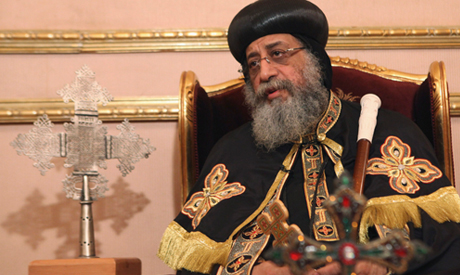

Coptic Pope Tawadros II, head of Coptic Orthodox church
 (Photo: Reuters)
Mass no longer is being celebrated at The Church of St. Mary. Police officers guard the entrance.

Throughout the Egyptian town of Eastern Bani Ahmed south of Cairo, the Christian-owned shops are closed.  At least seven Christian homes, and even more of their vehicles, have been ransacked, burned, or both. At least 18 people are injured, and police have issued dozens of arrest warrants.

A disagreement over a song on the radio was all it took to set off the violence Aug. 3.

Since July 3, when the Egyptian military removed the Muslim Brotherhood from power, anti-Christian backlash has flared in pockets across Egypt. Though there have been many examples of Christians and Muslims breaking bread together and joining ranks to support moving the government off the Brotherhood's Islamist path, the crescendo of violence has heightened Christian anxiety.

It has proven worrisome enough that Coptic Pope Tawadros II last week backed out of public appearances he had planned for this week at St. Mark's Cathedral in Cairo. He determined his presence could endanger the congregation, according to Bishop Angaelos, leader of the Coptic church in the United Kingdom, who revealed the pope's change of plans to the BBC.

Also last week, 16 Egyptian human-rights groups issued a joint statement of "grave concern regarding the increasing sectarian violence which has targeted Christians and their churches since the June 30 uprising."

Two days after the July 3 government takeover by the Egyptian military, four Christian men were killed during daylong assaults on Christians in al-Dabayia, a town west of Luxor in southern Egypt. On July 6, gunmen shot and killed a Coptic priest, Mina Abboud Sharubim, in northern Sinai.

Five days later in Sheikh Zuweid, a remote settlement a few kilometres west of the Israeli border, the decapitated body of Magdy Lamei Habib, a Christian electronics merchant, was discovered.

The fuse that touched off the violence in Bani Ahmed on Aug. 3 was lit inside a cafe owned by Sherif Abdel Moneim Radi, a Muslim. It was early evening, before the iftar, the traditional evening meal during the month-long observation of Ramadan, at which Muslims break their day-long fast. According to a statement issued by the Diocese of Minya and Abu Qurqas, events unfolded this way:

Over the radio in the cafe could be heard the song "Teslem Elayady," a catchy pop tune that praises the Egyptian military. Radi moved to turn the music off. A customer, a Christian man named Hanna Dos Fahmi, asked Radi to keep the radio tuned to the song. The argument began. Cooler heads stepped in and broke up the argument.

After the iftar, however, a group of Muslim men appeared at the cafe. A group of Christians showed up in opposition. The confrontation escalated quickly as Muslims from neighbouring villages arrived in Bani Ahmed, chanting slogans against Copts, police and the military. Some carried guns and Molotov cocktails. The crowd grew to about 4,000 people.

A pharmacy, furniture store, auto-repair shop and other Christian-owned businesses were looted, according to the diocese statement. Several homes were set on fire. Clashes broke out in surrounding villages. Security forces did not arrive in force until 11:30 p.m., and used tear gas to disperse the rioters. The Associated Press reportedthat 18 people were injured, and that police issued arrest warrants for at least 35 people. The diocese said the riots caused damage estimated at nearly 3.4 million Egyptian pounds, or about US $480,000.

On Sunday morning, Aug. 4, a group of Muslims barricaded the entrance to the Coptic Church in Bani Ahmed, preventing members from attending mass.

A Christian teacher in Bani Ahmed told World Watch Monitor that a tense calm has settled over the town during the days since the Aug. 3 disturbance. Security forces are visible in the town. On Aug. 9, the teacher said, Muslims burned an abandoned Muslim home in an attempt to accuse Christians of the act, but security officers moved in before the gathering crowd could lash out. In the meantime, the teacher said, shops and the church remain closed. World Watch Monitor is withholding his name to ensure his safety.

On Aug. 6, about 100 kilometres south of Bani Ahmed, thousands of Islamists marched through the streets of Assiut, chanting "Islamic, Islamic, despite the Christians." Christians shuttered their shops and retreated to the interiors of their darkened homes.

News service Ahram Online reported Aug. 7 that Egypt's prosecutor-general had ordered 11 people held in custody for 15 days while authorities investigated the Bani Ahmed violence.

On the same day, the coalition of 16 human-rights groups denounced the "continued negligence of the institutions of the state to provide the necessary protection to Christian citizens, to decisively confront sectarian attacks, and to enforce the law by holding those responsible for the acts of sectarian violence, which have been seen in several governorates, to account."

*****************
WWM_email_sig_sized
©2013 World Watch Monitor

Pakistani Christians ensure police arrest key murder suspect

Family and friends gather round the body of Ishaq Masih.
45-year-old Ishaq Masih, a resident of a village in the Okara district, near Lahore, was shot dead on July 27, his children say, by a man named Muhammad Luqman (alias Ranjha) who, accompanied by others, had illegally occupied Masih’s land.
Fearing the police would not follow “due process” as a minority Christian was involved, local Christians rushed to the scene.
They then refused to bury the body for three days (contrary to Pakistani practice of burial the next day) until police had agreed to register the murder, arrest two of the suspects and conduct an autopsy.
On July 29, police promised that they would arrest all other suspects (including Ranjha) within a week, but only if the Christians would bury Masih, and then disperse peacefully. The protesters agreed, and Catholic Father James Bahadur buried Masih that night.
Police, however failed to arrest prime suspect Ranjha by their self-imposed deadline of August 5, the outcome Bahadur and others had feared. (Meanwhile seven suspected accomplices were released on bail).

Top pastor’s arrest adds to Christians’ concerns in Central African Republic


 President Michel Djotodia, pictured, seized power in a coup in March.
On Tuesday (August 6), the leader of the country’s evangelical churches, Rev. Nicolas Guerékoyamé, was arrested for comments about the government. He was released a few hours later.
Local media reported that Guerékoyamé, who is president of the CAR’s Evangelical Alliance, was questioned about remarks during a sermon in Bangui, the capital, on August 4.
However local sources, which remain anonymous for security reasons, said his arrest was linked to the publication of an article in which he inferred that the citizens of the CAR are being treated like slaves.

Tuesday, August 13, 2013

Boko Haram investigated for 'crimes against humanity'

Cover photo courtesy of Pinterest/
Story photo courtesy of World Mission.
Nigeria (MNN) ― When the courts of a country fail to prosecute, the International Criminal Court (ICC) steps in.

ICC’s Chief prosecutor, Fatou Bensouda, stated last Monday August 5 that Boko Haram is being investigated by ICC for “crimes against humanity” through “widespread and systematic attacks.”

Greg Kelly with World Mission says, “They’ve been targeting Christians especially. In the neighborhood of about 3,000 people have lost their lives as the direct result of their attacks since 2009. So they’re very aggressive, they definitely target Christians, and they primarily operate in Northern Nigeria.... They want to incorporate Sharia law among all of Northern Nigeria.”

World Mission has worked in Northern Nigeria for 12 years and have been personally impacted by Boko Haram’s attacks.

“We’ve lost leaders in that area,” says Kelly. “In fact, just a few months ago, one of our leaders...in Northeast Nigeria [was] participating in a prayer meeting, and Boko Haram people sort of invaded that area and executed 10 people, including our state national leader.”

It’s not safe to be a Christian in Northern Nigeria. When someone makes a decision to follow Christ, sometimes World Mission has to take protective action.

Kelly says, “In villages where hostilities are exaggerated,... it’s just not safe for someone who’s made a decision to follow Christ. Once they’re found, then they tend to disappear, and we never hear from them again. So that’s why we try and bring people out into a safe harbor, disciple them, mentor them, grow them in their understanding of who Jesus is, and then reintroduce them into either that village or another area where they can be effective.”

Because Boko Haram is so radical, they are difficult to engage, says Kelly. But God has called World Mission to reach northern Nigerians, including Boko Haram. “We’ve been distributing The Treasure--which is our solar-powered audio Bible--in the Hausa language, which is the language of the Boko Haram,” Kelly says. “So we do distributions and set up listening groups, and we’ve seen 20 people give their lives to Christ just in recent weeks.”

A high percentage of the population in Northern Nigeria learns orally. 9 times out of 10, they prefer The Treasure audio Bible to a written Bible. World Mission has a goal to distribute 500 Treasures to Northern Nigeria this year. On average, one Treasure touches the lives of 12 people. Over 50,000 people would be impacted by these 500 Treasures.

According to Kelly, “It takes $50 for us to distribute a Treasure. That unleashes our entire arsenal so to speak. We’re distributing a unit, paying the royalties, providing follow-up, providing leadership training.”

There’s also an opportunity to engage a community’s physical needs when World Mission passes out Treasure audio Bibles. “In many instances, especially in Northern Nigeria and places where there’s radicalization of Islam, we’ll do a water well or we’ll do a humanitarian expression which just softens the soil and makes the Treasure that much more impactful. So in Northern Nigeria, Boko Haram has created 240,000 refugees just in two states; there’s a real humanitarian crisis that’s really not spoken about,” says Kelly.

Pray for World Mission as they distribute Treasures to communities in Northern Nigeria. Pray for safety and for many Muslims to come to Christ.

Reverend missing; activists suspect kidnapping

Reverend Paolo Dall'Oglio.
(Photo courtesy of VOMC/Flickr /veDro - l'Italia al futuro)
Syria (MNN/VOMC) ― Rev. Paolo Dall’Oglio is still missing two weeks after his disconcerting disappearance in Syria.

Dall’Oglio, an Italian Jesuit priest, was last heard from on Monday, July 29th. Activists in the region speculate he may have been kidnapped by Syrian rebel forces linked to al-Qaeda.

Rev. Paolo Dall'Oglio spent three decades in Syria before the government deported him last year for helping victims of President Bashar al-Assad's military crackdown, according to Voice of the Martyrs Canada (VOMC) source, Assist News Service. He re-entered the country in late July.

A source close to Dall’Oglio got an e-mail from him on July 26. The reverend wrote in the e-mail that he would be travelling to assist “difficult mediation,” according to the Religion News Service. The Christian Post says the source suggested, “It is possible the priest purposely went off the grid in Raqqa to help mediate the release of two hostages being held by Islamic rebels.”

The reverend's disappearance comes three months after the kidnapping of the Greek Orthodox and Syriac Orthodox archbishops of Aleppo in April. According to VOMC, these reflect the dangers Christians are still facing in this war-torn country.

Paul Yazigi of the Greek Orthodox Church and Yohanna Ibrahim of the Syriac Orthodox Church were kidnapped near the village of Kafr Dael on April 22nd while returning from the Turkish border on a humanitarian relief trip. The abduction happened on the road to Aleppo from the rebel-held Bab al Hawa Province, where gunmen intercepted their vehicle and killed the driver.

The fate of both clergymen is still unknown.

According to the United Nations, Syrian Christians have been vulnerable since the beginning of the civil war in 2011 which has left more than 100,000 people dead. Reportedly hundreds of believers have been kidnapped since hostilities began in 2011, and thousands more have fled the country. Many have crossed over into Lebanon or Turkey where they await legal or illegal means to reach Europe and obtain political asylum.
VOMC asks for prayer that the Lord would be a shield to the multitudes of innocent people who are caught in the cross fire between the forces of good and evil. Ask for His divine protection and strength to be upon all of His faithful servants who are boldly taking a stand for righteousness.

Egyptian Crhristians harassed by Islamists

Egypt 2012 (Photos by Ruth Kramer)
Egypt (MNN) ― As tensions boil in Egypt, the country's Christians are dreading its repercussions.

Since President Mohammed Morsi and his Muslim Brotherhood were removed from power by the military in early July, Islamist extremists have targeted Egypt's Christian minority, holding them partly responsible. E3 Partners Middle East expert Tom Doyle explains, "Whenever there is some political change, whenever there is something new--the Arab Spring, whatever arises--inevitably targets result...and typically, it's Christians."

Over the weekend, a clash in one southern city between Christians and Muslims saw 15 people wounded, and homes and a church burned. It started innocently enough: Muslim neighbors had a dispute over a speed bump being built in front of a Christian home. Tempers flared and fighting broke out, resulting in the ruins seen in the light of day.

When asked why Christians were blamed for the Morsi's ouster, Doyle said, "They went from having oppression under the government, to now [being] out of power and then being the agitators. They really can't do anything to the military, at this point, because the military is so strong. So they're going after Christians. They're unleashing their anger on Christians."

Applications to leave the country are increasing among both Christians and Muslims. By some estimates, tens of thousands of Christians have fled post-revolution Egypt.

According to corresponding reports from the Voice of the Martyrs USA, radicals have vandalized Christian-owned shops to identify them. Many Christian shop owners have closed their businesses. Christian women and girls are staying at home to prevent being attacked or kidnapped by radical Muslims. Asking for protection provides little comfort. Doyle cited a case where church officials got wind of a threat against them, asked police for help, and only after the church burned to the ground did help arrive. As cases like these pile up, he says, "God is their protector there because they cannot depend on the government."

Doyle goes on to say that the paradox of persecution comes to life in times like this. "There's unrest on both sides, Christian and Muslim. It's a dangerous situation, and people are reevaluating how they think and what they believe."

As people begin questioning the violence, their dogma, and more, ground is being prepared for the seed of hope. "We really need to pray for believers there. There are Christians that are in above-ground churches, like the Coptics. There are underground believers that come from a Muslim background, that are worshiping privately in homes so they're not in danger."

Christians in Egypt are asking you to pray with them for protection, but there's more to it than that. "Pray that the Christians can be known for love and not retaliation," notes Doyle. When believers respond in the name of Christ, and with boldness, it gets noticed. "Privately, Muslims are coming to faith in Jesus, wanting a different way, looking for a different relationship with God that they can only find through Jesus."