Monday, August 27, 2012

Fate of Turkish believers might lie in this decision

(Image courtesy of Wikipedia)

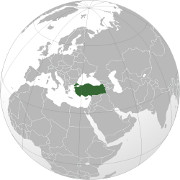
Turkey (MNN) ― Currently the cause of unrest between parties writing Turkey's new constitution, the issue of religious freedom could act as a catalyst.

"Depending on who wins this battle, they certainly will gain more power in moving the country: either toward a more secular, European/Western country," Rody Rodeheaver with IN Network explains, "or into a closed, Islamic fundamentalist country like their neighbor, Iran."

What would this decision mean for Turkish believers?

"There is great danger here, and in the midst of this are the Christians," he said.

One point of controversy in the freedom of religion proposals is education: namely, the Religious Culture and Knowledge of Ethnics (RCKE) courses required at all public schools. In this class, kids have to memorize parts of the Koran, the history of Mohammed, and various teachings from the Koran. They're also expected to participate in various Muslim celebrations and holidays.

The RCKE course puts children of believers on the front-lines of persecution. Rodeheaver explains that a common Turkish view is: "If you're a Turk, you're Muslim." This can be very difficult for kids trying to fit in at school because the RCKE course requires them to reveal their faith, making them stick out like a sore thumb.

"Our director and his children have experienced some very hurtful things," Rodeheaver said. "The children were selected for ridicule: 'You Christians, you're just all Americans in disguise.'"

Pray for Christian children who face persecution from their peers.

Another area impacted by this decision is Turkey's membership in the European Union (EU). Turks are primarily divided into two groups; some Turks want their nation to join the European Union and adopt policies with a secular lean, while others want Turkey to become a fundamental, Islamic nation. With Turkey's interest in becoming a part of the EU comes freedom for believers.

"If this changes, [believers] will lose a lot of ground and it could become very dangerous for them."

However, a recent survey by the Turkey-Europe Educational and Scientific Research Foundation (TAVAK) shows a significant drop in Turks' desire to join the EU. The study attributes this drop in support to the economic crises in EU member states and self-assurance among Turks that "they can do without the EU."

As the government continues to drag its feet toward change, there is a desperate need for prayer. Pray for the safety of believers in Turkey.


Pakistan: A Christian Minor Girl Murdered after allegedly being Gang Raped by Muslims

By Dan Wooding Founder of ASSIST Ministries
SAHIWAL, PAKISTAN (ANS) -- A Christian minor girl from Sahiwal, a city in Punjab, Pakistan, was recently murdered after being "gang raped" by a group of five Muslim men. The young girl's name, Muqadas Kainat, was revealed to the ASSIST News Service (www.assistnews.net) by the Legal Evangelical Association Development (LEAD Family Pakistan), an organization that provides free legal aid, settlement and spiritual support to Christian persecuted and destitute, The group said that they had discovered news of this terrible crime after being visited in their office by two rights campaigners who told them that the father of child, Mr. Rafique Masih, had been working as a brick maker and had lived in the area for the past 15 years. Also that he, and his wife, had seven children. They were told that on August 14, 2012, he was visiting a local hospital where his wife was having her appendix removed and during that time, the group were told that the minor girl had gone into a local field to relieve herself and was then viciously set upon by a gang of men and gang raped and murdered. “The father’s elder brother, Arshad Masih, came to hospital and told Rafique Masih that his daughter had not come home since the morning,” said a spokesperson for LEAD Family Pakistan. “Rafique Masih rushed to home and searched for her in area of the brick kiln company [where he worked] and also in the homes his neighbors, but did not find his daughter.
“Then, on August 15, 2012, the Muslim clerk of the brick kiln company told Rafique Masih that he had received a phone call on his cell phone from an unknown caller that Muqadas Kainat was in fields. On hearing this, Rafique Masih, along with other people, started searching the nearby fields and eventually found dead body of his daughter.” The spokesperson went on to say that her body was taken to the police station for a postmortem which, he said, proved that she had been “gang raped and later strangled to death by five men.” The Farid Town Police Station has since registered a First Information Report (FIR) against unknown rapists and killers and started an investigation, but at this time none of culprits have been found and arrested. Now Missionary Pastor, Mushtaq Gill, President/National Director of LEAD, is pledging for legal help and support for this case.

Sunday, August 26, 2012

Christian Pastor Youcef Nadarkhani to Face New Charges in Iran

A Source Says That ‘Banditry and Extortion’ Will Replace ‘Apostasy’ Charge

By Dan Wooding
Founder of ASSIST Ministries
ASSIST News Service (ANS)

IRAN (ANS) -- A 35-year-old Christian pastor, who has spent nearly three years behind bars in Iran and has been sentenced to death for refusing to renounce his faith, has been ordered to appear in court next month, where he is expected to face new charges.
Pastor Youcef Nadarkhani faces new charges
According to the Farsi Christian News Network (www.fcnn.com) the charges of “banditry and extortion” will replace “apostasy” for Youcef Nadarkhani.

“The new leveled charges raise concern that following widespread international criticism about the ruling issued for Mr. Nadarkhani, Iranian authorities wish to influence the case process by bringing up arbitrary charges. The new trial adds to these concerns,” said a spokesperson for FCCN.

The news service went on to quote the International Campaign for Human Rights in Iran, which said that Pastor Youcef will be put on a new trial on Monday, August 27.

Nadarkhani, who refused to repent from being a Christian in earlier judicial proceedings and faces a death sentence, is now facing these new charges of “banditry and extortion.”

The Christian pastor’s earlier charges were “apostasy” and “converting to Christianity,” but the new charges of “banditry and extortion” were first mentioned last year on the Farsi News Agency (http://english.farsnews.com).

FCCN said that a source close to the case of Youcef Nadarkhani “who wishes to remain anonymous on security grounds” told the International Campaign for Human Rights in Iran that, “Mr. Nadarkhani’s ‘banditry’ charges are fundamentally meaningless; he is not a thief or a bandit. This is a new accusation leveled against him for unknown reasons.”

Youcef Nadarkhani was born to Muslim parents and converted to Christianity at the age of 19.

Nadarkhani’s death sentence on charges of apostasy was upheld by Branch 11 of Gilan Province’s Appeals Court on August 23, 2010. On June 28, 2011, Iran’s Supreme Court overturned the ruling, but made the decision conditional on Nadarkhani’s repentance. There were three court sessions between September 25 and September 28, 2011 in which Youcef Nadarkhani was asked to repent and he refused. Nadarkhani is currently in detention inside Rasht Prison.

On September 30, 2011, the charge of “extortion” was mentioned for the first time on an Iranian website in a news article about Nadarkhani. The article claimed that Youcef Nadarkhani is accused of rape and repeated extortion. “Youcef Nadarkhani has [committed] security crimes and had set up a house of corruption. This individual is a criminal and his crime is not inviting some to the religion of Christianity, but he has security crimes. Nadarkhani’s death sentence has been issued for security crimes,” it quoted Gholamali Rezvani, Deputy Governor of Gilan for Security.

Mohammad Ali Dadkhah, Nadarkhani’s lawyer, told the International Campaign for Human Rights in Iran at the time, “If he is under trial in another court on other charges, I am not aware. But we only defended him against the death sentence in the case of his charge of apostasy. The charge the court staff announced that I defended during several different court sessions was apostasy and no other charge.”

“The new leveled charges raise concern that following widespread international criticism about the ruling issued for Mr. Nadarkhani, Iranian authorities wish to influence the case process by bringing up arbitrary charges. The new trial adds to these concerns,” said the FCCN spokesperson.

In his interview with the International Campaign for Human Rights in Iran today, the source referred to evidence in Youcef Nadarkhani’s case. “In his defense documents, there is a hand-written letter from the late Grand Ayatollah Montazeri, in which he explicitly wrote about Youcef Nadarkhani that he “must not be executed”. His lawyer, Mr. Mohammad Ali Dadkhah, presented this note as evidence in the case, as well as other legal reasoning why he should not be executed,” said the source.

“We are sure that Youcef Nadarkhani will be exonerated and released, because so far as we have seen, even the Chief Justice does not believe in his execution, and it is only the Judge who keeps insisting on it,” the source told the International Campaign for Human Rights in Iran.


Construction of a Church in Bahrain ‘Irritates’ Islamic Republic Authorities

By Dan Wooding
Founder of ASSIST Ministries

MANAMA, BAHRAIN (ANS) -- Following the news that the Bahraini government has granted a piece of land to construct the first Catholic Church in the country – the Sacred Heart Roman Catholic Church, Manama -- Iranian authorities have been “enraged” and the Iranian Shi’ite media has “vigorously criticized the action.”

Guests a service at the new church
The Iranian Christian news agency, Mohabat News (http://mohabatnews.com), whose website is banned inside Iran, says that it is now about a year since Iranian-Bahraini political relations became strained.

“Iran's intervention in Bahrain's internal affairs, as well as Iran’s support of Bahraini Shi’ite opposition, has made Bahraini authorities to stand against Iran,” said a spokesperson for Mohabat News.

“This time, however, the two countries’ political disputes have gone one step further as authorities of the Islamic Republic of Iran, especially its Shi'ite religious websites, expressed concern over the construction of a church in Bahrain and severely criticized Bahraini and Saudi-Arabian officials.”

The Sacred Heart Roman Catholic Church, Manama
In this connection, the news agency told the ASSIST News Service (www.assistnews.net) that the independent religious website of Iranian Shi’ites which is affiliated with the Islamic seminary of Qom, wrote, “The Bahraini government has granted Christians a large and well-located lot to build their church there!”

This website, which promotes Shi’ite thinking in Iran, claimed, “One crime of Al Khalifa and Al Saud in Bahrain is that they destroyed Shi’ite mosques and Hussainia [a congregation hall for Shi’ite commemoration ceremonies].

“There were 100 Shi’ite mosques and Hussainia. Now, [King] Malik Hamad Bin Isa Al Khalifa, dictator [their phrase] of Bahrain, has allowed the first Christian church to be constructed in Bahrain. In fact, the Vatican is seeking to move its Persian-Gulf region vicariate [a form of territorial jurisdiction of the Roman Catholic Church] from Kuwait to Manama, the capital of Bahrain.”

In another section of its report, the Shi’ite website wrote, “By giving a construction permit for the first church and catholic vicariate in Bahrain, the King of Bahrain introduced himself as an open-minded man.”

His Majesty the King
Hamad Bin Isa Al Khalifa
Mohabat News said that confirming this news, Bishop Camillo Ballin, the Vatican's ambassador to Kuwait, mentioned the reasons for this move saying, “first of all, Bahrain is located in a more central area compared to Kuwait and is closer to Qatar and Saudi-Arabia. 

Secondly, receiving visa to Bahrain is easier for Christians. There are some difficulties for Christians to receive Kuwaiti visas and enter that country.

“Another possible reason the Roman Catholic Church has decided to move its vicariate to Bahrain, could be that the Kuwaiti Member of Parliament Osama Al-Munawer announced his plans to submit a bill calling for the removal of all churches in Kuwait,” said the Mohabat News spokesperson. “After facing criticism, he later said that existing churches should remain, but he advocated a ban on the construction of any new non-Islamic places of worship.”

Bishop Camillo Ballin added, “More than two million Catholics from the Philippines, India, Bangladesh and Sri Lanka are residing in different Gulf region countries. Therefore, our vicariate needs to be in a place where it is equally close to these countries.”

He expressed his gratitude to the government of Bahrain because of the land it granted to the Catholic Church to construct its church.

He added, “The government of Bahrain has granted us a large and well-located lot to build our church. Currently there are one and half million Christians residing in Saudi Arabia, 350 Christians in Qatar, 350 thousand in Kuwait and 100 to 140 thousand in Bahrain.”

The news agency added that although the Vatican is concerned about freedom of worship in countries like Saudi Arabia, where Islam is the only recognized religion and Christians mostly hold their services secretly, the Vatican official believes that this is a sign of a more open atmosphere in Bahrain.

“We hope that this example in Bahrain happens in other countries as well,” said the spokesperson.

An attitude the Islamic Republic is not pleased with!

He went on to say, “The Islamic Regime of Iran has expressed its irritation and its affiliated staff journalists have criticized the action of the Bahraini government, while a large number of Arabic countries, though they are the origins of Islam, have tried to show more flexibility and softness in recent years and provide a better situation for religious minorities, instead of religious fanaticism.
Ayatollah Khomeini
“It should be remembered that after the Islamic revolution in Iran in 1979, Ayatollah Khomeini issued a Fatwa banning the building of churches of any kind in the country. Also, in some cases, churches in different cities of Iran were ordered to close by the Intelligence authorities.

“It seems that Iranian Christians must cope with the number of churches they already have. Some churches have even experienced difficulty in obtaining a maintenance permit from municipal officials to maintain or restore their old church buildings.”

Note: Bahrain, officially the Kingdom of Bahrain, is a small island country situated near the western shores of the Persian Gulf. It is an archipelago of 33 islands, the largest being Bahrain Island, at 55 kilometers (34 miles long by 18 kilometers (11 miles) wide. Wikipedia

Friday, August 24, 2012

Egyptian in 'Second Day of Rage'

(Cover photo by Sharif Hassan.
Story photo by MA3T, file footage Egypt protests 2011)

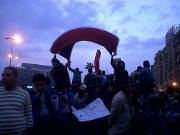
Egypt (MNN) ― A potentially ugly confrontation is brewing in one of the Arab Spring countries.

Friday August 24 has been dubbed Egypt's "Second Day of Anger." The actions of President Mohamed Morsi 12 days ago fueled the tensions.Open Doors President and CEO Carl Moeller explains, "There's a lot of disaffection among Coptic Christians about the one-party de facto situation in Egypt with the Muslim Brotherhood being the primary winner of all the elections and everything that has gone on--the power that's being consolidated in the presidency right now."

Fearing a turn toward an Islamic state, Moeller adds, "Many in Egypt, including secularists and evangelicals, also feel like the Revolution has been stolen, and so they're calling on people to take to the streets in opposition to this 'one-party man' show, they're saying, which, in effect, could be highly confrontational. "

Hostility ratcheted up a notch when the top Sunni Muslim cleric issued a fatwa. His decree labeled demonstrators as "infidel," which essentially legitimized the killing of protestors who were marching in the nationwide rallies.

Christians say all they want to do is restore the objectives and accomplishments of Egypt's historic January 25th Revolution. Being on the streets will be dangerous in two ways, Moeller says. One: if there is a violent response to the demonstration, and two: "As the Muslim Brotherhood, they've called for people to stay home. Those that come out in the streets are obviously singling themselves out as not participating in the Muslim Brotherhood, not listening to their agenda, and it could be violent against, what is essentially, the Christian community."

People are nervous, dreading the potential chaos that could erupt and drag on. "Who knows what tomorrow holds? In something like this, the Church can easily be the target of the anger of a mob because it represents sort of 'opposition' to what's happening politically," he adds, but that's where prayer comes in. "The Church is praying that this protest, this demonstration, remains peaceful. [They're praying] that, on the Christian side, they are not going to do anything to provoke or overly antagonize the government. They're praying that the government shows great restraint in allowing this protest to take place."

The scenario is vague. There could be a swift, irrevocable response. The response could be delayed, or there may not be an official response at all. Moeller says the last time the Christian community was silenced, the end result was not a squashing of faith, at all. In fact, he says marginal Muslims have been drawn to the message of Christ. "The need for Bibles, the desire for Bibles, training, Muslims coming to faith in Christ: those numbers are all way, way up. A lot of the overt Christian ministry has been reduced somewhat because there's difficulty in carrying on programs if there's no infrastructure and no security to carry them out."

Crackdowns would only slow things down, but not stop the advance of the Gospel. The question is: how extreme will the response be?

Egypt is holding her breath, on her knees. Will you join her? Our Featured Links Section has more.  


Syrian nightmare continues; believers deliver respite

(Photo courtesy Baptist Global Response)

Syria (BGR/MNN) ― Syria's government forces spent much of Thursday in a violent confrontation with rebels in parts of the capital city.

Pro- and anti-Assad gunmen, fueled by tensions in neighboring Syria, were also fighting over the border in Lebanon's city of Tripoli, nullifying a truce less than 24 hours old.

At the same time, the U.S. and Turkey held an "operational planning" meeting aimed at ending  Syrian President Bashar al-Assad's embattled regime.

In the 18-months since the first rebellion during the "Arab Spring," the United Nations estimates 2.5 million people are in need of humanitarian aid. The flow of refugees to neighboring countries continues its steady growth, although there are many thousands still trapped within Syria. Civilian deaths, according to observer reports topped 21,000 earlier this month. That number has climbed higher over the last two weeks.

Despite the growing desperation, there are some who bring hope and light with the gentle knock at the door. Baptist Global Responsesays there's a Syrian Christian couple living in a neighboring country who is delivering food and other basic necessities to internal refugees.

These Christians are going into Sunni Muslims neighborhoods near one of the Syrian cities hit hard by shelling and army-rebel combat. The nearby area, populated primarily by Syrian Christians, has been spared the worst of the violence.

"I don't know that there's any 'safe zone' in Syria, but because this area is largely Christian, it hasn't been a target of a lot of the fighting," a Christian worker says. "A lot of refugees who didn't leave the country went to this area and sought refuge. There's a great opportunity there. We're in the very beginning stages of that project.The severity of the need is greater inside the country than what we're seeing [among refugees leaving the country]."

Confused and frightened, thousands of Syrians are looking for something to cling to. They are disillusioned by the war around them and respond to Truth that appears on their doorstep in the form of physical aid, the compassion of Christ, and ultimately, the Word of God.

"In the midst of all the violence, you see these bright spots and know He really is at work and drawing the hearts of people to Himself," the aid worker says. Pray for as these workers share the hope of Christ.