Wednesday, January 25, 2012

As Egypt marks one year since revolution, Christians look past surface tension to real need

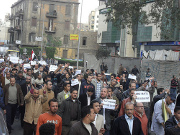
Photo by Ramy Raoof,
 Demonstrators heading to Tahrir
 Square in January 2011

Egypt (IMB/MNN) ― Egypt's new lower house of parliament just held its first session two days ago, after completing an historic election that put Islamic groups in the legislative lead.

A year ago, Cairo was in turmoil as thousands of angry protesters clashed with government soldiers and tanks.
While the square seems calm, there's an energy that leads Christian worker to note the region's volatility.

Lucy Hamilton (not her real name), with the Southern Baptist International Mission Board says the Arab Spring was the manifestation of the tension in the region. "In Egypt at least, there's a revolution attitude of ‘I can do what I want' because people are disillusioned and desperate, and the police force is unable to keep up with petty crime problems."

The changes in Egypt haven't been as deep as many expected, but they have still made a region-wide impact, says Nik Ripken (not his real name), who has served 25 years with the International Mission Board and is an expert on the persecuted church in Muslim contexts.

"I believe that the Arab Spring and what has happened in Egypt has begun to redefine the Arab if not the entire Muslim world," Ripken says. "What has happened to Mubarak has so terrified the leaders of countries like Yemen and Syria,  and of course we saw what played out in Libya -- that no dictator or leader is now willing to participate in a peaceful transition to a more democratic or less corrupt form of government."

The people seem to want something as different as possible from the leadership they've had, Ripken notes, adding that this may mean a more Islamic form of government.

Because Egyptian people don't feel like they have gotten the jobs, economic improvement, new opportunities or respect, not much has changed in their view. Proving Ripken's point, the winners of the elections came from the Muslim Brotherhood and the ultra-conservative Salafi al-Nour party.


But with this, much like Tahrir Square on its peaceful days, things may not be exactly as they appear, says Ripken. "This is not necessarily a bad thing from a believer's point of view, because having conversations concerning faith and religion are more important for us than conversations about government and corruption." Ripken continues, "Often it is in the most conservative of Muslim hearts that we are finding God appearing to them in dreams and visions and sending them on a spiritual pilgrimage that can last for years, where they secretly read the Bible many times and have quiet discussions with followers of Jesus Christ."

Hamilton says a sense of hopelessness in the government can bring them to Christ, too.

"We hear that many are turning to the One whose Kingdom is just and merciful and has no end," she says. "The church in Egypt also seems to be waking up as never before. It is great to watch Him use His church in the work of revolutionizing hearts."


In the light of this, Ripken says, "We want to pray that we will take every opportunity we can to feed the hungry, clothe the naked, give that cold cup of water in Jesus' name. We must pray for the absence of fear for both believers in country and those from the West who are seeking to meet the needs of both the body and soul inside these countries." 

Pray that people will have access to the Gospel through any means possible. Ripken concludes with this thought: "Now we have time to prepare the next generation for going to people groups and countries that have experienced massive change."

Syria's Assad to be left alone?

(Photos by PanARMENIAN Photo)
Syria (MNN) ― The Syrian government rejected the Arab League's call for President Assad's resignation, defending their brutal crackdown on rebels as an obligation. In response, Arab nations actually appear to be stepping down.


Gulf Arab states announced yesterday that they are withdrawing from the Arab League's observe mission in Syria, reports BBC News.

At this point, it seems unlikely that the Arab League or any individual Arab nation will try to step in again, says Tom Doyle, Middle East/Central Asia Director of E3Partners.

"[Because] Syria is such a strong Arab nation, I think the other Arab nations risk isolation from Syria. In that area, they all need each other," explains Doyle. "Eventually, probably what's going to happen is it will all be a lot of talk for nothing."

Months of talk have lifted the hopes of rebels in Syria, but those hopes are dying. "They feel forgotten. They expected a coalition of nations to come against the dictator, much like happened in Libya, and it hasn't happened." And Doyle says it likely won't.

The bloodbath has cost at least 5,000 lives in the last 10 months. It seems unlikely that any nation will step in unless it gets much worse, says Doyle. Essentially, it seems Assad will hold onto power unless forced out of it.
It's an interesting position for believers. Although Assad's regime has been violent, the government has laid off Christians as of late.

"Through this revolution, the pressure on believers has let up because I think the government has seen that the church, the believers, are not a threat--they're not trying to overthrow Assad," explains Doyle. "So the pressure that's normally been on them--which has been fairly intense in the last five years--has kind of lessened."

If a rebel-run government were to take over, things could get much worse for Christians. Unsure of what's to come, believers are taking advantage of this interim time to boldly preach the message of Christ.

"We've seen an upsurge in the Gospel. People are desperate; they're frustrated; they have lost a lot of hope. This is prime soil for the Gospel to just flourish." Seeds are being sown, and a harvest of both Alawites and Muslims is growing.

Above all things political, pray for the church in Syria. Pray that believers would continue to boldly proclaim the hope found only in Christ. Pray that Syrians would cling to this truth. 

Seven Christians Killed in Bauchi State, Nigeria


Many injured, church building destroyed.
Early morning attacks in Tafawa Balewa, Bauchi state on Sunday (Jan. 22) left at least seven Christians dead and a church building destroyed.

The attack on the Evangelical Church Winning All Church 2, residents of Tafawa Balewa said, was carried out by area Islamic extremists alongside members of the Boko Haram sect, with the church building and surrounding houses bombed.

Yunnana Yusufu, a pastor with the Church of Christ in Nigeria in Tafawa Balewa, told Compass that the assailants arrived in the early morning hours and began shooting at Christians in the town, about 100 kilometers (62 miles) south of Bauchi City.

“I saw seven dead bodies of some of the Christians killed,” Yusufu told Compass by phone. “The situation is terrible, and I am about to go out to other parts of the town, to see the extent of the damage caused by the attackers.”

Yusufu said that many other Christians were injured.

“Some of them have been taken to the General Hospital here, while others are being treated at home by medical personnel who are Christians,” he said.

All churches have cancelled services.

“The situation we are in calls for attention to the injured and taking appropriate steps to calm frayed nerves over the attack,” he said.

Bauchi Police Commissioner Ikechukwu Aduba reportedly confirmed the attack on Tafawa Balewa, saying two soldiers and a policeman, as well as eight civilians were later killed in a gunfight. He added that six suspects had been arrested.

Police also reported that bombs were thrown at a Catholic church building and an evangelical church building in Bauchi City, causing little damage and no deaths or injuries.

Bukata Zhadi, secretary of the Christian Elders Council in Tafawa Balewa, said attacks on Christian communities in the area have been incessant, with Sunday’s attack bringing to 10 the number of Christians killed in the past two weeks in Tafawa Balewa.

A fortnight ago, gunmen believed to be Muslim Fulani herdsmen attacked three Christian farmers on their farms in Pyakman village, near Tafawa Balewa, killing the three of them. Corpses recovered from the farms had bullet wounds and machete cuts, Zhadi said.

Boko Haram, the name given to the Islamic extremist group officially called Jama’atu Ahlis Sunna Lidda’awati Wal-Jihad – “The People Committed to the Propagation of the Prophet’s Teachings and Jihad” – seeks to impose a strict version of sharia (Islamic law) on Nigeria. The name Boko Haram translates loosely as “Western education is forbidden.”

END

Tuesday, January 24, 2012

Boko Haram declares war in Nigeria

(Photos by Associated Press/Sunday Alamba)

Nigeria (MNN) ― Police in Nigeria discovered ten more car bombs yesterday in Kano, an area already reeling from multiple bombings on Friday.

Spokesman for Voice of the Martyrs USA, Todd Nettleton, says the level of sophistication is what's drawing their concern. "This was a very serious attack. It also shows the growing ability of Boko Haram to coordinate attacks and to maximize the body count."

Boko Haram, a radical Islamist sect, claimed the bomb blasts that killed 256 people. The attacks came shortly after Muslim prayers in that beleaguered nation's second-largest city. This time instead of churches, it was police headquarters and other police stations, a secret police building, and immigration offices that were targeted. According to a video released by the group's leader, the attacks were a response to a refusal by the authorities to release the sect's members from custody.

The government deployed thousands of troops to quell the violence. While they have over 300 people in custody, Nettleton says it's not doing much to reassure the shell-shocked Nigerians. "The government seems unable to stop these attacks, unable to take a really significant stand against Boko Haram, and that's a concern not only to Christians in Nigeria, but really to everybody in Nigeria."

Although the group has mainly confined their activities to northeastern Nigeria, many fear extremist elements within the sect may try to escalate the crisis throughout the country -- "not only government of Nigeria targets, but international targets, as well. They have basically declared war on law and order in Nigeria, and anybody who represents law and order, they are willing to attack as they continue these calls that Nigeria should be an Islamic nation and should follow Sharia law."

This could amount to starting a civil war and destabilizing the government at the same time. President Goodluck Jonathon declared a 24-hour curfew to clear the streets. However, from there, it's clear that fear is spreading. 

If Christians are provoked further, church leaders warn they will defend themselves. "Pray that the Christians will have wisdom to know how to respond, because we want to respond like Christ. We want to represent Him. At the same time, they don't want to be 'sitting ducks' for more of these attacks that are specifically targeting Christians."

Nearly 200 religious leaders gathered on Monday for a prayer vigil. A short time later, police discovered the car bombs as well as nearly 300 homemade explosives.  

In Hausa, Boko Haram means "Western education is sinful" and is modeled on the Taliban movement. Since Christianity is equated with the West, Nettleton says believers know they're in the cross-hairs. "What is this going to mean for Nigeria? What is this going to mean for religious freedom in the northern part of the country? Are Christians going to have the ability to witness, the ability to meet together, the ability to worship in a place where they have been clearly told by Boko Haram, 'You should leave, or else'?"

Experts predict the violence will continue to spiral out of control. Nearly every news report Nettleton watches concludes with a grim prediction of civil war.

"Pray for wisdom for the Christians in Northern Nigeria to know how to respond, to balance their own need for safety and protection while also living out the biblical mandate to love our enemies and to forgive those who persecute us."

Accused apostate's accuser recants in Pakistan?

Pakistan (MNN) ― The case of Asia Bibi, the Pakistan Christian mother-of-five who was sentenced to death for alleged blasphemy, has taken an extraordinary turn.


According to a story monitored by the ASSIST News Service, Qari Salam, who accused Bibi of blasphemy charges which resulted in a jail sentence and possible hanging, is reported to have "ostensibly" regretted filing a blasphemy charge against the impoverished Christian woman.

"The source of his guilt: realization that the case was not based on facts but on hyped religious emotions and personal bias of some village women, including his wife," said the story posted at: 
http://www.topix.com/forum/religion/islam/T72AF1K9C8RL3C6TG.

Bibi has been languishing in Sheikhupura jail since a sessions court gave her a death sentence for insulting Prophet Muhammad.

Qari, according to some of his close friends, was now thinking of not pursuing the case anymore and expressed his desire to some of his friends, only to find himself in a difficult situation when activists of an Islamic religious organization "convinced" him not to change his mind.

"We will chase her through hell. Don't worry about the money, hiring best lawyers," Salam told The Express Tribune, quoting the son of Khatm-e-Nabuwat's London chapter's leader.

The leader's son flew to Nankana from London after hearing that Salam might not go to Lahore High Court (LHC) when the review petition against Asia's conviction is taken up.

Convert from Islam in Uganda Survives Societal Hostilities


Ostracized by family and fired from his job, Christian overcomes false charge.
Hassan Muwanguzi, a convert from Islam in Uganda who lost his family and job because of his Christian faith, is thankful after fighting off the latest attack – an attempt by Muslims to imprison him and shut down the school he started.


Following his conversion in his early 20s in 2003, Muwanguzi’s family immediately kicked him out of their home, and enraged Muslims beat him, he said. His wife left him that same year, and he lost his job as a teacher at Nankodo Islamic School, near Pallisa.


Undaunted, a year ago he opened a Christian school, Grace International Nursery and Primary School, at Kajoko, Kibuku district, 27 kilometers (17 miles) from Mbale town; the area’s population of 5,000 people is predominantly Muslim.


Incensed by his boldness, an Islamic teacher, Sheikh Hassan Abdalla, filed a false charge that Muwanguzi had “defiled” his daughter, a minor. Together with his Muslim countrymen, Abdalla filed a case at the chief magistrate’s court in Palissa-Kalaki, and a warrant for Muwanguzi’s arrest was issued on April 1, 2011.


Initially he was locked up for three weeks, he said.


“After 48 hours, I was taken to court, and the judge read the charges against me and asked whether I knew of the case,” Muwanguzi said. “I answered that I was not aware of such charges. I asked for a court bail, but the judge insisted that a bail can only be given after hearing from the complainant.”


He was then sent to Kamuge Prison. On April 22, he appeared again before the judge, but the complainant did not appear. His lawyer appealed for his release.


He was freed on bail for 600,000 Uganda shillings (US$246), he said. At his first hearing on May 21, the complainant did not appear. Nor did Sheikh Abdalla appear at hearings on June 25, July 16 and Aug. 13, Muwanguzi said.


“The judge found out it was a false accusation, hence the case was dropped,” Muwanguzi said. “I had been subjected to humiliation, but I forgave them for the sake of my Christian outreach in the area.”


He said the Muslims filed the charges because he had opened the Christian school against the wishes of the Muslim majority. More than a quarter of the school’s 235 children come from Muslim homes, with the consent of their Muslim parents, he said.


“The Muslims have tried to use all kinds of threats to make me close the school – first they used witchcraft,” he said. “This did not work, so then they tried to discourage Muslims from bringing their children to the school, saying that the school was converting Muslim children to Christianity by teaching Christian Religious Education.”


The constitution and other laws protect religious freedom in Uganda, including the right to propagate one’s faith and convert from one faith to another.


Muwanguzi has also helped the area to improve its agricultural practices, training the community to become self-reliant by starting tomato and eggplant gardens, among others, and providing free seeds to widows and other indigent people, including more than 100 Muslims.


“There is need for more seeds and insecticides so that the farmers can have good yields,” he said. “This will help them see that Christianity has something good to offer to better their lives.”


END