Showing posts with label parliament. Show all posts

Wednesday, August 1, 2012

Censorship tightened on religious materials

(Photo courtesy of Sefer Ibrahim)

Azerbaijan (MNN) ― The reins are tightening on what is and isn’t allowed to be sold in Azerbaijan—including religious materials.
\
Christians in Azerbaijan face more restrictions with the amendment passed by parliament last month censoring all religious materials.

According to The Voice of the Martyrs, USA's source Forum 18 News Service, all religious materials in Azerbaijan must have a state-issued verification mark in the form of a sticker before they can be sold.

Religious materials subject to censorship include electronic and hard copy literature, audio, and video.

The amendment created a new Article in the Code of Administrative offenses. It says anyone found selling religious products without state verification can face fines and the materials confiscated.

Several religious committee members told Forum 18 that they rarely bring religious literature into Azerbaijan through customs for fear of having them confiscated.

A Tax Ministry spokesperson stated that the amendment was created to make sure all commercial religious literature is getting taxed. Censorship is not required for religious materials and books produced non-commercially.

This amendment adds to the compulsory censorship that religious materials are already subject to by the State Committee for Work with Religious Organizations. Shops selling religious literature have been subject to compulsory licenses since 2009.

The State Committee has the ability to restrict the number of copies which are printed or imported, check shop contents selling religious literature, and keep a list of banned religious materials.
The Expertise Department responsible for that list refuses to make it public.

A member of the Baku-based religious community told Forum 18, “This is just the latest measure to restrict religious activity.”

Pray for Azerbaijani Christians to persevere in their faith and in distributing God’s Word despite added difficulties.

Friday, July 20, 2012

Ramadan begins today amid war on Egypt's horizon


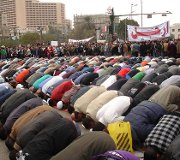
Egyptians praying in Tahrir Square last year.
 (Photo by Kodak Agfa)

Egypt (MNN) ― Today is Day One of Ramadan and the start of what could be a trying 30 days for Egypt.

The atmosphere in much of Egypt has been tense for over 17 months. But the announcement of Mohammed Morsi as president, followed by the military's decision to dissolve parliament, have forced Egypt to the brink of civil war.

Things are shaky at best, but bigger tremors may be on the way to Egypt. During Ramadan, says Middle East expert Tom Doyle with e3 Partners, "Spiritually, it's heightened there. It's just that push for Islamic dominance, and there could be major conflict that turns into a civil war as early as this week."

Doyle just returned from Egypt earlier this week. He says zealous supporters of the Muslim Brotherhood packed Tahrir square to the breaking point. Ramadan will increase the likelihood of disagreement -- if not for spiritual reasons, for physiological ones.

During Ramadan, Muslims are to fast during the day. Most drink and eat at night, but refraining from food during the day often causes emotional problems.

"We notice in Muslim countries [during Ramadan] people are much more grumpy, more jumpy, more angry. So this just kind of breeds any situation to get bigger and larger such as the situation we find ourselves in in Egypt right now," Doyle explains.

In this sense, Ramadan could mean a lot of trouble in Egypt. But at the same time, Ramadan brings with it a great deal of opportunity for believers.

In any year, throughout the Muslim holy month of Ramadan, Muslims are seeking God, says Doyle. "They are looking for something that will be life-changing. They are caught up in legalism and the law, and it is not satisfying to them. So they look for something to happen during the 30 days of Ramadan."

Within the corrupt and frightening times Egyptians currently are experiencing, people are searching even to Christ in recent months. Fed up with politics and the corruption they see in the name of Islam, many are looking for something else.

But even for those who aren't looking yet, Ramadan can change that. In the past, as believers have prayed during Ramadan, Muslims have begun to have visions and dreams of Jesus.

With this in mind, says Doyle, "As Christians, we shouldn't worry about the 30 days of Ramadan and what happens during that time. We should just be on the offensive and pray for Muslims, who have an open heart at that point. [Pray] for something to happen: a believer to share with them, for them to hear something maybe on Christian radio, or for even a dream."

Friday, January 20, 2012

Elections don't change much or give new freedom in Kazakhstan

Training for church leaders.
 (Photo courtesy of Slavic Gospel Assocation)

Kazakhstan (MNN) ―Leaders in Kazakhstan are looking to lift the state of emergency that was to last through January 31. Things seem to have settled down in the oil-rich town where riots between striking oil workers and security forces claimed over 50 lives in mid-December.

Kazakh President Nursultan Nazarbayev declared the emergency in response to uprisings that took place--a move that was partially aimed at salvaging his image of stability right before elections. 

On January 15, voters went to the polls against the backdrop of the smoke of the government crackdowns. The result: two more parties will join Nazarbayev's party in parliament for the first time in 20 years of independence. The new Parliament is slated to open its first session today.

The ruling party Nur Otan took the lions' share--nearly 81% of the votes. Ak Zhol, the Democratic Party garnered nearly 7.5%, and the Communist People's Party brought up the rear with just over 7% of the vote.  

However, not everyone was pleased with the results. Opposition leaders organized a modest rally in Almaty denying the legitimacy of the January 15 election that reinforced Nazarbayev's power. Joel Griffith with Slavic Gospel Association' says, "The Organization for Security and Cooperation in Europe issued a statement pretty critical of Kazakh authorities for de-registering parties and candidates at the last minute. They were basically saying that it deprived voters of their choices."

Still, it seems clear that things will remain as they are for now. "President Nazarbayev continues to maintain a fairly firm grip on power, and I don't think we see that changing anytime soon. What will be interesting in the days ahead will be if this continued criticism manages to encourage any further democratic reform."

As with any democratic election process, there's a slim hope that change will result from casting a vote.  Toward the end of 2011, the country adopted harsh new restrictions that raised eyebrows among human rights watchdog groups. Griffith says between the same people in power and the trend of the region, that hope appears to have been dashed, especially when couched in security terms. "The reasons given for passing these types of laws are they want to put controls on Muslim extremism."

In reality, Griffith says, "Once these laws go into place, it's the evangelical churches that appear to take the brunt of the crackdown that takes place. It's definitely a situation that bears watching. It's definitely a situation that bears for a lot of prayers. We need to pray for the security and protection of the evangelical churches that are there."

SGA has come alongside evangelical churches in Kazakhstan through a variety of ministries, including support of the Almaty Bible Institute. Griffith says that won't change. "These churches are going to  continue their ministry, regardless of what government does. But of course, they'll have to do it in a much more secure, discrete fashion, and we certainly don't want to do anything that would jeopardize their security in any way."

SGA supports children's ministries such as Immanuel's Child, Orphans Reborn, summer camps and national church-planting missionaries. There's more at our Featured Links.

Tuesday, July 26, 2011

Praying for A Miracle on Children's Religious Rights

Children's rights to attend
 worship services and functions
 in Tajikistan are under attack
 with new laws waiting to be passed.
 (Photo courtesy of Grace Episcopal Church)

Tajikistan (MNN) ―Parliament in Tajikistan adopted two new laws Thursday July 21 which would ban most children under the age of 18 from religious activities.

As reported by Forum 18, these documents are to be forwarded to President Emomali Rahmon for his approval. If President Rahmon signs these legal documents, it could spell out increased suppression of parent and child religious rights in the country.

Joel Griffith with Slavic Gospel Association says, "Apparently the Presidential administration was sort of behind [the effort] to put this kind of a law through to begin with, so the initiative came from there. So if it's not signed, it would certainly be a miracle."

Specifically, the two measures adopted are the Parental Responsibility Law and the Criminal Code amendments. These would affect many religious organizations, including churches in Tajikistan supported by Slavic Gospel Association.
The Parental Responsibility Law, in practice, would place a ban on most children under 18 from participating in religious activities. The Office of Human Rights in Tajikistan told Forum 18 that the law is needed especially for parents who lose control of their children to extremist religious groups.

"I'm sure the government would say that it's aimed basically at extremism," says Griffith. "It's really difficult to know what their real motivation is for passing such a thing, because it goes beyond targeting just what everybody would agree maybe would be extremist elements and ends up impacting mainstream as well.... As the law is worded, it would seem to impact everybody."

On top of that, the Parental Responsibility Law also calls for parents to restrict certain types of jewelry, tattoos, and even names they can choose for their kids.

This, paired with the amendments to the Criminal Code, demonstrates the type of penalty given to violators. A maximum of two years' imprisonment would be sentenced to organizers and participants in things such as unapproved gatherings, meetings, and demonstrations.

Griffith states, "You've got local churches themselves that would be impacted by this; there's question whether children would even be allowed to go to a worship service until they're 18 years old.... It's a matter of deep concern to the churches."

If the laws are enacted and put into practice, state religious affairs officials told Forum 18 that they have specialists who would be in place at religious services to be sure the laws are being followed. If they find kids or teens in religious activities, higher structures will be appealed to.

Griffith assures, "Evangelical churches are going to continue to proclaim the Gospel no matter what, and I'm sure that they are going to continue to teach their children the things of the Lord. But obviously as they proceed to do that, it would put churches and their families at great risk if this [proposed law] is enforced aggressively."

Please pray that these laws would not be signed by Tajikistan's President. If the laws are passed, pray that they truly are limited to extremist groups and would not endanger the evangelical church in the country and that the Lord would protect them.

Proverbs 21:1 says, "The king's heart is a stream of water in the hand of the LORD; He turns it wherever He will." (ESV)