“The same sufferings are experienced by your brotherhood in the world” (1 Peter 5).
Thursday, January 31, 2013
More people punished for their faith
Kazakhstan (MNN) ― It's been a year since Kazakhstan expanded its Religion Law, and more people are being punished for their faith.
According to Forum 18 News, several large fines have been handed out since August, and two more are pending for local Baptists. Forum 18 says believers are being punished for "illegal missionary activity," and the fines are equal to seven months' wages, or $1,150 USD.
A few of the seven people punished for "illegal missionary activity" were sharing their faith on the street, while others were leading religious meetings within their communities. Forum 18 says prosecuted individuals include four Jehovah's Witnesses, two Muslims, and a Christian.
The two believers awaiting trial are part of Almaty's Council of Churches Baptist congregation, reports Forum 18. Along with accusing Yuri Bronitsky and Fedor Karabeinikov of violating Kazakhstan's new religion law, officials visited another Baptist church in the region.
"[Police] came during worship and photographed us," congregants complained to Forum 18. "They said they had an order…that now the new law has been adopted, they will close us down."
Elsewhere in Kazakhstan, reports Forum 18, courts fined a believer for handing out Christian books to people on the streets. The man expected a hearing for his case, but instead was taken directly to the court after work.
These are the latest cases in a series of crackdowns since Kazakhstan passed two new religion laws in October 2011. It was thought to be one of the freer countries in Central Asia, but with more and more cases surfacing, Kazakhstan is starting to look very similar to the other restrictive "Stan" countries.
Labels:
baptists,
central asia,
fines,
former soviet union,
forum 18 news,
kazakhstan,
persecution,
religious crack-down
Location:
Kazakhstan
Lawyers to challenge Abedini's sentencing, but more help is needed
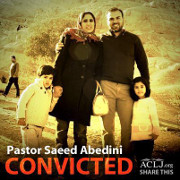
Iran (MNN) ― Calling it a "mockery of justice," lawyers representing the family of an American pastor jailed in an Iranian prison won’t let his conviction pass without challenge.
Tiffany Barrans is the International Legal Director for the American Center for Law and Justice. She says, “Under Iranian law, Pastor Saeed and his attorney in Iran have 20 days from the sentencing to appeal. We have heard from him and the lawyer in Iran that that is something they do plan to do, although we recognize that the fruitfulness of those appeals are rarely successful.”
Pastor Saeed Abedini was sentenced to 8 years Sunday on charges that included "disrupting national security."
Barrans explains, “In 2000 to 2005, it was not unlawful for Pastor Saeed to have a house church in Iran. In fact, it’s technically not unlawful today. But because he had this church from 2000 to 2005, the regime says NOW that those actions were a threat to the national security of Iran.”
Abedini, a Christian pastor who became an American citizen in 2010, was arrested in September last year for his involvement in an underground house church movement. However, he plainly stated his visit in Iran was to help establish an orphanage.
On January 25, White House Press Secretary Jay Carney said the State Department is "actively engaged in the case" and called for his release. The extra pressure can only serve to help, notes Barrans. “Because we lack diplomatic ties with Iran, we need other governments--governments that are trade partners, governments that are closely tied, even with religious affiliation to Iran--to step up to Iran and say that they need to release Pastor Saeed and all prisoners of conscience inside Iran.”
![]() |
| (Story image courtesy of ACLJ) |
The Iranian government has long been adversarial to Christians, according to the reports from religious rights groups like Open Doors and the Voice of the Martyrs. Barrans explains, “They see that Christianity is a threat because it’s growing in Iran. Iran is a theocracy of Islam so, as the youth start to turn to Christ, they find that they have less control over their people.”
Pray for a change of heart, for an overturning of the conviction. Pray that Pastor Abedini will maintain his faith and hope in Christ while in the notorious Evin Prison. Mobilizing advocates is another way to let the Iranian government know this case has not been forgotten.
There’s a petition circulating from the ACLJ, calling for Abedini’s release, among other things. More than raising the awareness, it’s calling governments to account. Barrans concludes,“It’s so important for us to make sure this concept of religious freedom and how it affects the security of every country around the world, when it is violated, is taken to the world leaders so that they start to put pressure on Iran. So that really is our focus right now, in making sure that we have other government support.”
Labels:
Evin Prison,
Iran,
middle east,
persecution,
religious freedom,
saeed abedini,
state department
Location:
Iran
U.S. Representatives demand intervention for persecuted pastor
![]() |
| (Image courtesy of ACLJ) |
USA (MNN) ― U.S. Congressmen are demanding more action from national leadership on behalf of Pastor Abedini, an Iranian American pastor from Boise, Idaho.
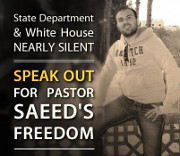
While "protecting human rights around the world is central to U.S. foreign policy," as stated on the U.S. State Department's Web site, it remained silent following Abedini's arrest in September 2012. The governmental body didn't issue a peep during the pastor's subsequent months of imprisonment in Iran's notorious Evin Prison.
Last Friday, the State Department commented on Abedini's situation in a daily press briefing.
"We remain very concerned about U.S. citizen Saeed Abedini, who is detained in Iran on charges related to his religious beliefs," said spokesperson Victoria Nuland. "We call on the Iranian authorities to respect Mr. Abedini's human rights and to release him."
Two days later, the persecuted pastor received an 8-year sentence from the Iranian courts. His crime? "Planting house churches that are intended to undermine national security," Abedini's lawyer told Mohabat News.
"In the Middle East, they react by strength. You show weakness, they react against weakness. When you show strength, they, in many cases, back off," says Illinois Congressman Adam Kinzinger.
He adds, "If you have the President of the United States come out and [make] it obvious and evident that he's paying attention to what's going on..., it makes it hard for a nation to put them in a facility...that is known for torture and terrible conditions."
In December 2012, Fox News brought Abedini's story to light when his wife expressed hope that a media campaign would help set him free. Nearly a month later, the State Department made its first comments on the situation.
In mid-January, Kinzinger and his fellow Congressmen wrote a letter of appeal to Secretary of State Clinton, calling the U.S. to intervene on Abedini's behalf.
"The administration has seemed to be hesitant to engage, concerned they might offend Iran or something like that," says Kinzinger. "But it's important to engage at this level. So we sent this message, and hopefully it hit home loud and clear."
Overall, says Kinzinger, the government's response to this cut-and-dry example of persecution is lackluster at best.
"It's been pretty disappointing to me, frankly, how the State Department has not engaged on this issue. This is something very serious," he states.
But despite America's rocky relationship with Iran, Kinzinger believes a happy ending is possible.
He says, "It's important for the administration to come out and stand tall, and say it's time for the pastor to be released. I think we can see a positive end to this."
Encourage your friends to sign the petition for Pastor Abedini, and keep him in your prayers. Pray that President Obama would take a stronger stand on this issue.
Labels:
adam kinzinger,
Evin Prison,
illinois congressman,
Iran,
middle east,
persecution,
religious freedom,
saeed abedini,
state department,
usa
Location:
Iran
2 attacks prompt Christians to stop meeting at Indian church
Angry Hindus restore access to water, back off threat to deny food rations
| Photo Credit: barnabasfund.org |
The first attack came Dec. 30, when Adivasi tribal Christians living in the village of Tamsai gathered for a worship service at the Yehovah Nisih Prayer Church. About 20 people burst in, said church member Bharat Patel.
The intruders “shouted that there is no place for worship meeting in the village for Christians, and if we want to pray, we should all go to Mumbai. (They) tore bibles and broke musical instruments and stared to beat us up,” he said.
Patel said his left ear was injured, and that three other members suffered injuries, one of them a severe cut on the head. The hour-long assault ended when area Christian leaders intervened and took the victims to the police to report the incident.
The police, however, were of little help, according to Catholic Christian Secular Forum, a Christian-rights group based in Mumbai.
Ravindra Yadav, a pastor in a neighboring area, said Christian men from Tamsai came to him seeking shelter because of death threats from the militants.
“Most of the Christian men fled the area in fear leaving behind their wives and children after the extremists threatened to kill all them if they do not renounce Christ,” he said. Those who remained in the village were forbidden to fetch water from the public well or gather firewood, he said.
“The Hindu extremists even threatened to cut off our ration card,” Patel said. Ration cards are used by villagers to buy rice, sugar, wheat and other staples at reduced prices.
The Catholic Christian Secular Forum brought the incident to the attention of Maharashtra Home Minister R.R. Patil, who instructed the state’s director general of police to launch a formal inquiry.
Christians in Tamsai didn’t gather again until Jan. 13, this time under heavy police protection.
“The Hindu extremists massed up to attack the Christian again but they backed off when they saw the police near the church,” said Yadav, the pastor.
On the same day, police arranged a meeting of the Christians and Hindus. The extremists agreed to stop their social boycott of the Christians, restoring their access to water and other community services.
For their part, “the Christians agreed to conduct prayer meetings in their homes even though the Christians said that they had the relevant land records for the prayer hall,” Joseph Dias, general secretary of Catholic Christian Secular Forum, told World Watch Monitor.
The truce lasted one day.
At about 2 p.m. on Jan. 14, three Christian women were washing clothes in a public well. Nearby, a 12-year-old held a mobile phone, which was playing a gospel song.
Other villagers within earshot protested that “such songs should not be played within their hearing range,” Dias said. Later, about 50 people massed near the houses of the three women, summoned them from their homes and started beating them up, according to Patel.
The girl, whose mother was among those assaulted, rushed out to help and also was beaten, Patel said. One of the women suffered bruises and abrasions all over her body and her face was swollen. Two others received minor injuries, Patel said.
According to Dias, the Christians in Tamsai were attacked because the Hindu extremists did not like their worship, including healing services. Christians, he said, refused to partake in Hindu idol worship, while some Hindus were discovering Christ.
“There were reports of healings, villagers giving up alcohol and not socializing with the other villagers,” he said. “Instead the new converts spend time reading the Word and discussing it, or in praise and thanksgiving. Many also went to nearby villages to share how God had blessed them.”
Five Indian states have laws regulating religious conversions, but Maharashtra, where Tamsai is located, is not among them.
India is ranked No. 31 on the 2013 World Watch List, an annual report on the 50 countries where life as a Christian is most difficult. The list is published by Open Doors International, a ministry to persecuted Christians.
In India, “one of the most prominent attackers of the Christian minority are religious militants, namely Hindu nationalists, who claim that every Indian has to be Hindu,” according to the World Watch List. “This ideology also has firm roots and strong support in many government structures as in the police. The Christian minority therefore never counts on a fair treatment and is discouraged to claim their rights.”
END
*****************
Copyright 2013 World Watch Monitor
North Korea's Overlooked Atrocities
By Jeremy Reynalds
Senior Correspondent for ASSIST News Service
![]() |
| Robert Park |
According to an article by Robert Park published in the World Affairs Journal, more than two decades of engaging and negotiating with North Korea on security issues while relegating mass-atrocity crimes occurring within the country to a low-grade status, has borne no fruit.
Park said that for the millions who suffer from a state-induced famine and the hundreds of thousands of innocent people languishing in hellish concentration camps, this approach has proven to be both unethical and harmful.
Park said in the wake of UN High Commissioner for Human Rights Navi Pillay's Jan. 14 call for an international inquiry into what "may amount to crimes against humanity," and with reports of North Korea's plan to conduct a third nuclear test in the very near future now surfacing, it is high time for the world community to act.
He said, "There must be a reassessment of policy on North Korea to focus on the unparalleled humanitarian and human rights emergency occurring in the country."
Park said the North Korean government spent an estimated $1.34 billion on its rocket program last year, according to South Korea's Ministry of Unification. An official with the ministry stated these resources could have taken care of food shortages within the country for "four to five years." Recent missile tests have taken place at a time when North Korea's famine is reportedly at one of the worst points in the nation's history.
Park wrote that a report from the International Food Policy Research Institute (IFPRI) indicates that North Korea's hunger situation is at the "serious level," with its Global Hunger Index (GHI) at 19 points, substantially higher than that of 15.7 in 1990.
Park said, "This is very alarming news, especially since the famine in the 1990s claimed the lives of between 2 to 3.5 million people."
According to the IFPRI, Park wrote, North Korea had the highest GHI growth rate since 1990 (21 percent) of any country in the world, in spite of significant international humanitarian assistance.
Park said those who cite poverty or natural disasters as the reasons for North Korea's ongoing famine are not correct.
Park said the UN's former special rapporteur on human rights in North Korea, Vitit Muntarbhorn, stated in his report to the General Assembly in 2010 that the DPRK, which has the largest per capita army and the highest military expenditures in the world according to GDP, was not at all poor.
Muntarbhorn noted that North Korea has very large mineral resources and generates billions in export and trade, but that the profits from this activity are being used entirely on the party elite and for militarization.
Park said he concluded, and has since reiterated in interviews, that the DPRK has the means at its disposal to feed its people and that the real issue is not a lack of resources but the military-first policy, blatant discrimination, and misappropriation of provisions (including the mass diversion of international humanitarian aid) by the authorities in Pyongyang.
Park commented, "One must never forget the fact that the North Korean state has brutally and systematically starved masses of people within its prison camps for over six decades."
Among several important reports analyzing North Korea's human rights crimes issued over the past 20 years, the law firm DLA Piper published "Failure to Protect: A Call for the UN Security Council to Act in North Korea" in 2006. It found that North Korea's discriminatory and exploitative food policy, resulting in famine, and its inhuman treatment of political prisoners constituted crimes against humanity as defined by the Rome Statute of the International Criminal Court.
Park said the report recommended the UN Security Council adopt a resolution urging open access to North Korea for humanitarian relief and for the release of political prisoners.
In an op-ed for the New York Times the same year, the late Czech President Vaclav Havel, Nobel Laureate Elie Wiesel, and former Norwegian Prime Minister Kjell Magne Bondevik (who commissioned the report mentioned above) called on UN Secretary General Ban Ki-moon to "make his first official action a briefing of the Security Council on this dire situation."
Park said again, in 2009 and 2010, the UN special rapporteur on human rights in North Korea urged for the "totality of the United Nations system, especially the Security Council," to be mobilized "to take measures to prevent egregious violations and protect people from victimization," and for an "end to impunity." These recommendations have yet to be implemented.
Park said North Korea's mass atrocity situation continues annually to be the subject of a vast and growing body of documentation.
In recent years, the North Korean state has been found to be comprehensively violating the UN genocide convention by targeting for destruction every group protected by the international treaty while also employing every method defined as genocidal in Article 2.
Park wrote that Genocide Watch, a nonpartisan NGO that exists "to predict, prevent, stop, and punish genocide," published a report in Dec. 2012 "that determined conclusively" that North Korea has committed genocide as defined by Raphael Lemkin's 1948 convention, stating that there is "ample proof that genocide has been committed and mass killing is still under way in North Korea."
Park said genocide is taking place through the DPRK's decades-long, racially based policy of killing the half-Chinese babies of North Korean women forcibly repatriated by China, and through its targeted and systematic extermination of its indigenous, religious (predominately Christian) population and their families.
Park commented, "Ignoring mass atrocities in North Korea is no longer a viable option. Mass human rights violations within the country amount to the most egregious of international crimes and a clear obligation to act has been flouted for too long, and at an inconceivable cost."
Park concluded, "What is long overdue is for the United States and other members of the world community to bring the matter of crimes against humanity and genocide in North Korea before the UN Security Council and, in all bilateral or multilateral discussions and initiatives on North Korea, to now prioritize the fundamental freedoms, rights, and lives of the North Korean people."
Robert Park is a minister, human rights activist, and founding member of the nonpartisan Worldwide Coalition to Stop Genocide in North Korea, a nonprofit working to provide life-saving resources to victims and their families in North Korea.
For more information go to www.stopnkgenocide.com/index.php
Wife worries she won't hear husband's voice for 8 years
U.S. authorities not hopeful Saeed Abedini will be released from Iranian prison
Colorado Springs, Jan. 28 (World Watch Monitor) — The wife of an American citizen sentenced to an Iranian prison for eight years expects she won't hear from her husband until 2021, unless U.S. pressure is able to pry him free.
Naghmeh Shariat Panahi told World Watch Monitor that the last time she heard Saeed Abedini's voice was Jan. 9, during a 3-minute cell phone call between Boise, Idaho and Tehran, Iran. Abedini's family in Iran held two cell phones together -- one linked to Panahi in America, the other to Abedeni in a holding cell -- so the two could exchange words.
"He wanted to hear the kids' voices," Panahi said Tuesday from her Idaho home. The couple has a 6-year-old girl, Rebekkah, and a son, 4-year-old Jacob. After the 3 minutes were up, "we heard there will be no more phone calls," she said.
Abedini, 32, was sentenced Sunday by a Revolutionary Court judge who concluded that Abedini's work to establish Christian churches threatened Iran's national security. A native of Iran and born Muslim, Abedini converted to Christianity in 2000 and spent several years establishing small "house churches."
He was arrested in September, though his U.S.-based advocates say Abedini had agreed in 2009 to stop organizing churches. Since then, they say, he had turned his attention to building a non-religious orphanage and had made several trips to Iran for the purpose.
His trial began Jan. 21. Though he testified that he had no political intent in sharing his faith, he and his Iranian lawyer were barred from the next day's proceedings, in which other Christians were called in to testify about Abedini's church work. He has been sent to Iran's Evin prison, where the country has locked up a long list of political prisoners over the years.
Panahi said her husband's lawyer is preparing an appeal of the conviction. The window of opportunity won't be open for long, she said.
"Appealing his case, the sentence, we have limited time to put pressure on Iran," she said. But neither she nor Tiffany Barrans, a U.S.-based international lawyer who represents Panahi, said they hold out much hope for persuading the Iranian Revolutionary Court to overturn the decision of one of its most prominent judges.
The judge, Pir-Abbassi, is known in the West primarily for his harsh sentences, including execution, of students who participated in protests after Iran's 2009 elections. The European Union has branded Pir-Abbassi, among other Iranian judges, a human-rights violator. The U.S. religious-freedom commission has recommended that the State Department make a similar declaration, but it has yet to do so.
Barrans told World Watch Monitor on Tuesday the more promising route to freedom runs through American diplomatic pressure. She said the United States, which does not have diplomatic relations with Iran, can exert leverage by enlisting the help of U.S. allies that trade with the Islamic Republic.
"They are in an economic bind now," Barrans said. "They cannot afford to risk an economic partnership. It's key that the U.S. look to economic partners with Iran."
While Barrans said such arm-twisting should occur behind the scenes, she said the U.S. administration should speak loudly about principles.
"They need to be a world leader in religious freedom," Barrans said. "There needs to be a higher priority in our government, in the White House, for religious freedom."
Barrans is international legal director for the American Center for Law and Justice, a Washington, D.C.-based attorney group that uses litigation to press for religious and speech freedom. The group represents Panahi and the family's children.
Panahi said the State Department has been in regular contact with her since mid-December, sometimes to update her with new information, but more often to ask her for information, which she said she obtains from near-daily phone contact with Abedini's family, under house arrest in Iran.
"Their response has been there's not much they can do," Panahi said about American authorities. "They're saying they're working on it. It seems they are dragging their feet."
"They have said they are concerned," Panahi said. "But there is not a lot of information on what they are doing."
State Department spokesman Darby Holladay issued a statement Sunday condemning "Iran's continued violation of the universal right of freedom of religion."
Katrina Lantos Swett, chairwoman of the U.S. Commission on International Religious Freedom, an appointed advisory body to Congress and the State Department, called the ruling "yet one more damning piece of evidence pointing to the rampant denial of religious freedom and the absence of any semblance of rule of law in Iran."
Panahi, born in Iran but raised in the United States and a naturalized U.S. citizen, met Abedini during one of her visits to family in Iran. The couple married in 2004, and moved to Idaho in 2005 after Abedini endured an interrogation session over his church activities, Barrans said. As the spouse of an American citizen, Abedini too was granted citizenship.
Panahi said she cannot phone her husband in prison. Nor can she visit him.
"This is the very hard, heartbreaking part of it," she said. "As a wife, my first reaction was to travel and be there. Unfortunately, I was threatened that if I step one foot in an airport in Iran, I would be arrested, and then the children would have no mother or father."
She said she and the children are living with her parents, in Idaho. Her church community, Calvary Chapel of Boise, has rallied around the family with prayer, she said.
"The greatest support has been prayer," she said. Urgent prayer.
"Unless we get him out quickly," she said, "we won't have a chance to release him for years to come."
———
Iran is ranked No. 8 on the 2013 World Watch List, an annual roster of the 50 countries where Christians are persecuted most harshly.
END
*****************
Copyright 2013 World Watch Monitor
Subscribe to:
Posts (Atom)
.jpg)