Showing posts with label threat. Show all posts

Thursday, March 21, 2013

Survivors of Muslim rampage in Pakistan need help

(Image courtesy Christian Aid Mission)

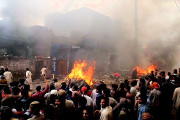
Pakistan (CAM/MNN) ― Christian Aid Mission has sent emergency assistance to help displaced families whose homes and businesses were torched by an angry Muslim mob in Lahore, Pakistan, March 9.

According to reports, many of the now homeless Christians in Lahore are living in the streets and are desperate for food and other necessities, and fearful of retaliation for the protests that followed the attacks.

Hundreds of Christians were left homeless in the wake of the March 9 fiery riots. A local church-planting ministry assisted by Christian Aid began hand-delivering food packages and water to victims the day after the attack. Christian Aid sent funds to the ministry days after the attacks, but much more is needed to assist men, women, and children who have lost everything.

Some 150 people were arrested in connection with the 3,000-strong Muslim rampage through Joseph Colony, in which every Christian home and business in the community was set ablaze. More than 100 homes, over a dozen stores, and two churches were destroyed in the carnage. No injuries or deaths were reported.

The riots stemmed from an argument earlier in the week between two friends: one Christian, the other Muslim, and from allegations that the Christian made derogatory comments about the Islamic prophet Muhammad.

The Christian was arrested and charged with blasphemy--a crime that carries a death sentence in Pakistan. As word of the incident spread, enraged Muslims turned their fury on Joseph Colony, a nominal Christian enclave where the accused man and his family live. Most of the residents had already fled by the time rioters began systematically moving through the neighborhood, burning every building that belonged to a Christian and leaving Muslim homes untouched.

Christian Aid's South Asia director has been in almost daily communication with the local Pakistani ministry. The leader e-mailed photographs of the destruction and sent out an urgent message Tuesday saying,"The Christian community here is in dire need of prayer."

In the appeal he wrote,"Christians were threatened to leave their houses; otherwise they would be burned alive. They were frightened and left, only to stand by and watch as their homes were looted and burned by the unscrupulous elements. The local police stood by and watched silently. The whole locality became a heap of rubble. It was turned to ashes within a few hours, while the local police watched. Over 120 families have become homeless and are sitting in the open sky."

Christians are killed every day for the sake of the Gospel in Pakistan, India, and other countries in South Asia. In this case, however, the eruption of violence did not result from Christians who were proselytizing or gathering for worship.

Speculation persists that the large-scale attack was driven more by political and economic gain than for religious motivations. Authorities are investigating whether extremist Muslim businessmen in the area used the blasphemy charge as an opportunity to instigate violence against the entire Christian neighborhood so their land could be seized and turned into commercial development.

Christians across Pakistan followed with their own angry protest and called for the government to provide equal protection for all of its citizens.

A similar incident with more tragic results took place in Pakistan in 2009 in the village of Gojra. A rumor was broadcast that pages from the Koran had been torn out and stepped on by Christians as part of a wedding ceremony in the community. Radical Muslims responded by setting fire to the Christian section of Gojra, killing eight people and destroying over 70 homes. The Pakistani government later said the rumor was unfounded and pledged to help rebuild the houses.

"It is hard for those of us who live in the Western world to understand what it means to be persecuted because you bear the name of Christ," said Christian Aid's South Asia director." We have the freedom to exercise our faith. But for most of our brothers and sisters in the world, it is not so."

Christian Aid worked with an area ministry after the Gojra incident to provide trunks and suitcases for affected families so they could store salvaged belongings.

The ministry also responded to the 7.6-magnitude earthquake in October 2005 that killed nearly 75,000 people. Christian Aid supplied funds to a ministry partner for the rebuilding of 300 small houses in the mountainous Kashmir region.

As rebuilding efforts begin in Joseph Colony, Christian Aid may have the opportunity to assist these families through the ministry they are helping in Lahore. Food and water are the most immediate needs, however. A week's worth of emergency supplies costs approximately $100 for a typical Pakistani family.

Prayer requests:
• For Christians in Joseph Colony to be encouraged by the prayers and support of their brothers and sisters around the world
• That the Christians will not retaliate in anger and that they will use this opportunity to show Christ´s love to their enemies
• For the authorities in Pakistan to repeal the blasphemy laws that are often used as a means of revenge to resolve interpersonal disputes.

Thursday, July 26, 2012

Suicide bomber threatens ministry


(Photo courtesy of Freedom House)

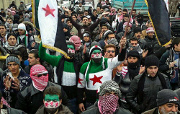
Syria (MNN) ― [Note: The violence is growing. On average, 131 Syrians are killed each day. Assad troops continue to clash with Syrian rebel forces.

Lyndsey Gammage with Mission Network News had a chance to hear about the current situation in Syria from a representative of a ministry doing humanitarian aid work and evangelism there. Because the situation is so dangerous, we can’t name the organization, the correspondent, or go into detail about their project. But they’re doing great work for the name of Christ. Here’s the interview.]

Lyndsey: Syria. Kind of a hot topic right now, and you’re updated on a lot of the issues going on there and even some humanitarian aid work. Could you just tell us a little bit about the current events and what’s going on?

*Joe: Okay, thank you for this opportunity. I just got off the phone about half an hour ago with our contact [in Syria]. The people that are working on [our] project are all scattered. As a matter of fact, all the people that we have inside this country have been taken out. They’re not in the country anymore; they’re in neighboring countries. We had to close our big distribution effort [in a strategic location]. They were threatened by suicide bombers, and so they had to close everything down. So there is no distribution going on inside the country at the moment.

But we do have distribution in neighboring countries because of the refugees. You know, there are thousands of people. As I heard this morning, it’s a continuous stream of people now crossing the border into Lebanon and Jordan. It’s a devastating situation, but it’s an opportunity for us to be able to give out food packets and medical packets to these people. So we have two huge distribution efforts going on at the moment [outside Syria].... In both situations, [we] are working with established churches. While there are advantages and disadvantages of working with a church, one [advantage] is that you have a lot of volunteers helping you, and it’s a little bit more official--especially in [unnamed city] where the people could come onto the church compound and get packets where you could freely share whatever you want with them because it’s a Christian environment. In [another area], it’s not as easy because they go door-to-door, and they offer them a packet which contains food and medical supplies and some other materials that we hope they will be able to watch and read. But there’s an opportunity to talk to the people; there’s a personal contact. Mostly what the [volunteers] do is sympathize with the situation and find out what their real needs are. And then most of the time, they would offer to pray for them. Most of these people—although they are Muslims—would accept prayer. And of course. the prayer is in the name of Jesus.

Lyndsey: When exactly did your team have to pull out of Syria?

Joe: Two days ago they had to pull everybody out. The situation is escalating at an incredibly dramatic pace. They expect that in the next month or two...the violence is just going to escalate, and we don’t know how much of that is going to spill over into Israel because, as you see in the news, there are other countries supplying weapons to the radical groups [in Syria], and their aim is to take Israel out. So the thing is really in a very volatile situation at the moment.

Lyndsey: Now what would it take for your team to be able to go back into Syria and continue the distribution?

Joe: Well, as soon as things normalize. I mean, the people who have come out of there are all nationals. They love [Syria]. Their kids are in school there. So, as soon as the situation normalizes, they will go back. For now, they’re all out of the country. [The] people that have pulled out are all nationals; there are no westerners. We don’t have westerners working in that part of the world.

Lyndsey: The suicide bombers threatening: Is that troops with Assad, or is it the rebel forces, or is it just independents?

Joe: You know, we don’t know. It could be both. It could be from either side. You know what happens: if there’s an escalation of violence against the government…the radical Muslims in the country then use that position or situation to their advantage. We find in every country, when the violence starts breaking out, the next thing that happens is they start targeting Christians and churches. They start burning down. It happened in Egypt, it happened in Libya, it happened in Indonesia, it happened in Bahrain, all over the place. The minute there’s violence against the government, the radicals use that opportunity to start persecuting the Christians. I doubt [the threats] would be from the government because they normally wouldn’t [conduct] suicide bombings. It would probably be the radicals, which I think if you scratch a little bit on the surface you’ll find out its al-Qaeda that is behind all of this. So they just use the situation normally, and they take advantage of it because it’s chaos. The more its chaos and energy, they would be able to do stuff without being opposed or stopped. Normally the government, if a church is bombed, will sort of turn a blind eye, but they would still try and warn the people not to do it. But if you have energy like this and there’s chaos, then nobody even cares about that.
Lyndsey: How is your team encouraging the church in this time?

Joe: We help them like we are doing right now, channeling as much as we can in there to get them at least humanitarian aid as far as possible, to relieve the need. We try and uplift the people by praying with them, helping them. A lot of times we would evacuate people out of the refugee camp or where they are and take them to a hospital because they don’t have transportation. We could take children and people that are wounded or sick and help them get medical treatment.

Lyndsey: And how can other Christians be praying?

Joe: Our staff has a huge prayer network going on all over the world and is praying for the situation.

Lyndsey: Well, thank you so much for talking with us today about this. Is there anything you wanted to add, anything that I missed?

Joe: No, this is the information I have at the moment.... I think from what I’ve said now, it should be okay. We mentioned cities and names of places, but it shouldn’t be a problem as long as we do not connect it with people, names, or with the specific product.... That’s a huge security risk.

Lyndsey: Will do. I’m Lyndsey Gammage with Mission Network News.

*Correspondent’s name changed for security reasons.