|
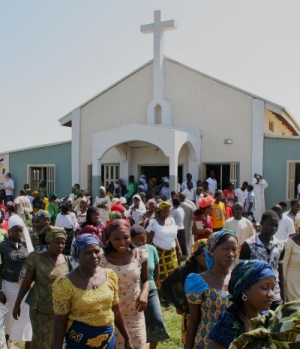
| Baptist church in Loije, Burma, where funeral was held for 47-year-old Christian the army killed without provocation on Christmas Day.(Photo: Kachin News Group) |
Government troops kill 47-year-old Christian, destroy church property in Kachin state.
NEW DELHI, January 9 (CDN) — Attacks on Christians in Burma continued into the Christmas season in Kachin state as Burmese Army troops killed a civilian and destroyed church property despite President Thein Sein’s order to stop the war against insurgents.A Baptist church in Loije, Bhamo district, held a funeral on Dec. 27 for 47-year-old Maran Zau Ja, who was shot dead without provocation by Burmese Army ’s Light Infantry Battalion No. 321 on Christmas Day, a Kachin source told Compass by phone.
Zau Ja was a farmer who was returning from his sugarcane field with a friend when troops sprayed bullets at them. His friend survived the gunshots.
The two were not armed insurgents of the Kachin Independence Army (KIA), the armed wing of the Kachin Independence Organization (KIO) that has fought for autonomy in the Christian-majority state since the early 1960s, when then-Burmese Prime Minister U Nu made Buddhism the state religion.
About 90 percent of the roughly 56 million people in Burma, also known as Myanmar, are Buddhist, mostly from the Burman ethnic group. Burmese soldiers see “all Kachin civilians as the enemy,” the Kachin News Group recently quoted a Kachin village elder as saying.
On Dec. 16, troops of Light Infantry Battalion No. 142 burned a building housing the kitchen of a Baptist church in Dingga village, also in Bhamo district, the source added. KIA men and local villagers managed to save the church building, but the fire engulfed five homes.
Earlier, on Nov. 30, Burmese soldiers killed a woman and injured six villagers as they fired mortar shells targeting civilians in Tarlawgyi area in Waingmaw Township, while another battalion burned down 10 homes in Nam Wai village and five more in neighboring Hpa Ke village. (See, “Christian Civilians in Burma Face Deadly Attacks,” Dec. 5, 2011.)
On Oct. 16, about 150 soldiers from Light Infantry Battalion 438 stormed Nam San Yang village in the Daw Phung Yang area of Bhamo district and opened fire at members of a Catholic church before the weekly mass. While no one was hurt, the priest and some parishioners were detained. (See , “Burma Army Targets Christian Civilians in War on Insurgents,” Oct. 28, 2011.)
Thailand-based activist Shirley Seng of the Kachin Women’s Association told Compass that civilians have been living in fear since military action hit Kachin state last June, and that her research team found that women and children were most affected by the war. At least 37 women and girls were raped during the first two months of the conflict, she said – 13 of them killed.
She added that other girls and women continue to be abducted.
“They just disappear after being abducted,” Seng said. “Perhaps they are first sexually abused and then killed or sold to brothels.”
President’s Sham Order
The KIO controls most of Kachin state and runs schools and hospitals and the public distribution system. The Burmese government or Army has little control outside the state capital of Myitkyina. Since June 2011, however, when the Army ended a 17-year-long ceasefire with the KIO, government troops were heavily deployed in KIO-controlled areas leading to clashes.
More than 90 clashes have occurred between the Army and the armed insurgents since President Sein, a former junta general, reportedly instructed the military on Dec. 10 to start no fighting with the KIA.
The president’s order was apparently a mere show, the Kachin source said, adding that deployment of Army personnel and attacks on civilians were on the rise and helicopters were bringing in ammunition and reinforcements.
“The government made peace with [formerly detained opposition leader] Aung San Suu Kyi and has set a few political prisoners free to gain concessions from the international community on its brutal military offensive against ethnic minority states, primarily in Kachin,” the source said.
After the general election in 2011, believed to be rigged and the first in two decades of junta rule, the military’s proxy Union Solidarity and Development Party came to power and has been trying to showcase reforms in an attempt to end economic sanctions and gain legitimacy.
Little has changed, however, for Burma’s ethnic minorities.
Internally Displaced People
According to local estimates, the military conflict has displaced about 45,000 people.
“It’s a major threat to thousands of displaced civilians who are caught between the warring parties,” Lynn Yoshikawa, an advocate from the Washington, D.C.-based Refugees International, told Compass by email. “The Burma Army does not distinguish between combatants and civilians, leading to severe human rights abuses. There is not enough assistance, and with winter setting in, displaced people lack enough warm clothes and are more vulnerable to diseases.”
Yoshikawa urged the international community “to put pressure on the military to follow the president’s orders to halt attacks against the KIO and make sure that the UN’s access to areas outside government control is sustained and expanded to meet the growing needs.” International donors should fund the humanitarian response, she added, or else the United Nations World Food Program’s food stocks will run out in February.
In addition to Kachin, six other ethnic minority states – including Christian-majority Chin state and Karen state, which has a substantial presence of Christians – have had armed and unarmed groups fighting for autonomy from the successive military-led regimes for decades.
While Kachin is the current target of the Burma Army , it is feared that other states are also likely to face war in the near future. Ethnic minority areas along Burma’s borders with India, Thailand and China are resource-rich and have strategic importance for the Union government. Burma’s neighbors have invested, and intend to accelerate investment, in power generation and other projects in and around the ethnic minority region.
The ethnic minority states were administered separately during British rule. Some ethnic leaders agreed to incorporate their states into Burma after the Panglong Agreement was signed in 1947 providing for full autonomy, a share of the national wealth and the right to secession to ethnic states. But Gen. Aung San, democracy activist Suu Kyi’s father who was then heading the interim government and led the signing of the agreement, was assassinated months later. Subsequent regimes refused to honor the agreement and forcibly made ethnic states a part of the new country.
The federal government is carrying on with the military offensive on the one hand, and holding “peace talks” with armed ethnic minority resistance groups on the other, the Kachin source said. Minorities are still praying and hoping for peace in the near future, he added.
END