Monday, March 5, 2012

BBC says it's okay to mock Christians

Evangelist Sammy Tippit

International (MNN) ― There has been a perceived bias against Christians in the media in the western world, but now it's more than perceived. According to the Christian Institute in the United Kingdom, the head of the BBC, Mark Thompson, says the company would never mock Mohammed like it mocks Jesus.

He admitted the religious bias suggesting that mocking Mohammed might have the "emotional force" of "grotesque child pornography." But he claims Jesus is fair game because Christianity has broad shoulders and fewer ties to ethnicity.

That's not sitting well with Christians world-wide, especially evangelist Sammy Tippit who travels all over the world. Tippit says it's not good to mock any religion. He says it's a dangerous precedent. "I think the type of attitude and philosophy that's being expressed at the BCC prepares people for persecution."

He says media bias in Rwanda prepared that nation for genocide. While this may be an extreme case, Tippit says it's not right. "If this kind of drumbeat continues, it could be very bad for Christians, not just in the western world, but all over because the BCC has its tentacles all through the world."

Tippit is issuing this call. "I would just issue a call for BBC to stop their unethical--and what could be and become a very immoral--practice. I would say 'stop it' before someone gets hurt. Probably people are already being hurt."

Christians are being urged to speak out about this, but Tippit saysbe different. "We don't need to respond with 'insult for insult' and respond with anger to those who hate us. We need to have the proper response. And yet, I think it's proper also to call for repentance among those who are doing that."

While it was common for Communists to make fun of Christians and other religions, Tippit says this isn't Communism. "When you start seeing this in the western world--the free world, the lying of what Christianity is, the media is very powerful in this day. And there are a lot of people who will believe what they see on that tube, so we need to speak out about these things."

Tippit says the west desperately needs revival. If that happens, he believes Christians will face even more persecution.
Sammy Tippit ministries offers a number of resources on their Web site to help Christians going through difficult circumstances. Click here to find those resources.

Libya's reform comes slowly; believers sense freedom

(Photo by Crethi Plethi)

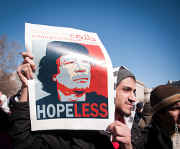
Libya (ODM/MNN) ― On February 20, the first elections since the overthrow of Muammar Gaddaffi were held in Misrata, Libya's third-largest city.

Reform is coming slower than the revolutionaries want, but the National Transitional Council says elections served as a model for the June vote that will usher in a 200-member national assembly. The assembly will name a new government and select a panel to write a constitution.

In the meantime, there is a sense of freedom in Libya, which seems to be giving Christians new determination. An Open Doorsworker, who wants to stay anonymous, says, "The Christians in Libya are more open right now; they have more courage to share about their faith. But of course the freedom is still minimal."

At the beginning of 2011, before the revolution, Open Doors estimates there were about 180,000 expatriate Christians living in the country and just 180 indigenous believers. The vast majority of the Libyans are Sunni Muslim. However, as the dust settles post-revolution, it seems that many expatriates left the country, significantly reducing the numbers of believers.

The hostilities some Christians are reporting stem from racism connected to politics. "Sub-Saharan Africans have said that they are discriminated more openly. On the streets they hear people saying bad words to dark-skinned people, for example. Before the revolution, this didn't happen so strong and open", the Open Doors worker says. According to him, the racism has partly to do with the fact that Gaddaffi used sub-Saharan Africans to fight for him. As a result, members of the churches for the sub-Saharan Africans are trying to survive in an increasingly unfriendly environment.

Skepticism about the politics isn't helping. "Politicians are having a hard time at the moment. Nobody trusts them, and they can't do anything right in the view of the majority of the people. Nobody has any respect for them, and every decision is being criticized," the Open Doors worker says. "This might be understandable after so many years of oppression, but for the long run, this might be not a very constructive way of thinking for rebuilding the country."

Pray for all the Muslims that might be open to the Gospel, that they will meet Christians to help them. Pray for the expat churches that exist in Libya that they, even though it is forbidden, will find ways to reach out to locals.

SAT-7 programming responds to emotional toll of Syrian conflict

Syria (MNN) ― The physical cost of Syria's current state of violence has been great. Conservative estimates say that over 6,000 people have died during the last year's unrest. Still, most have so far avoided this fate. But no one has been able to escape the emotional toll the crisis demands.

As mortar shells and rockets fall on Homs, Syrians are asking why and how such devastation could occur. In response to this prolonged agony, SAT-7 programming is addressing how to cope with and respond to the events taking place.

SAT-7, a Christian satellite television service to North Africa and the Middle East, has certainly not been shy on the subject of Syria, or on comforting the nation's people. During difficult times, SAT-7 aims to transmit a message of comfort and encouragement. SAT-7 believes calling people to pray gives them a hope for the future that with God's power, can be better than today.

SAT-7 broadcasts a current events show called "Salt of the Earth." Recently, the program aired an episode about fears for Syria's future. The show host interviewed Bessam Kamel, a member of the General Secretariat of the Syrian National Counci. Kamel stressed the importance of being part of the solution to the problem. He also emphasized the priority of protecting religious minorities like Christians.

This was some comfort, but news broadcasts from other media outlets in the region have been showing images of people injured and dying. A LIVE SAT-7 broadcast of a sermon preached in Egypt spoke to the difficulty of understanding violence from a Christian perspective.

"We are called to beseech God to stop the spilling of blood, so that there will not be killing and victimization of others," the speaker charged. "And we should not be selfish and forget our brothers [and sisters] in Syria, for they are suffering too... As we pass through these difficult circumstances, we are called to be joyful."

Furthermore, in the series "The Revealer of Secrets", SAT-7 ARABIC is running a report called "Pray for Syria." It is running similar reports for Yemen, Egypt, Sudan, and Tunisia. The report begins with a background that familiarizes the viewer with basic facts about the country. This leads into a description of Syrian Christians' role and predicament in society.

"Christians live in a state of silence in the shadow of these circumstances. And as a result of this silence, incorrect concepts of Christianity dominate.... In spite of the spiritual chains and social barriers, the Word of God will continue. We pray for the Syrian people and the Church in Syria, that God will truly draw them near to Himself." 

Friday, March 2, 2012

No Justice One Year after Assassination of Shahbaz Bhatti

By Dan Wooding
Founder of ASSIST Ministries


KHUSHPUR, PUNJAB, PAKISTAN (ANS) -- Friday (March 2, 2012) marks the first anniversary of the brutal killing of Shahbaz Bhatti, Pakistan’s Federal Minister for Minorities Affairs, who was shot by Islamist extremists on March 2, 2011 for his opposition to the country’s blasphemy laws and his support of a Christian blasphemy defendant, Asia Bibi.

Shahbaz Bhatti in Washington in February 2011. He gained the respect of world leaders (Photo: Jewel Samad/AFP/Getty)
According to Christian Solidarity Worldwide (CSW), a UK-based human rights group, a memorial for Shahbaz Bhatti is being held Friday in his home village of Khushpur, Punjab.

“This will be followed a few days later by another event in Islamabad and attendees are expected to include political colleagues and members of the diplomatic community, with whom Bhatti had forged close links. Pakistani Christians in the UK and around the world are also marking the anniversary,” said a spokesperson for CSW.

Mervyn Thomas, Christian Solidarity Worldwide (CSW) Chief Executive said, “We pay tribute to our friend Shahbaz, whom we miss dearly, and our thoughts and prayers are with his family and friends at this time. We continue to draw inspiration from his commitment both as a grassroots activist and a politician, not to mention his faith. He was utterly committed to making justice and equality a reality in the lives of Pakistan’s minorities.”

Bhatti’s killers are yet to be caught, and announcements from the investigative team have thus far been overshadowed by inconsistency and speculation, including in the most recent arrests in February. Bhatti’s long-term friends and associates at the All Pakistan Minorities Alliance (APMA), which he co-founded in 2002, are recommending that all memorial events should highlight the lack of progress in the hunt for his killers, stating that “a mockery has been made of the investigation”.

The funeral for Shahbaz Bhatti was held in his remote village; still, 20,000 Christians came and showered rose petals on his coffin.
APMA continues to call for a judicial commission of inquiry to be established, as was done in the case of murdered journalist Shahzad Saleem.

Mervyn Thomas added, “It is crucial that his murder investigation reaches a satisfactory conclusion, not only to do justice and honour the memory of Shahbaz himself, but also to make it clear that the rule of law still means something in Pakistan. At stake is the ability and willingness of the Pakistani state to stand up against those taking justice into their own hands, including those who target religious minorities with confidence that they will never be held to account.”

Note: Christian Solidarity Worldwide (CSW) is a Christian organization working for religious freedom through advocacy and human rights, in the pursuit of justice.

For further information or to arrange interviews please contact Kiri Kankhwende, Press Officer at Christian Solidarity Worldwide on +44 20 8329 0045 / +44 78 2332 9663, email kiri@csw.org.uk or visit www.csw.org.uk.

Notes to Editors:

1. CSW’s briefing -- Pakistan: Religious freedom in the shadow of extremism, examines how rising religious extremism in Pakistan has catapulted some of the country’s primary religious freedom concerns into the public consciousness, in a context relevant to Pakistanis of all faiths; two examples of this have been the assassinations of prominent politicians Shahbaz Bhatti and Salmaan Taseer for their opposition to the country’s blasphemy laws.

2. Although a candlelit procession and vigil will be held in Islamabad today, the main memorial event was not scheduled for the day of the anniversary because it coincides with Pakistan’s Senate elections. This round of elections will be the first to include four seats for religious minorities, one from each province, a measure secured by Shahbaz Bhatti while he was minister.
3. For further details about the life of Shahbaz Bhatti, see his obituary (www.guardian.co.uk/world/2011/mar/10/shahbaz-bhatti-obituary) written by CSW’s Annabelle Bentham.


Dan Wooding, 71, is an award winning British journalist now living in Southern California with his wife Norma, to whom he has been married for 48 years. They have two sons, Andrew and Peter, and six grandchildren who all live in the UK. He is the founder and international director of ASSIST (Aid to Special Saints in Strategic Times) and the ASSIST News Service (ANS) and was, for ten years, a commentator, on the UPI Radio Network in Washington, DC. He now hosts the weekly “Front Page Radio” show on KWVE in Southern California which is also carried throughout the United States. The program is also aired in Great Britain on Calvary Chapel Radio UK and also in Belize and South Africa. Besides this, Wooding is a host for His Channel Live, which is carried via the Internet to some 192 countries and also provides a regular commentary for Worship Life Radio on KWVE. You can follow Dan Wooding on Facebook under his name there or at ASSIST News Service. Dan has recently received two top media awards -- the Passion for the Persecuted award from Open Doors US, and one of the top "Newsmakers of 2011" from Plain Trust magazine. He is the author of some 44 books, one of which is his autobiography, “From Tabloid to Truth”, which is published by Theatron Books. To order a copy, press this link. Wooding, who was born in Nigeria of British missionary parents, has also recently released his first novel “Red Dagger” which is available this link.


** You may republish this story with proper attribution.

BBC Chief Admits Christianity ‘gets less sensitive treatment than other religions’

By Michael Ireland
Senior International Correspondent, ASSIST News Service


LONDON, UK (ANS) -- Mark Thompson, director-general of the British Broadcasting Corporation (BBC) has claimed Christianity is treated with far less sensitivity than other religions because it is ‘pretty broad shouldered.’

Mark Thompson, outgoing director-general of the BBC, outside the White City studios of the BBC in London (Photo from BBC website).
In an article in the Mail Online, the London Daily Mail newspaper’s web presence www.dailymail.co.uk  , reporter Paul Revoir says the BBC chief “suggested other faiths have a ‘very close identity with ethnic minorities’, and were therefore covered in a far more careful way by broadcasters.”

Revoir reports that Thompson also revealed that producers had to consider the possibilities of ‘violent threats’ instead of polite complaints if they pushed ahead with certain types of satire.

According to the Mail Online article, Thompson said: ‘Without question, “I complain in the strongest possible terms”, is different from, “I complain in the strongest possible terms and I am loading my AK47 as I write”. This definitely raises the stakes.’

Revoir says Thompson added that religion as a whole should never receive the same ‘protection and sensitivity’ in the law as race.

The Mail Online article says Thompson was making his comments during a wide-ranging interview about faith and broadcasting, which included the furor provoked by the BBC’s decision to screen the controversial show Jerry Springer: The Opera on BBC2 in 2005.

At that time, hundreds of Christians rallied outside BBC buildings before and during the broadcast to protest about what they saw as blasphemous scenes such as Jesus Christ wearing a nappy, the Mail Online reported.

The Mail Online article said that at least 45,000 people contacted the BBC to complain about swearing and its irreverent treatment of Christian themes. Many said that no one would have dreamed of making such a show about the Prophet Mohammed and Islam.

Revoir reported that: “Thompson has now appeared belatedly to accept their argument. In an interview, he said Islam was ‘almost entirely’ practiced by people who already may feel in other ways ‘isolated’, ‘prejudiced against’ and who may regard an attack on their religion as ‘racism by other means’.”

Thompson said that “Christianity was ‘an established part of our cultural-built landscape’ which meant it was ‘a pretty broad- shouldered religion,’ ” the newspaper website reported.

Revoir wrote that Thompson conceded the broadcaster would never have aired a similar show about Mohammed because it could have had the same impact as a piece of ‘grotesque child pornography’.

In the interview posted online for the Free Speech Debate – a research project at Oxford University – Thompson said: “The kind of constraints that most people accept around racial hatred, the fact that it may be in certain forms of expression or certain forms of depiction, may be outlawed because of the way in which they go to racial hatred and potentially the promotion and incitement of racial hatred.

“I think religion should never receive that level of protection or sensitivity,” he said.
“But I think it is wrong to imagine that it therefore goes into the general swim and that a cartoon of the Prophet Mohammed is no more challenging than a debate about what two plus two equals.”

He added: ‘The point is that for a Muslim, a depiction, particularly a comic or demeaning depiction, of the Prophet Mohammed might have the emotional force of a piece of grotesque child pornography.

“One of the mistakes secularists make is not to understand the character of what blasphemy feels like to someone who is a realist in their religious belief.”

The Mail Online report says that, when asked by his interviewer, the historian Timothy Garton Ash, if it was the case that the BBC wouldn’t dream of airing something ‘comparably satirical’ as Jerry Springer: The Opera about Mohammed, he said: “Essentially the answer to that question is yes.”

He added: “The idea you might want to… think quite carefully about whether something done, in quotes, in the name of freedom of expression, might to the Jew, or the Sikh, or the Hindu, or the Muslim, who receives it, feel threatening, isolating and so forth, I think those are meaningful considerations.”

The Mail Online report goes on to say that Thompson, who is expected to leave his job after the 2012 Olympics in Britain, said he was a ‘practicing Catholic’ who believed that the ‘truths of the Christian faith’ were objective rather than subjective.

He said had never watched Martin Scorsese’s film The Last Temptation of Christ or Monty Python’s The Life of Brian because he was ‘quite personally sensitive to mockery of religious images’.

But the Mail Online reports he said this did not mean that he was against either film being broadcast, adding that the best advice if you thought something might offend you was not to watch it.

However, he had no problem with the decision to show Jerry Springer: The Opera, and ‘thoroughly enjoyed it’.

In the conclusion to the Mail Online article, Revoir quotes Thompson as saying the fatwa against Salman Rushdie over his novel The Satanic Verses, the September 11 terror attacks, and the murder in Holland in 2004 of film-maker Theo van Gogh, who had criticized Islam, had made broadcasters realize that religious controversies could lead to murder or serious criminal acts.


** Michael Ireland is the Senior International Correspondent for ANS. He is an international British freelance journalist who was formerly a reporter with a London (United Kingdom) newspaper and has been a frequent contributor to UCB UK, a British Christian radio station. While in the UK, Michael traveled to Canada and the United States, Albania,Yugoslavia, Holland, Germany,and Czechoslovakia. He has reported for ANS from Jamaica, Mexico, Nicaragua, Israel, Jordan, China,and Russia. Michael's volunteer involvement with ASSIST News Service is a sponsored ministry department -- 'Michael Ireland Media Missionary' (MIMM) -- of A.C.T. International of P.O.Box 1649, Brentwood, TN 37024-1649, at: Artists in Christian Testimony (A.C.T.) International where you can make a donation online under 'Donate' tab, then look for 'Michael Ireland Media Missionary' under 'Donation Category' to support his stated mission of 'Truth Through Christian Journalism.' Michael is a member in good standing of the National Writers Union, Society of Professional Journalists, Religion Newswriters Association, Evangelical Press Association and International Press Association. If you have a news or feature story idea for Michael, please contact him at: ANS Senior International Reporter

** You may republish this story with proper attribution.
Indonesia: saying "NO" to Islamic Intolerance

-- specifically to the Islamic Defenders Front (FPI)

By Elizabeth Kendal

Something happened in Palangkaraya, the provincial capital of Central Kalimantan, on Saturday 11February 2012 that may prove pivotal for Indonesia. While it was not the first time Indonesian moderates, reformists, human rights activists and peace-loving citizens have taken a stand against Islamic intolerance, it was an inspirational victory.

On 11 February, four prominent leaders of the Islamic Defenders Front (FPI: Front Pembela Islam) flew into Central Kalimantan from Jakarta to inaugurate their organisation in Palangkaraya. Upon landing, however, the FPI delegation -- which included FPI founder, Saudi-educated Habib Rizieq -- was blocked by a crowd of around 800 locals, mostly indigenous Dayaks, at Palangkaraya's Tjilik Riwut Airport.

After first staging a street protest -- displaying banners at strategic locations and railing against the FPI and its plans to open an office in the city -- the protestors met up at Tjilik Riwut Airport in time to besiege the FPI leaders on their plane. According to Tempo Interactive, "The residents said they did not want the organization, which often uses violence, to enter their area."

The protestors forced their way onto the runway to confront the FPI officials, causing air traffic to be disrupted for over three hours. They dispersed only after airport officials convinced them that the FPI members would not be permitted to disembark and would travel on to another destination.

The Jakarta Globe headline on 16 February was a classic: "Could Palangkaraya Be Our Rosa Parks' Moment in the War Against Violence?" According to Jakarta Globe correspondent Pangeran Siahaan, "The people of Palangkaraya believe violence, which the FPI advocates, is intolerable and they found FPI’s presence in their city as a threat to society. The residents were successful in ousting the FPI, as the FPI officers . . . fled without stepping off their plane."

From Palangkaraya to Jakarta . . .

As Peter Alford, Jakarta correspondent for The Australian comments, "Islamic Defenders Front (FPI) bullying is so rarely confronted that the spectacle of its officials being almost literally run out of town in Central Kalimantan last weekend grabbed national attention.

"Civil society activists in the national capital, where the hard-liners wield their strongest influence, have tried to seize upon FPI's momentary discomfiture to galvanise a 'Movement for an FPI-free Indonesia'."

Jakarta's 'Movement for an FPI-free Indonesia' held its inaugural public demonstration at the Hotel Indonesia (HI) traffic circle on 14 February. "If Kalimantan can do it, Jakarta can also do it," activist spokeswoman Tunggal Pawestri told the Jakarta Globe.

The Jakarta Globe's Pangeran Siahaan attended the demonstration, which he says was inspired by the courage, determination and principle on display in Palangkaraya and fuelled by the same spirit.

"Everybody," writes Siahaan, "has said that they’re fed up with the unlawful behavior of such organizations, but nothing had been done publicly to declare a war against violence and intolerance until the citizens of Palangkaraya stood up and their voices reached the people of Jakarta. Driven by the same spirit and anger caused by the government’s leniency towards violence, I joined the protest rally at the HI traffic circle. It was a peaceful event as the protesters unfurled banners and posters while chanting, 'Indonesia Damai! Tanpa FPI! Tanpa Kekerasan' ('Peace in Indonesia! Without FPI! Without Violence!')."

Siahaan despairs that when FPI militants disrupted the protest and began assaulting some of the protestors, the police chose to shepherd the protestors, rather than the attackers, away from the HI traffic circle, supposedly for safety reasons. 

"What a bucket of nonsense," rails Siahaan, "because what’s the purpose of the police’s being there if not to prevent harm to the rally attendants?"

Vivi Widyawati, a coordinator with the "Movement for an FPI-free Indonesia" said the Jakarta rally was intended to widen opposition to the hardline group following the Dayaks’ 11 February protest at Palangkaraya airport.

. . . to Surabaya and beyond

And as Megawati Wijaya reports for Asia Times, opposition to the FPI iswidening. "The anti-FPI movement spread to Surabaya, another major metropolitan area where people referring to themselves as 'Surabaya Residents Against Violence' held a similar rally on February 17. Although the group did not specifically refer to the FPI in its addresses promoting non-violence, yells of 'Indonesia without FPI, Indonesia without violence' could be heard from the gathered mass, according to local press reports."

In order to maintain momentum, Jakarta's "Movement for an FPI-free Indonesia" is planning to take the battle online using Twitter, blogging and other social media tools. Bhagavad Sambada, one of the movement's founders, is confident: "The snowball has rolled and it is getting bigger. The movement will be more widespread and will be unstoppable."

The FPI has slammed the movement as a "Western-funded plot".

-----

Related:
FPI files reports to police over hostile Palangkaraya welcome
Dicky Christanto, The Jakarta Post, Jakarta | Mon, 02/13/2012 11:54 AM

No love shown to the FPI
Bagus BT Saragih, The Jakarta Post, Jakarta | Wed, 02/15/2012

FPI and the Government: Best Friends?
by Calvin Michel Sidjaja, Jakarta Globe, 21 Feb 2012