Showing posts with label revolution. Show all posts

Friday, August 24, 2012

Egyptian in 'Second Day of Rage'

(Cover photo by Sharif Hassan.
Story photo by MA3T, file footage Egypt protests 2011)

Egypt (MNN) ― A potentially ugly confrontation is brewing in one of the Arab Spring countries.

Friday August 24 has been dubbed Egypt's "Second Day of Anger." The actions of President Mohamed Morsi 12 days ago fueled the tensions.Open Doors President and CEO Carl Moeller explains, "There's a lot of disaffection among Coptic Christians about the one-party de facto situation in Egypt with the Muslim Brotherhood being the primary winner of all the elections and everything that has gone on--the power that's being consolidated in the presidency right now."

Fearing a turn toward an Islamic state, Moeller adds, "Many in Egypt, including secularists and evangelicals, also feel like the Revolution has been stolen, and so they're calling on people to take to the streets in opposition to this 'one-party man' show, they're saying, which, in effect, could be highly confrontational. "

Hostility ratcheted up a notch when the top Sunni Muslim cleric issued a fatwa. His decree labeled demonstrators as "infidel," which essentially legitimized the killing of protestors who were marching in the nationwide rallies.

Christians say all they want to do is restore the objectives and accomplishments of Egypt's historic January 25th Revolution. Being on the streets will be dangerous in two ways, Moeller says. One: if there is a violent response to the demonstration, and two: "As the Muslim Brotherhood, they've called for people to stay home. Those that come out in the streets are obviously singling themselves out as not participating in the Muslim Brotherhood, not listening to their agenda, and it could be violent against, what is essentially, the Christian community."

People are nervous, dreading the potential chaos that could erupt and drag on. "Who knows what tomorrow holds? In something like this, the Church can easily be the target of the anger of a mob because it represents sort of 'opposition' to what's happening politically," he adds, but that's where prayer comes in. "The Church is praying that this protest, this demonstration, remains peaceful. [They're praying] that, on the Christian side, they are not going to do anything to provoke or overly antagonize the government. They're praying that the government shows great restraint in allowing this protest to take place."

The scenario is vague. There could be a swift, irrevocable response. The response could be delayed, or there may not be an official response at all. Moeller says the last time the Christian community was silenced, the end result was not a squashing of faith, at all. In fact, he says marginal Muslims have been drawn to the message of Christ. "The need for Bibles, the desire for Bibles, training, Muslims coming to faith in Christ: those numbers are all way, way up. A lot of the overt Christian ministry has been reduced somewhat because there's difficulty in carrying on programs if there's no infrastructure and no security to carry them out."

Crackdowns would only slow things down, but not stop the advance of the Gospel. The question is: how extreme will the response be?

Egypt is holding her breath, on her knees. Will you join her? Our Featured Links Section has more.  


Thursday, August 2, 2012

Egypt scolded over religous freedom issues

(Story photo courtesy SAT-7)

USA (MNN) ― This year's International Religious Freedom Report notes that sectarian violence had increased in Egypt, despite efforts by the government to ease tensions.

The report denounced "both the Egyptian government's failure to curb rising violence against Coptic Christians and its involvement in violent attacks."

Despite promises from Egypt's new leader, President Mohamed Morsi, "to be the president of all Egyptians," Christians are unsure.

Still, there are steps in the right direction, notes Rex Rogers, President of SAT-7 USA. "The new president in Egypt has extended an opportunity for two Christian leaders we know at SAT-7, to work with the new constitutional committee whenever that group finally begins its work."

That's a unprecedented move. It spurs hope. "It seems like he's followed through with his pledges of diversity and pledges to recognize Christians and other minorities in the government as it's being formed. That's quite positive, but you need to wait and see what happens."

Egypt's recent history can be hard to understand unless there's perspective. Rogers says, "When you watch something like the Middle East every day, and with things revolving so rapidly, it's like going on a diet and checking your weight every day: it goes up and down, and it fluctuates. You can be encouraged one day and discouraged the next. You need to do it once a week, and really you need a bigger perspective on what's happening in the Middle East and what's happening with politics."

At least one in ten Egyptians is a Christian. With the government leaning toward a greater reliance on Islamic principles, it's no wonder a significant part of the country has post-election jitters. There are those who are wondering about what the Christians believe, too. It's a good place for SAT-7's programming.  They're a Christian satellite television agency to the Middle East and North Africa.

Rogers explains that their teams in Cairo adjusted programming to create a public forum to handle the nervousness. "We've done live panels on issues. In particular, how Christians can turn the other cheek, as the Scripture indicates, but at the same time, stand up for their rights. How do you do that in a Christian way, and how do you balance those seemingly contradictory ideas of how to live out your Christian faith?"

Farid Garas, the Executive Director of the SAT-7 studio in Egypt, has said, "SAT-7 has played the role that it should... presenting hope through faith, encouraging people to trust God, who is in control."

As an organization that does not take political positions, SAT-7 supports viewers by teaching how they can apply Christian principles to everyday life. Says Rogers,"We simply talk about 'Who is Christ?' 'What does He mean in your life?' [We] have testimonials of people whose lives have been changed and again, we get great response. We get people contacting us in a variety of ways, talking about their new-found faith and new commitment to Jesus Christ."

Keeping Christians involved is helping to shape SAT-7 programming. It emphasizes the need for an attitude of reconciliation, as well as a readiness for participating in writing a new constitution. Interestingly, it is that approach that has kept them safe in a time of turmoil. "SAT-7 has not been directly threatened, harassed, or pressured in any way has there been any suggestion that we need to curtail what we are doing, in terms of operating as a Christian ministry."

In essence, Egypt is a country searching for hope. Wishing for change fueled the uprisings, but investing the Truth is what makes the difference. Rogers says, "Life is just difficult. You come along with Christianity in a way that they've never heard before, you come along in terms of how Christianity can make a practical Christian worldview difference in their everyday lives in addition to salvation. It's a blessing of living the Christian life. People perk up and respond to that. It is hope."

Pray that God will bring peace and justice to Egypt through those who govern this country. Pray for the church as it disciples and supports Muslim-background believers in secret. Thank God for the prayers of Christians and the increased unity between denominations.

Wednesday, June 27, 2012

Egypt's new president makes history again


(Photo courtesy of Jonathan Rashad)
President-elect Morsi.
 (Story photo courtesy SAT7)

Egypt (MNN) ― Egypt's first-ever democratically-elected president, Mohamed Morsi, has already made history.
Now, he'll do it again by appointing a Christian vice president as one of his first acts. He will also choose another vice president who is a woman.

The Islamist figure, a Muslim Brotherhood leader, promised to ensure rights of minorities. Farid Samir, the Executive Director of *SAT-7's studios in Cairo, says despite the show of good will, "Although most of the promises that he had made are positive, it's not the promises. [Minorities] had fears of being treated as second-class citizens."

In a May 12th speech at Cairo University, Morsi said, "The Koran is our constitution, the Prophet is our leader, jihad is our path, and death in the name of Allah is our goal.
"   
However, the greater concern for Christians came from a report Monday from Iranian state media. Samir says, "They're afraid of following Iran's regime because the first announcement he made, he said, 'We want to restore our relationships with Iran.'"

According to the semi-official Fars news agency, Morsi views a renewal of diplomatic ties with Tehran as a way to achieve "strategic balance" in the region. Samir says nobody is sure how far that renewal will go. "They have two armies. One army is the official army, and the other army is to protect Islam and to protect the regime. So we don't know if this is what he means by 'following the Iranian regime' or learning from that."

Then, in what seems to be an about face, Morsi's policy adviser this week emphasized that Egypt "definitely" would not be an "Islamic Republic."

Meanwhile, Egypt's courts suspended a ruling that said the military could arrest citizens, forcing the military back from what was perceived to be a move toward martial law.

What does all this mean? It seems it's an effort to allay fears of sharia, jihad, and religicide. Samir notes, "We can't forget that this Muslim Brotherhood didn't just start now, but it was there for 80 years, working underground. But now, it's official." There's good reason for concern. "There is a lot of fear, also, about seeing the same violent acts against Christians, but this time, with legal coverage."

Christians may face losing more of their voice, more rights, and possibly, face more trouble. Reports of widespread evacuation have already begun to file in.

The greatest concern: who will Morsi be to believers after the "honeymoon" period is over? Samir says, first, "Church leaders are trying their best to strengthen the faith of people trying to talk about higher authority of God over any humans, and that God's will is over all that's happening."

Then, SAT-7 studios in Cairo began offering a forum for viewers. Samir explains, "We started a current affairs show called 'Salt of the Earth,' bringing hope, encouraging Christians to share in the community."

The events of the past few weeks have revealed serious divisions in society, and many Egyptians are stunned. Samir adds that the uncertainty has had an interesting effect on ministry. "They'll talk about our role as Christians in the region, and the important thing is that the churches are full of people now. The same day that they announced Morsi as president, the churches were full of people. They seek God more now."

As an organization that does not take political positions, SAT-7 supports viewers by teaching how they can apply Christian principles to everyday life. In this case, says Samir, "We need this to be effective. We include a dialogue between denominations, and between Christians and Muslims, also."

Biblical perspective helps. It emphasizes the need for an attitude of reconciliation between election winners and losers, as well as a readiness for participating in writing a new constitution. Samir adds, "Fear is not really logical, but when we give some logic, and some biblical facts, it helps ease the fears down a little bit."

In the days ahead, there is a lot at stake. Samir encourages believers to stay involved in Egypt's emergence. It's a painstaking process, and what the nation will look like on the other side remains undetermined. "Pray for protection for the staff and the facilities, for wisdom for producers, for presenters to speak the truth. Pray also...for people to read the Word of God."

*A Christian satellite and television ministry to the Middle East and North Africa.

Wednesday, January 25, 2012

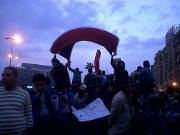
Protestors gather to remind government of revolution demands

Protestors in Tahrir one year later.
 (Photo by Bora S. Kameel)

Egypt (MNN) ― Egypt's military ruler has decreed a partial lifting of the nation's hated emergency laws effective today--the first anniversary of the start of the popular uprising that toppled longtime authoritarian ruler Hosni Mubarak.
The move caps off a wild beginning for Egypt's first democratically -elected parliament in 60 years.

A top priority will be for the chamber to elect a 100-member panel to draft a new constitution, which will have to be put to a vote in a referendum. The next major step in the transition will be a presidential election, scheduled to be held before the end of June.

However, the changes are not going in the direction revolutionary groups wanted. They're calling for mass demonstrations against the military rule on January 25, the one-year anniversary of the uprising that eventually led to former President Hosni Mubarak's ouster. SAT-7 USA President Rex Rogers says, "There's a lot of hope tempered by realism. There have certainly been some positive changes. Things have opened up."

That's a step in the right direction, but it hasn't come easily. SAT-7, a Christian satellite television ministry to the Middle East and North Africa, has an office in Cairo. Despite the weeks of unrest, their team has kept up with the events and adjusted accordingly. Rogers notes, "We've done a lot more live programming. We've tried to interact with people's on-the-ground needs. We've tried to share with them how practical Christianity is for life, and at the same time, continue to pray because we don't know exactly which direction this is going to go."

Daily live TV shows gave an outlet for the building emotional tension. Egyptian church leaders created an opportunity to calm angry spirits, to call for peace and to explain the Gospel. Rogers explains, "We try to encourage people, we try to help them understand how do you stand up for your rights, and at the same time turn the other cheek? We try to get in and understand 'what does the Word of God say?' 'When is it right to do one thing and right to do another?' "

Even as protestors gather in Tahrir Square to remind Parliament of the revolution's demands, Rogers says, "Pray for safety, obviously. Pray for an understanding of individuals different from oneself. I mean that religiously, and otherwise. You pray for people, and have a concern those that do not believe as you believe because ultimately, you want to reach out to them."

Despite a growing sense of disillusionment that's been widely purported, Rogers adds, "Staff is hopeful. They continue to pray. They are optimistic, but at the same time, they recognize there are a lot of political tensions taking place."

SAT-7's five channels include: SAT-7 ARABIC, SAT-7 PARS (Farsi), SAT-7 TÜRK (Turkish), SAT-7 KIDS (Arabic) and SAT-7 PLUS (Arabic). SAT-7 has an estimated 15 million viewers (Intermedia research, 2009) and broadcasts in three languages: Arabic, Farsi and Turkish. SAT-7 can be viewed via satellite in the Middle East, North Africa, Europe, much of Central Asia and worldwide atwww.SAT7.org.

Syria's Assad to be left alone?

(Photos by PanARMENIAN Photo)
Syria (MNN) ― The Syrian government rejected the Arab League's call for President Assad's resignation, defending their brutal crackdown on rebels as an obligation. In response, Arab nations actually appear to be stepping down.


Gulf Arab states announced yesterday that they are withdrawing from the Arab League's observe mission in Syria, reports BBC News.

At this point, it seems unlikely that the Arab League or any individual Arab nation will try to step in again, says Tom Doyle, Middle East/Central Asia Director of E3Partners.

"[Because] Syria is such a strong Arab nation, I think the other Arab nations risk isolation from Syria. In that area, they all need each other," explains Doyle. "Eventually, probably what's going to happen is it will all be a lot of talk for nothing."

Months of talk have lifted the hopes of rebels in Syria, but those hopes are dying. "They feel forgotten. They expected a coalition of nations to come against the dictator, much like happened in Libya, and it hasn't happened." And Doyle says it likely won't.

The bloodbath has cost at least 5,000 lives in the last 10 months. It seems unlikely that any nation will step in unless it gets much worse, says Doyle. Essentially, it seems Assad will hold onto power unless forced out of it.
It's an interesting position for believers. Although Assad's regime has been violent, the government has laid off Christians as of late.

"Through this revolution, the pressure on believers has let up because I think the government has seen that the church, the believers, are not a threat--they're not trying to overthrow Assad," explains Doyle. "So the pressure that's normally been on them--which has been fairly intense in the last five years--has kind of lessened."

If a rebel-run government were to take over, things could get much worse for Christians. Unsure of what's to come, believers are taking advantage of this interim time to boldly preach the message of Christ.

"We've seen an upsurge in the Gospel. People are desperate; they're frustrated; they have lost a lot of hope. This is prime soil for the Gospel to just flourish." Seeds are being sown, and a harvest of both Alawites and Muslims is growing.

Above all things political, pray for the church in Syria. Pray that believers would continue to boldly proclaim the hope found only in Christ. Pray that Syrians would cling to this truth. 

Friday, July 22, 2011

Will The Arab Spring Spread?

Africa (MNN) ― "Arab Spring" is a term used to describe a wave of revolution across the Arab world that began in Tunisia in December 2010.

By July 2011, revolution included Egypt and Libya. Civil uprisings spread to Bahrain, Syria and Yemen, and protests captured Algeria, Iraq, Jordan, Morocco and Oman. There were reports of unrest in Kuwait, Lebanon, Mauritania, Saudi Arabia, and parts of Sudan.

The big question now is: Will the "Arab Spring" turn into an "African Summer?" There have been protests in Burkina Faso, Senegal, Uganda, Nigeria, Malawi and South Africa, too.

Todd Nettleton with Voice of the Martyrs thinks a season of revolution is unlikely, noting that the root causes for the unrest between the Middle East and North Africa and what's going on in the Sub-Saharan part of the continent are a little different.

However, their teams can't rule out the possibility of similar-looking events. "I think it's a ‘domino effect' in that you look at the countries around you at what the people there have accomplished, or what they want to accomplish, and I think there's more of an inspiration than a ‘cause and effect.'"

Reports on the waves of protests and strikes in the Sub-Saharan region are readily available online. The global community is smaller than ever before. Nettleton says that means "they're happening where people see them. Obviously, one of the things that happens is that people are inspired to take action in their own country when they see those taking action in another country, bringing about what's perceived to be positive change."

Rising food prices, inflation, and unemployment have combined to threaten governments across the continent, adding to the instability of newly-formed administrations (Nigeria, Sudan, Guinea). Often, believers find themselves as scapegoats when such times arise. Nettleton says that while persecution CAN happen during transition, it's really not a secure time for anyone. "When there's chaos, that's bad for everybody. It's bad for believers, it's bad for non-believers. That's one effect. The other thing that can happen is that you can move to a government that is less open to religious freedom."

However, believers in the persecuted church have long handled difficult times as opportunities for Kingdom building. "As there is unrest, as there [are] people who are in the state of upheaval, there are some spiritual questions that get asked. That can really be a time where the church grows."

Even if the Sub-Saharan region dissolves into a frenzy of "African Summer," there is a church body that is supported by groups like Voice of the Martyrs. Nettleton urges prayer for protection, wisdom and boldness. "We can pray for them in their outreach efforts, and pray that they will represent Christ well, whatever is going on around them."