Showing posts with label amnesty international. Show all posts

Thursday, October 4, 2012

Iranian lawyer imprisoned, sentenced to 9 years in Evin


Iran (MNN) ― Human rights watchdog Amnesty International is demanding freedom for lawyer Mohammad Ali Dadkhah. He's currently detained in Tehran's notorious Evin prison, sentenced to nine years of imprisonment.

"I was in a court in Tehran defending one of my clients--a jailed political activist on death row," Dadkhah told theGuardian, a UK news service, "when the judge told me that my own sentence has been approved and I will be shortly summoned to jail to serve the 9-year sentence."

It's not the first time he's been behind the bars of Evin. In 2009, Dadkhah was tortured and held in solitary confinement for the majority of his 74-day incarceration.

Ask the Lord to protect Mohammad Ali Dadkhah. Pray that the charges against him would be dropped.
"I have been convicted of acting against the national security, spreading propaganda against the regime, and keeping banned books at home," he said.

He was also banned from practicing law for the next decade. A co-founder of the Centre for Human Rights Defenders (CHRD), Dadkhah was convicted in July 2011 of charges that included "membership of an association [the CHRD] seeking the soft overthrow of the government" and "spreading propaganda against the system through interviews with foreign media." The CHRD was forcibly closed in 2008 by Iranian authorities.

Dadkhah is the fourth CHRD member to be imprisoned within the last 18 months.

"He should never have been put on trial for his legitimate human rights activities," said Ann Harrison, Deputy Middle East and North Africa Program Director at Amnesty International.

"The Iranian authorities must overturn his conviction and sentence, and release him immediately and unconditionally."

Dadkhah has defended the rights of many high-profile clients, including Pastor Youcef Nadarkhani who faced apostasy charges and a potential death sentence. With the help of Dadkhah and international pressure, Nadarkhani's case was dropped, and he returned to his family last month.

"Mohammad Ali Dadkhah and other human rights defenders should be encouraged and supported in their lawful and important work instead of being persecuted for their activism," Harrison continued.

The World Organization Against Torture (OMCT) also condemned the sentencing of Dadkhah and Iran's continual harassment of CHRD members.

"The authorities in Iran are doing their utmost to stifle human rights defenders by imposing heavy sentences of imprisonment, exile, and ban on professional practice," said Gerald Staberock, OMCT secretary general.
"All this is aimed at intimidating the whole society into a deadly silence."

In 2011, the UN Human Rights Committee expressed concern over the reported persecution of human rights defenders (HRDs) in Iran. It stated that "human rights defenders and defense lawyers often serve prison sentences based on vaguely formulated crimes such as 'mohareb' (enemy of God) or the spreading of propaganda against the establishment."

Friday, March 2, 2012

Pakistan government fails to protect religious minorities says Amnesty

The Pakistan Government has failed to protect religious minorities from systematic campaigns of violence and vilification, Amnesty International said yesterday (1 March) on the first anniversary of the assassination of Minorities Minister Shahbaz Bhatti.
The only Christian member of the federal cabinet and one of a handful of Pakistan’s leading politicians to call for changes to the country's controversial blasphemy laws, Bhatti died after armed men opened fire on his car as he travelled to work in the capital, Islamabad.
Although Shahbaz’s brother Dr Paul Bhatti was made a special adviser to the President for religious minorities after his death, no one has replaced him as Minister for Minorities.
Sam Zarifi, Asia-Pacific director at Amnesty International, said:“Pakistani officials should honour Bhatti’s legacy by challenging the systematic campaign of vilification and attacks on minorities.
“The ministerial post remains vacant at this critical time, a sad reflection of the government’s inaction in the face of continued violence against minorities.
“A year has passed since Bhatti was assassinated yet the perpetrators remain at large with no clear sign that they will be brought to justice any time soon.”
The Pakistani Taliban claimed responsibility for killing Bhatti over his criticism of the country’s blasphemy laws – British-era criminal sanctions that were amended in the 1980s under the rule of General Zia ul Haq, making it an offence to defile the Quran or Prophet Muhammad punishable by life imprisonment or death respectively.
Religious minorities have been disproportionately accused of blasphemy, but the largest proportion of victims are mainstream Muslims, reflecting the danger these laws pose to all members of Pakistani society and the rule of law.
In 2009, a year after replacing military ruler General Pervez Musharraf, the current government pledged to review “laws detrimental to religious harmony,” which includes the blasphemy laws.
But the government fell silent after former Punjab governor Salmaan Taseer was assassinated in January last year by one of his own security guards over his criticism of the blasphemy laws.
Sam Zarifi, said: “After Taseer’s assassination, Minister Bhatti remained resolute in his criticisms.
“Since Bhatti’s death, the Pakistan government has allowed itself to be intimidated into silence. Pakistani officials must break that silence and speak out against those who seek to harm others because of their religion.”
This year a coalition of extremist and militant religious groups has openly called for the murder of Shi’a and some Sufi Muslims, Ahmadis and Christians, and have held large rallies across Pakistan’s major cities.
On Tuesday 28 February, 18 Shi’a Muslims were brutally shot dead in the Kohistan district of Pakistan’s north-west, after the perpetrators stopped their bus and singled them out from other passengers because of their religion.
Amnesty says the Pakistani government must do all it can to protect its citizens regardless of their religious background, especially where perpetrators candidly speak of committing violence against them.
Sam Zarifi, said: “The failure to bring Bhatti’s killers to justice or protect the most vulnerable citizens from violence while extremist groups publicly call for them to be killed tells the perpetrators of abuses that they will go unpunished if they disguise their crimes as the protection of religious sentiments, even when the targets are senior government officials.
“Violence against religious minorities is leading to a breakdown in the rule of law and increased tension within Pakistan’s diverse society."
He concluded, “The Pakistan government must take urgent, concrete measures to improve the quality of police investigation, and reform laws like those on blasphemy that promote abuses against religious minorities.”
[Ekk/4]

Wednesday, January 11, 2012

Middle East protest and repression set to continue, says Amnesty

Repression and state violence is likely to continue to plague the Middle East and North Africa in 2012 unless governments in the region and international powers wake up to the scale of the changes being demanded of them, Amnesty International warned today in a new report into the dramatic events of the last year.
In the 80-page Year of Rebellion: State of Human Rights in the Middle East and North Africa, the organization describes how governments across the region were willing in 2011 to deploy extreme violence in an attempt to resist unprecedented calls for fundamental reform.
But Amnesty International said that the region’s protest movements appeared to show few signs of abandoning their ambitious goals or accepting piecemeal reforms.
“With few exceptions, governments have failed to recognize that everything has changed,” said Philip Luther, Amnesty International’s interim Middle East and North Africa Director. “The protest movements across the region, led in many cases by young people and with women playing central roles, have proved astonishingly resilient in the face of sometimes staggering repression.”
“They have shown that they will not be fooled by reforms that make little difference to the way they are treated by the police and security forces. They want concrete changes to the way they are governed and for those responsible for past crimes to be held to account.”
“But persistent attempts by states to offer cosmetic changes, to push back against gains made by protesters or to simply brutalize their populations into submission betray the fact that for many governments, regime survival remains their aim.”
Despite great optimism in North Africa at the toppling of long-standing rulers in Tunisia, Egypt and Libya, Amnesty International said that these gains had not yet been cemented by key institutional reforms to guarantee that the same kinds of abuses would not be repeated.
Egypt's military rulers, the Supreme Council of the Armed Forces (SCAF), pledged repeatedly to deliver on the demands of the “January 25 revolution” but Amnesty International found that they had in fact been responsible for a catalogue of abuses that was in some aspects worse than under Hosni Mubarak.
The army and security forces have violently suppressed protests, resulting in at least 84 deaths between October and December 2011. Torture in detention has continued while more civilians have been tried before military courts in one year than under 30 years of Mubarak’s rule. Women appear to have been targeted for humiliating treatment to try to deter them from protesting. In December the offices of a number of Egyptian and international NGOs were raided by security forces in an apparent attempt to silence critics of the authorities.
Amnesty International said it feared that 2012 could see further attempts by the military council to restrict the ability of Egyptians to protest and freely express their views.
The uprising in Tunisia brought significant improvements in human rights, but one year on many consider that the pace of change has been too slow, with families of the victims of the uprising still awaiting justice.
Following elections in October a new coalition government was formed. Moncef Marzouki, a human rights activist and former Amnesty International prisoner of conscience, is the country’s interim president.
Amnesty International said that that in 2012 it was critical that Tunisians seized the opportunity of drafting a new constitution to ensure that it guaranteed protection of human rights and equality under the law.
In Libya, there were significant questions about the ability of the new authorities to control the armed brigades that had helped oust the pro-Gaddafi forces and prevent them from replicating the patterns of abuse learnt under the old system.
Despite the National Transitional Council calling on its supporters to avoid revenge attacks, serious abuses by anti-Gaddafi forces have rarely been condemned. In November the UN stated that an estimated 7,000 detainees were being held in makeshift centres under the control of revolutionary brigades, with no prospect of a proper judicial process.
Elsewhere, Amnesty International said that governments remained grimly determined to cling onto power, in some cases at almost any cost in human lives and dignity.
The Syrian armed forces and intelligence services have been responsible for a pattern of killings and torture amounting to crimes against humanity, in a vain attempt to terrify protesters and opponents into silence and submission. By the end of the year there were over 200 cases of reported deaths in custody, over 40 times the recent average annual figure for Syria.
In Yemen the standoff over the Presidency caused further suffering for ordinary Yemenis. More than 200 people were killed in connection with protests while hundreds more died in armed clashes. Tens of thousands were displaced by the violence, causing a humanitarian crisis.
There were hopes in Bahrain that the November publication of an independent report by international experts on protest-related abuses might mark a fresh start for the country. At the end of the year the strength of the government’s commitment to implementing the commission's wide-ranging recommendations remained to be seen.
The Saudi Arabian government announced major spending packages in 2011, in what seemed to be an attempt to prevent protests spreading to the Kingdom. Despite that – and the drafting of a repressive anti-terror law – protests continued at the end of the year, in particular in the country’s eastern region.
In Iran, whose domestic policies remained largely out of the spotlight during 2011, the government continued to stifle dissent, tightening restrictions on freedom of information and specifically targeting journalists, bloggers, independent trade unionists and political activists.
Amnesty International said the response of international powers and regional bodies such as the African Union, Arab League and EU to developments in 2011 had been inconsistent, and had failed to grasp the depth of the challenge to entrenched repressive rule in the region.
Human rights were espoused as a reason in favour of a military intervention in Libya, but the Security Council, stymied by Russia and China in particular, had by the end of the year only issued a weak statement condemning the violence in Syria.
And while the Arab League acted quickly to suspend Libya from membership in February and later suspended Syria and sent a team of observers, it remained quiet when Saudi Arabian troops, acting under a Gulf Cooperation Council banner, backed the Bahraini government’s efforts to crush protests.
“Support from world powers for ordinary people in the region has been typically patchy,” said Philip Luther.
“But what has been striking about the last year has been that – with some exceptions – change has largely been achieved through the efforts of local people coming onto the streets, not the influence and involvement of foreign powers.”
“The refusal of ordinary people across the region to be deterred from their struggle for dignity and justice is what gives us hope for 2012.”
[Ekk/3]

Nigeria asked to end police attacks on fuel price protesters

The Nigerian authorities must immediately end excessive use of force against protesters, Amnesty International says, after at least one person was killed in Kwara state during protests over fuel price rises.
Witnesses say a student, 23-year-old Muyideen Mustapha, was shot by police attempting to disperse protesters in the state capital of Ilorin on Tuesday. Police officials claim he was stabbed to death by other protesters and say an investigation into the killing has been launched.
Police reportedly fired tear gas and beat protesters as demonstrations continued over the weekend.
“The police have a duty to protect lives and property and uphold the rule of law. It is therefore completely unacceptable for them to use live ammunition against protesters,” said Paule Rigaud, Amnesty International’s Deputy Director for Africa.
“The Nigerian authorities should respect and protect peoples’ rights to freedom of expression guaranteed by the Nigerian constitution, and should instruct the police force to refrain from shooting at protesters,” she said.
Under a controversial regulation, known as “Police Force Order 237”, police officers can shoot at rioters or protesters whether or not they pose a threat to life. The regulation directs officers to fire “at the knees of the rioters” and explicitly prohibits firing in the air.
“Force Order 237 is being abused by police officers to commit, justify and cover up illegal killings at every given opportunity. This regulation goes against international standards and should be repealed immediately,” said Paule Rigaud.
Thousands of Nigerians in cities across the country have taken part in marches protesting against the removal of a state fuel subsidy, which has seen fuel prices and transport fares double.
Civil society groups and labour unions have announced further protests on 9 and 11 January 2012.
“With more protests coming up, it’s essential that the Nigerian police publicly announce that the use of lethal force is only allowed when strictly unavoidable to protect life. This simple step could make a big difference to the number of unlawful police killings we are seeing in Nigeria,” said Paule Rigaud.
Amnesty International has documented numerous incidents of excessive and unlawful use of force by police and other security forces, especially during demonstrations.
[Ekk/3]

Slovak court rules against anti-Roma school discrimination

The elementary school in the Slovak village of Sarisske Michalny in the Presov region must desegregate Roma classes as ordered by a court decision communicated earlier this month, Amnesty International and the Slovak non-governmental organization (NGO) Centre for Civil and Human Rights report.
In a landmark decision, the Presov District Court ruled on 5 December 2011 that the school had discriminated against Romani children by teaching them in separate classrooms without reasonable justification. The decision was delivered by the court on 3 January 2012.
“For the first time a domestic court in Slovakia has addressed the widespread and unlawful practice of segregated education of Romani children that affects the lives of thousands of children and traps them in a cycle of poverty and discrimination,” said Barbora Cernusakova, Amnesty International’s expert on Slovakia.
“Romani children in the elementary school in Sarisske Michalany are starting the new term in segregated classes but it must not be for long. The school must make immediate arrangements so that they can enjoy the same educational standards as other children within integrated classes," said Stefan Ivanco from the Centre for Civil and Human Rights.
For years the elementary school in Sarisske Michalany has organised separate mainstream classes on a different floor of the building attended exclusively by children of Roma ethnic origin. This situation was compounded in the school year 2008/2009 when the school transferred to the separate classes all the remaining Romani children who had previously attended integrated classes with other children from the majority population.
The proceedings against the school were initiated by the Center for Civil and Human Rights in June 2010. The Center argued that this segregated education of Romani children in separate classes constituted a serious form of unlawful discrimination based on their ethnic origin and a violation of their right to an education free from discrimination. Amnesty International submitted a written intervention in the case highlighting that the separation of Romani children in segregated Roma-only classes constitutes a violation of the right to equal treatment and the prohibition of discrimination under international law.
The Presov District Court rejected the school’s arguments that the education of Romani children from socially disadvantaged background in separate classes is the only means to provide equal quality of education for all pupils. The school had argued that the separate classes were set up to allow teachers to adopt a more individualised approach when teaching those children. However, the school failed to provide any evidence of the benefits for the Romani children of being taught in separate classes and that the measure was only temporary rather than long term.
Furthermore, drawing on a range of international and regional human rights standards including relevant judgments by the European Court of Human Rights, the District Court stated that the school practice of segregated education violates the country’s human rights obligations. The school is considering whether to appeal the District court decision.
"The school authorities must eliminate all forms of segregation and replace it with inclusive education. This may be a challenging task, but there is no alternative in order to fully realise the rights of all pupils in the school. We will be happy to assist the school in formulating and implementing an internal desegregation plan in line with the Court's decision," said Stefan Ivanco from the Centre for Civil and Human Rights.
"The implications of the Court’s decision go much further than the elementary school in Sarisske Michalany. It is a wake-up call for Slovak schools in general to adopt an inclusive approach based on the ethnic, cultural and social diversity of children. Inclusive education in a diverse environment teaches them to be friendly, tolerant, considerate and responsible in a society that is inherently diverse."
"All elementary schools must develop an individualised approach to teaching which does not unjustly exclude any child from mainstream education. National and local governments have to fully support them in line with their domestic and international legal obligations."
Amnesty International and the Center for Civil and Human Rights have been raising concerns over entrenched discrimination and segregation of Romani children in Slovak schools with the Slovak government for years. In September 2010, Amnesty International recommended a set of measures to be taken by the government in order to ensure the prohibition of segregation is enforced and put into practice.
“The Court’s ruling against segregation in education based on ethnic origin in one particular school must spur Slovak authorities into action. Following the resignation of the government in November 2011, all political parties that will form the new government following elections in March must pledge to eradicate the existing systemic discrimination and segregation within the school system in the country,” said Barbora Cernusakova from Amnesty International.
“Real change won’t happen without genuine political will. So far we have seen very little action from the Slovak authorities. Accountability for the elimination of discriminatory barriers and for the successful integration of Romani children into mainstream education lies with the Slovak government.,” she concluded.
[Ekk3]

Monday, November 28, 2011

Yemen power transition tainted by ‘immunity’ deal

A power-transfer agreement reportedly granting Yemeni President Ali Abdullah Saleh and others immunity from prosecution in exchange for leaving office, deals a serious blow to victims of human rights violations, critics say.
While only part of the agreement, which was signed at the end of last week, has been made public, it is widely believed to offer the President and some of those serving under him immunity from facing criminal investigations and prosecutions for a string of serious abuses.
It is based on a deal originally brokered by the Gulf Cooperation Council (GCC) and comes after negotiations facilitated by a UN envoy.
“Granting immunity as part of the transition agreement would deliver a hammer blow to accountability for human rights violations by blocking the investigation or prosecution of high-ranking officials,” commented Philip Luther, Amnesty International’s Acting Director for the Middle East and North Africa.
“Immunity leads to impunity. It denies justice and deprives victims of the truth and full reparations,” he added.
Under international law, including the Convention against Torture and Other Cruel, Inhuman or Degrading Treatment or Punishment, Yemen is obliged to investigate and, where there is sufficient admissible evidence, to prosecute anyone suspected of such crimes.
President Saleh, who has been in power for 33 years, has hinted at stepping down several times in the past months, only to change course later.
Under the GCC transition deal, Ali Abdullah Saleh will retain the title of president until elections take place within 90 days, but will hand over some presidential powers to Vice-President Abd Rabbu Mansour Hadi, enabling him to implement the agreement. A member of the opposition will head a government of national reconciliation, with ministerial posts divided up among political parties. The new government would remain in power for an interim period of two years.
The deal was welcomed by international governments, but sparked protest from some Yemenis who oppose it, calling for Saleh and other officials to stand trial for their role in abuses.
Armed Saleh supporters opened fire on a group of unarmed protesters marching against the decision from the protest camp known as Change Square in Sana’a on 24 November 2011.
At least five were killed by gunshot wounds to the head, neck and chest, and dozens more were wounded. Security forces were reported to have been spotted but did not attempt to intervene to stop the attacks.
Over the past 10 months, more than 200 people have been killed and thousands injured as security forces and armed Saleh supporters attempted to quell mostly peaceful pro-reform protests in Sana’a and elsewhere.
Amnesty International and the UN Office of the High Commissioner for Human Rights have called for an independent, international investigation into Yemen’s ongoing human rights violations.
Despite a fact-finding mission to Yemen by the UN Office of the High Commissioner for Human Rights in July finding evidence of serious crimes under international law, the UN Security Council last month issued a resolution calling for the signature and implementation of an agreement. The resolution was based on the GCC’s proposed transition deal, which was believed to contain an immunity provision.
The Security Council resolution also underlined the need for a comprehensive, independent and impartial investigation consistent with international standards into alleged human rights abuses and violations, with a view to avoiding impunity and ensuring full accountability.
“By lending their support to the transition deal, it appears that UN officials have allowed wiggle room for serious human rights violators to go unpunished in Yemen and violated the UN Secretary General’s directive that prohibits brokering peace agreements which contain immunity clauses,” said Amnesty's Philip Luther.
“The only way to ensure accountability is to carry out an independent, international investigation into the allegations of serious crimes under international law, regardless of the rank or affiliation of those responsible.
“Any such investigation should have the ability to refer cases to Yemeni prosecuting authorities so that suspects can face trial wherever there is sufficient admissible evidence,” he concluded.
[Ekk/3]

Tuesday, November 22, 2011

Ethiopia using anti-terror law to stifle peaceful dissent

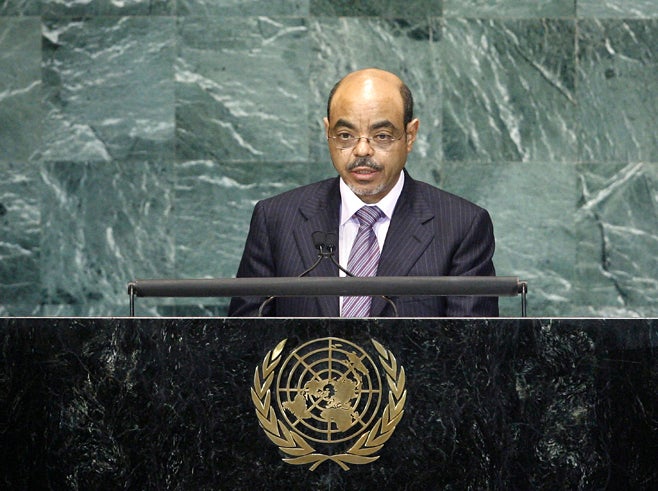
Ethiopian Prime Minister Meles Zenawi.

The Ethiopian government should cease using its overly broad anti-terrorism law against journalists and peaceful political activists, two major human rights groups say.
Human Rights Watch and Amnesty International issued a comment on the worsening situation on Monday 21 November 2011 - two days before the trial of 24 people charged on 10 November with terrorism offences continues.
Those charged include six journalists and two members of the opposition Unity for Democracy and Justice (UDJ) party.
Sixteen of the 24 are being tried in absentia. Several other terrorism trials of journalists and opposition activists are ongoing.
“The Ethiopian government is exploiting its vaguely worded anti-terror law to crush peaceful dissent,” said Rona Peligal, deputy Africa director at Human Rights Watch.
The Anti-Terrorism Proclamation of 2009 includes an overbroad and vague definition of terrorist acts and a definition of “encouragement of terrorism” that makes the publication of statements “likely to be understood as encouraging terrorist acts” punishable by 10 to 20 years in prison.
These provisions mean that critics of government such as journalists and political opponents could be charged for encouraging terrorism, Human Rights Watch and Amnesty International said.
The organisations urged the Ethiopian government to facilitate systematic monitoring of the trials by the diplomatic community. The times and locations of hearings have been altered at the last minute at least twice during the ongoing trials. The government should ensure that key information, including location and time of hearings, is available to the public.
Amnesty International and Human Rights Watch also urged diplomats stationed in Ethiopia to carry out systematic monitoring of the ongoing terrorism trials and the trials of members of the Oromo political opposition arrested during 2011.
This is particularly important in the absence of independent human rights organisations, which the Ethiopian government has effectively banned. While diplomatic representatives have attended several remand hearings and trial sessions of terrorism cases, none were apparently present at the November 10 confirmation of charges hearing, following a last-minute change of location, nor at the subsequent hearing on 15 November.
Ethiopia’s foreign partners closely followed a series of trials from 2005 to 2007, in which treason charges were brought following contested elections. The Council of the European Union appointed a full-time trial observer, although the findings of its report were never made public. EU embassy staff monitored these trials on a rotating basis, and a US embassy staff member was also present.
“Diplomats’ systematic monitoring of these trials is essential,” said Michelle Kagari, deputy director for Africa at Amnesty International. “Without the presence of local civil society, diplomats can play a vital role in witnessing whether or not the suspects’ right to a fair trial is respected.”
None of the defendants detained and charged under the Anti-Terrorism Proclamation during 2011 had access to a lawyer during the pre-trial period. Three of those charged have complained in court of mistreatment in detention.
Public comments by Prime Minister Meles Zenawi and the government spokesman, Shimeles Kemal, have undermined the defendants’ presumption of innocence, Human Rights Watch and Amnesty International said. Their comments might also exert political pressure on the courts in a country where the judiciary lacks independence.
Since June 2011, the Ethiopian government has charged at least 33 people under the Anti-Terrorism Proclamation of 2009.
In addition, in 2011, at least 98 members of the two main Oromo political opposition parties, the Oromo Federal Democratic Movement (OFDM) and the Oromo People’s Congress (OPC), have been arrested and charged under the Criminal Code on the basis of alleged involvement with the Oromo Liberation Front, a banned rebel group.
Seven of the people charged on November 10 had previously been charged during the trials that followed the 2005 elections. All had been given a presidential pardon. Three of the seven are among the defendants who are now in custody, two others fled the country after their earlier release, and two were already living in exile when they were charged in the earlier cases.
Human Rights Watch and Amnesty International have long called for the anti-terrorism law to be amended to bring it into line with Ethiopia’s domestic and international legal obligations.
“The anti-terror law itself is a huge problem,” Peligal said. “The international community, especially the European Union, United States, and United Kingdom, should ask the Ethiopian government hard questions about why it is using this law to crack down on peaceful independent voices.”
[Ekk/3]

Monday, November 21, 2011

End discrimination against Roma, new Italian government told

As prejudice and racism against travelling and gypsy people deepens disturbingly across Europe, a leading human rights NGO has spoken out on behalf of Roma in Italy.
Amnesty International has called on the Italian authorities to end discriminatory measures against Roma after the country’s 'Nomad Emergency' decrees were declared unlawful by the country's highest administrative court.
The Italian Council of State has ruled to end the 'Nomad Emergency', which has exposed Roma communities to serious human rights violations since it was introduced three years ago.
"Ending the 'Nomad Emergency' is a step in the right direction - it was unlawful and should have never been declared,” said Nicola Duckworth, Amnesty’s Director for Europe and Central Asia.
“The Italian government now has a responsibility to provide effective remedies to all the Roma families who suffered forced evictions and other human rights violations during the 'Nomad Emergency'.”
In May 2008, the Italian government declared a state of emergency around settlements of nomad communities in the regions of Lombardy, Campania and Lazio.
This was supposedly to address a “situation of grave social alarm, with possible repercussions for the local population in terms of public order and security".
The emergency was later extended to the regions of Piedmont and Veneto.
Under the 'Nomad Emergency', government representatives in the regions were given authority to deviate from legislation that protects human rights and forced evictions of Roma communities became more frequent and were carried out with greater impunity.
"The 'Nomad Emergency' has exposed thousands of Roma to human rights abuses and aggravated discrimination against them," declared Nicola Duckworth.
“The new Italian government must now end discriminatory policies and practices that have targeted Roma for years. This is certainly not the end of the story, but may well be a new beginning.”
[Ekk/3]

Friday, November 18, 2011

Iranian Pastor on Death Row Under Pressure

Ruling awaited from supreme leader on Christian sentenced to death for leaving Islam.
By Damaris Kremida

Youcef Nadarkhani
ISTANBUL, November 15 (Compass Direct News) – The mistreatment of a pastor in Iran awaiting a decision on his death sentence for refusing to recant his faith amounts to physical and psychological torture, a source close to the pastor’s family said.

Yousef (also spelled Youcef) Nadarkhani, sentenced to death a year ago after a court of appeals in Rasht, Iran, found him guilty of leaving Islam in September 2010, is in deteriorating health, according to a member of Nadarkhani’s denomination, the Church of Iran, who requested anonymity.

He said that communication with Nadarkhani is limited, but that sources close to the imprisoned Christian indicated that he has undergone physical and psychological torture. 

“Certainly he was hit, but his [telephone] conversations are heard [by authorities],” the source said. “We know that he has been in extreme situations, and we consider that torture. When you have spent time in a solitary cell unable to talk to others for a long time, or you are told you will be killed, this is also torture.”

The court in Rasht, 243 kilometers (151 miles) northwest of Tehran, was expected to pronounce a verdict on Nadarkhani’s appeal last month, and sources said the court’s long silence bodes ill. Instead of pronouncing a verdict, the court sent the Christian’s case to the nation’s Islamic authority, Supreme Leader Ayatollah Khamenei, to make a ruling.

Authorities have also continued to pressure Nadarkhani to recant his faith while in prison. Last month they gave him Islamic literature aimed at discrediting the Bible, according to sources, and instructed him to read it.

Some sources indicate a ruling could come the second half of December. One said some Iranian Christians believe that, in the face of international outrage over the case, the government would announce a verdict near the Christmas holidays so that it would receive less notice. On Nov. 10, the Christian Broadcasting Network (CBN) reported that a verdict on Nadarkhani’s case was expected in mid-December, regardless of whether there is a ruling by Khamenei.

Authorities arrested Nadarkhani in his home city of Rasht in Oct. 2009 on charges that he questioned obligatory religion classes in Iranian schools. After finding him guilty of apostasy, the court of appeals in Rasht in November 2010 issued a written confirmation of his charges and death sentence.

At an appeal hearing in June, the Supreme Court of Iran upheld Nadarkhani’s sentence but asked the court in Rasht to determine if he was a practicing Muslim before his conversion. The court declared that Nadarkhani was not a practicing Muslim before his conversion, but that he was still guilty of apostasy due to his Muslim ancestry.

The Supreme Court had also determined that his death sentence could be annulled if he recanted his faith. The Rasht court gave Nadarkhani three chances to recant Christianity in accordance with sharia (Islamic law), but Nadarkhani refused to do so. His final appeal hearings ended on Sept. 28, and the court was expected to make its final decision two weeks from the final hearing.

“For the moment, we are waiting,” said the Church of Iran source. “We have no response for now. The only thing his lawyer told me is that the file went to the Supreme Court, but normally we should have had a response by now.”

There are two more Christians from the Church of Iran, a denomination that Iranian Christians accuse of being “non-Trinitarian,” who are also serving prison sentences. Behnam Irani has been in prison since he was arrested on April 14 in Karaj, charged with “propaganda against the system.”Authorities were due to release him on Oct. 20, but instead they handed him a letter just days before informing him that a five-year prison sentence from 2008 for “action against national security,” which had been suspended, was effective immediately due to the second conviction on a similar charge, according to Mohabat News.

The other incarcerated Christian, Mehdi Foroutan (also known as Petros), has been in prison in Shiraz for two months, serving a one-year sentence for propaganda against the state and “action against national security,” according to sources.

As Christians in Iran are held hostage to the government’s political whims, the source said, the key to their freedom is continued pressure from the international community.

“The pressure is the most important thing,” he said. “When the Iranian state sees pressure, they will understand the world hasn’t forgotten Yousef, Behnam and Petros.”

Nadarkhani’s lawyer, Mohammad Ali Dadkhah, also faces charges for “actions and propaganda against the Islamic regime,” due to his human rights activities.

In the past week U.S. State Department Ambassador-at-Large for International Religious Freedom Suzan Johnson Cook called for the release of Pastor Nadarkhani, according to CBN.

“I want to echo President Obama’s and Secretary Clinton’s – and repeat my own – condemnation of his conviction and our calls on Iranian authorities to release Pastor Nadarkhani immediately,” Cook said, according to CBN. “I urge all of you to do the same.”

Arrests of Christians
Another wave of arrests is expected this December and January, a favorite time for Iranian authorities to make the rounds at Christian house group meetings, according to the Church of Iran source. He said the best Christmas gift for Iranian Christians this year would be for Western powers and Christians to continue to lobby for their freedoms.

Historically, the Iranian government has cracked down on Christians during the Christmas season, when house group members gather in larger numbers. Last year in a two-month period over the holidays, authorities arrested more than 120 Christians belonging to Iran’s underground church.

All have been released, with a few known exceptions. One of those arrested, Farshid Fathi, 32, has been in the notorious Evin Prison in Tehran since Dec. 26, 2010.  He has spent much of that time in solitary confinement and has been mistreated, according to Mohabat News. He is married and has two young children.

Noorollah Ghabitizadeh (also spelled Qabitizade) has been in prison since Dec. 24, 2010. Authorities originally held him in Dezful and later transferred him to Ahwaz as punishment for starting a Bible study at the Dezful prison, Mohabat News reported.

Authorities have reportedly put Ghabitizadeh under intense pressure to renounce Christianity and return to Islam. In his first trial hearing two months ago, a judge pressured him by telling him his death penalty for apostasy would be decided in that court hearing, according to Mohabat News.

On Oct. 17 authorities arrested another Christian convert, Fariborz Arazm, 44, in Robat Karim, according to Mohabat News. His whereabouts and condition are unknown.

Earlier this week, Amnesty International issued a statement denouncing the continual degradation of human rights in Iran and the unwillingness of the government to espouse international human rights practices.

The official religion of Iran is Shiite Muslim, and the country’s laws and regulations are based on sharia.


END

**********
Copyright 2011 Compass Direct News
Tuesday, November 15, 2011

UN must follow Syria's Arab League suspension with action

The Arab League's decision to suspend Syria should spur the UN Security Council into action over its abuses, human rights campaigners say.
At an emergency meeting in Cairo today, 18 out of 22 member states voted in favour of suspending Syria's membership of the regional organisation with effect from Wednesday if the government continued to breach the terms of the Arab League's action plan.
"This decision sends a clear signal from the Arab League that the gross human rights violations that continue to be committed against mainly peaceful protesters in Syria must stop," said Philip Luther, Amnesty International's Middle East and North Africa Director.
"Now that the Arab League has taken decisive action, it is time for the UN Security Council to finally step up to the plate and deliver an effective international response to Syria's human rights crisis."
"The question is whether those countries who have been blocking effective international action on Syria - in particular Russia and China - will recognise how isolated they have become by giving support to a Syrian regime which Amnesty International considers to have been committing crimes against humanity."
Amnesty has called on the UN Security Council to refer the situation in Syria to the International Criminal Court, impose an arms embargo, and freeze the assets of President Bashar al-Assad and his top associates which are held abroad.
On 5 October 2011, Russia and China used their vetoes to block the passing of a UN Security Council resolution which condemned Syria's crackdown on protesters and left open the possibility of sanctions.
More than 100 people are reported to have been killed since Syria announced last week that it would abide by the action plan it agreed with the Arab League on 30 October. The majority of those killed appear to have been unarmed protesters and bystanders shot by the security forces and army.
[Ekk/3]