Showing posts with label Hindu. Show all posts

Monday, October 8, 2012

Church leader attacked; missionaries threatened daily

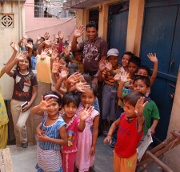
Children's Bible Clubs are
introduced in a community
through a 10-day program.
(Image courtesy of MNI)

India (MNN) ― While believers were gathered at his home singing worship songs, a mob of Hindu extremists brutally attacked Raju,* a church leader trained by Grand Rapids, Michigan-based Mission India.

Dave Stravers with Mission India said about 20 men broke into Raju's home wielding clubs. Radicals destroyed things in the home and then turned their rage to Raju. When his 12-year-old daughter asked the extremists why they were attacking her father, they began to beat her, too.

"Persecution is a growing reality in India," said Stravers. After violently attacking Raju and his family, extremists proceeded to drag the believer and his wife to a nearby Hindu temple.

"They smeared vermillion--which is like a finger-paint--on their foreheads and pushed their heads down…and forced them to worship the idols in the temple," Stravers explained.

"This is a pretty typical thing; it happens quite often in India," he added.

Last month, the Evangelical Fellowship of India observed weekly attacks on Christians. Hindu extremists throughout India threatened and beat believers, often accusing them of "forcible conversions."

Could this escalating violence lead to another Orissa-like situation?

"That possibility is always there, yes," Stravers admitted. "It's impossible to predict when that might happen or where, but it's always a possibility.

"In the meantime, you have these local acts of aggression that happen every week, and many cases every day. This is happening all over India."

One of Mission India's partners believes that a non-Christian relative may have told the attackers about Raju's worship group. Raju and his family are currently in hiding. Stravers said a similar pattern takes place in India whenever believers face persecution: they lie low for a few weeks until the chaos dies down, and then resume their work quietly.

"After a few weeks, people realize that these Christians aren't a threat and that they're actually bringing good to the communities," explained Stravers. "Ideally, Raju will go back to his ministry, and the church will start worshipping again."
Ask God to protect this believer and his family.

"We need to pray that they will take courage, that they will receive comfort and support from other believers," stated Stravers. Pray also that the Gospel would continue moving forward in India.

"India is right on the frontier of what God is doing to make the Great Commission the Great Completion in our day."

Stravers said India is hungry for God's Word. For one dollar, you can send a child to Mission India's Children's Bible Club. Many families learn about the Gospel through their children who attend these clubs.


Friday, March 2, 2012

A ministry team employs an unusual strategy in India

India (MNN) ― Disruptive violence against evangelists, pastors, and church gatherings continues to occur on a monthly basis in India, usually where the Christians live and work in remote or rural areas.

Mainly, the troublemakers are organized by extremist Hindu organizations who believe that those belonging to other faiths have no place in India and should be forced to leave.

According to Open Doors, it is likely that there's a higher degree of persecution because of the success Christianity is having among the low castes and untouchables, or Dalits. It means a loss of influence and power to Hindu leaders.

With the likelihood of rising oppression, Dave Stravers with Grand Rapids, Michigan-based Mission India asks, "How do you engage in this battle in a way that will break down the barriers and enable people to understand what Jesus can mean for their life?"

India's secularism may be critical to answering that question. Stravers explains that "India has never been more open to the Gospel than now. The growth of churches has really stirred up some of these activists. We have a ministry in India that's doing this in a really effective way, and it seems to completely disarm the opponents."

Their strategy is unusual, Stravers admits. "How can you use children to fight a spiritual battle? That's the question." That's especially important when you consider that for the average family helped by Mission India, grinding poverty is a major problem. 40% of India's population under five is malnourished; a staggering 72% of Indian children never attend high school, and there are 60 million child laborers.

You start with education. Mission India has Bible Clubs and many other programs that build on relationship in the community. "There are literally tens of thousands of Christian volunteers that want to do this. They go every day, two hours a day, and  they get this relationship with the kids and then with their parents. We have many converts, and in most cases, we end up with a new church."

Teachers that run the clubs are trained from the local churches. Mission India provides all of the materials and training. Stravers says they're not shy about who they are and what they're about. Even so, "Hindu and Muslim parents are very willing for their children to attend these clubs because they know Christians have a reputation for education, and they know their kids need this kind of help if they're going to succeed in school."

So, when word gets out that a club is starting, there's immediately a throng of eager participants. "Children come after school to meet in a location. A Christian teacher from some nearby church tutors them in their lessons, leads them in some games, tells Bible stories, helps with learning memory verses, and sings songs." Most of these kids take their new material home, sing the songs, and otherwise live out the lessons they're learning. On more than one occasion, says Stravers, that has resulted in the parents coming to Christ, too.

Even though Christians are bracing for increasing persecution in the future, that's having very little effect on the zeal following this program. "The demand is four or five times what we can provide. It only costs a dollar to bring a child through one of our 10-Day Clubs." Stravers goes on to say they have to turn away thousands of churches for lack of funding, which supports training and resourcing.

However, their teams can't afford to stop. A future body of Christ hangs in the balance. "India has 350 million children under the age of 14, more than the entire population of the United States. The remarkable thing is that it's the Hindu children and the Muslim children who are the most eager to participate."

Learn more on our homepage in the Featured Links Section.

Friday, January 20, 2012

Karnataka Christians most targeted in India

India (MNN) ― Karnataka State is one of the most dangerous places in India for Christians, according to the Evangelical Fellowship of India's (EFI) annual report.

After the Bharatiya Janata Party came to sole power in May 2008, anti-Christian attacks increased in the state and continue steadily increasing every year, according to the EFI. However, harassment doesn't always come in the form of violence. It is often subversive and emotionally draining.

Don Edwards, a spokesman with Grand Rapids, Michigan-based Mission India, shares one case involving a group of their partners. "Two and a half years ago, we had a training going on in the same state of Karnataka where all the trouble is happening today. 10 of our partners were arrested, thrown in jail, and then released on bond waiting for a court hearing."

In late 2010, there was faint hope that a judge would throw out the Karnataka case in which the team was accused of "inciting communal violence and bribing people to become Christians" in August 2009 during a 3-day training session for the Children's Bible Club program.

The partners have to travel back to Karnataka to appear before the court to answer the charges. The months of delay, while not a direct threat, intimidates through inconvenience and expense.

Edwards says, "They have to drop everything and show up at the court at least once a month. That's been going on now for two and a half years. Every time they show up,at court, the court case is postponed. It's quite an act of harassment."

Once again, the team arrived in Karnataka on Thursday, January 19. "There was another court hearing. It was postponed for another five days. The court hearing has now been postponed until next Tuesday, January 24. We certainly would appreciate any prayers from those who would remember Mission India's ministry, especially in the state of Karnataka."

The charges they face could be determined under India's Penal Code, Section 295-A which reads, in part: the offense is "deliberate and malicious acts intended to outrage religious feelings or any class by insulting its religion or religious beliefs."   

While legal protections against violations of religious freedom exist in India, corruption impacts how the laws are enforced, a fact noted by the U.S. State Department. Edwards notes, "It could be interpreted any way by the judge and whoever is the political power broker in the state at the time. That particular crime of 'intending to outrage religious feelings' is punishable by imprisonment for three years, or a fine, or both."

The accusations are false: the team was sleeping at the time they were arrested, so they could not have been inciting communal violence. "That's just one of the charges leveled against this particular group and often is leveled against people when they're attacked by Hindu fundamentalists and the government arrests the Christians rather than those who are committing the violence."

There is openness to the Gospel, and the church is growing. Edwards urges you to pray "that this case would be dismissed and these Christians would no longer be harassed simply because they  were conducting training for Christians to share the Gospel."

Mission India has long waiting lists of people who want to participate in their literacy program, Bible Club, and other outreach programs. Growth is only limited by resources, however. Here are links to help Mission India move forward.

Friday, August 26, 2011

India marks a bloody 3-year anniversary


India (MNN) ― This week, thousands of Christians marked the third anniversary of the mass violence in Orissa State, India.

During the pogrom, Hindu extremists brutally murdered at least 100 Christians, raped and pillaged 300 houses of worship and burned 5,000 homes. The riots also led to the displacement of over 56,000 Christians.

Dave Stravers with Grand Rapids, Michigan-based Mission Indiasays while the buildings are no longer ablaze, the scars remain. "The overt violence is not continuing, except now in isolated cases. In several of the places, the villages are still empty. People have not returned to their homes; they're permanent refugees because it's just not safe for them to go back."

Hindu nationalists named the anniversary of the attacks (which began August 23, 2008) as the day of "Protection of Religion." They handed out leaflets that reminded Hindus that their faith is under attack by Christians. Stravers says the plan to eliminate Christians is not surprising. "Over the last year, persecution has probably worsened from what it was just a couple of years ago all over the country. We feel that it's a confirmation of all the reports that we hear from all over India of people coming to Christ."

These nationals represent a militant action in a secular country, but it's not one to be discounted, says Stravers. "It's a small minority of people who are concerned that, for the first time in history, their traditional religious beliefs are being challenged. People are getting new hope. They're hearing the good news about Jesus and they're open."

According to Stravers, the same group is trying to get the anti-conversion laws implemented in more than the half dozen states that already have them. "There have been members of Parliament in the capital that have advocated nationwide anti-conversion legislation. This has not gained any massive support among the politicians."

Stravers explains that the laws that are in existence are not enforced uniformly, but they do cause disruption among their workers. In fact, just two weeks ago, "Fifteen people were baptized, and they were all arrested. The person who baptized them was arrested. They were charged with violating the law. They were in jail for a couple of days, then released on bail. Their case has not been settled. "

Stravers adds d that "this kind of intimidation and harassment is intended to discourage people who are considering Christ." Still, "It's not stopping the movement at all' in fact, we see the response to Christianity accelerating. The general population is all very open to the Gospel."

Their ministry comes alongside church leaders with training to help them not only share the hope of Christ, but also plant churches and disciple new believers.

Children's Bible Clubs are also fast becoming the foundation of ministry due to the 4/14 Window, a time when a child between the ages of 4 and 14 is most open and responsive to the Gospel.
Your help is needed. Click here for more.

Friday, July 8, 2011

Pakistan’s Christian Sanitation Workers Swept into Societal Gutter

‘Sweeper’ leader faces suspension, criminal charges; for others, disease, death – and murder.
 
The following news analysis was written by Asif Aqeel, director of the Community Development Initiative, a human rights group affiliated with the European Centre for Law and Justice.
 
LAHORE, Pakistan, July 7 (Compass Direct News) – The often unseen or unrecognized abuses suffered by Christians at Pakistan’s lowest level of society – street sweepers – have come into sharp focus this year.
 
Abbas Masih (photo courtesy Compass Direct News)
While one Christian sanitation worker in Lahore has been suspended and criminal charges filed against him for objecting to discrimination against fellow workers, another was killed the same month for not tending to a shopkeeper’s command fast enough.
 
Anayat Masih Sahotra, who has worked as a street sweeper for Lahore’s Solid Waste Management (SWM) department for 24 years, said he is facing baseless charges of forgery and fraud from his employers because of his work as a labor leader for area sweepers, who are nearly all Christians. He was suspended and accused of the crimes on May 14 after he asked SWM Managing Director Wasim Ajmal Chaudhry to fulfill a promise to make 400 Christian workers regular employees with full benefits, he said.
 
Sahotra said when Chaudhry refused his request to make the Christian sweepers regular employees according to the requirements of Pakistani law, he told the managing director that he could expect protests. Protest against injustice was their civil right, he said, and plans for a demonstration were underway when he received the suspension order alleging forgery and fraud.
 
When he went to Chaudhry’s office again on May 26 to object to the injustice of the suspension order, he said Chaudhry referred to him and other Christian workers asChuhras, an offensive term of contempt for street sweepers, an occupation assigned only to those of such low “untouchable” social standing that they are below the remnant caste system predating Pakistan’s predominantly Islamic society.
 
“I know you low-born Christian Chuhras, and I know how to deal with you,” Sahotra said Chaudhry told him.
 
Sahotra left Chaudhry’s office, he said, only to receive a phone call a few minutes later from SWM Assistant District Officer Faiz Ahmed Afridi telling him to come to his office. Sahotra went to Afridi’s office in the evening, where he was offered to sit and have a cup of tea, he said.
 
“While I was taking tea, police entered the office and arrested me,” Sahotra said. “I was shocked how cunning Faiz had been to me.”
 
Charges were filed the same day at Islampura police station, accusing Sahotra of criminally intimidating Afridi, though Sahotra said he was calmly taking tea when police arrested him.
 
The next day Sahotra was granted bail, but a few days later Anarkali police called him, saying the superintendent of police wanted to talk to him.
 
“The police of Anarkali are tricking me into meeting them,” he said. “They want to arrest me on any other charge in order to mount pressure on me to withdraw my support to the Christian employees who are not being made regular despite having worked there for several years.”
 
As temporary or “work charge” employees, the sanitation workers’ contracts expire every 88 days, and they are hired every third month. This goes on for decades, with the employees working until they are too feeble to do so without any benefits or pension. They get no days off – no weekends, no holiday, no sick leave.
 
Their morning shift begins at 6 a.m., but the general public does not want them working when they are awake, so the sweepers prefer to clean streets beforehand. Starting at 4 a.m., they work until 7 p.m. for US$100 per month, leaving them no opportunity to work any other part-time job. Thus they are kept poor, with no opportunity to provide quality education to their children, who
perpetuate the cycle as they too become sweepers.
 
Murdered Sweeper
The deep, culturally-rooted disparagement Christian sanitation workers suffer was apparent in another incident in May. Abbas Masih, 36, was cleaning the streets when he was murdered for not picking up trash quickly enough, human rights advocates said.
 
Eyewitnesses said Masih was cleaning streets in the Pir Maki area of Lahore on May 21 when Muhammad Imran, an Arain or agricultural caste member who worked at a flower shop, told Masih to pick up dried leaves and flowers from in front of the shop. Masih told him that he would gather them up when he came back from the end of the street.
 
“How can a Chuhra argue with me?” Imran said, and he took out a knife used at the flower shop and shoved it into Masih’s heart, according to the witnesses. Masih fell. He was taken to a hospital, where he died.
 
Two brothers who own the shop, Muhammad Tariq and Muhammad Shehzad, told Compass that Imran had opened the store that morning. Imran asked Masih to pick up a small pile of dried leaves and flowers and take them away with the garbage, they said.
 
As witnesses also noted, they said Masih told him that he would pick up the trash upon his return from the end of the street. Imran insisted that he pick up the pile immediately.
 
“Imran called him names and then took out the knife and stabbed the heart of Masih,” Shehzad said, adding that he was at home at the time but heard about it from another who came home from the scene of the incident. “I rushed to the spot, picked Masih up, put him in a rickshaw and rushed him to the Mayo Hospital. I also phoned the emergency police, Rescue 15, and informed the shop that Muhammad Imran must not be allowed to go, as Masih had passed away in the hospital.”
 
He said that Masih was “a very good person.”
 
The Lower Mall police station registered a First Information Report (FIR) only after several Christian leaders protested.
 
Although Masih had worked with SWM for 16 years, he remained a work-charge employee, so his family was not eligible for financial assistance upon his death. Several Christian leaders protested to the Chief Minister of Punjab Province, whose office in turn wrote to the SWM.
 
Based on feedback from the chief minister’s secretariat, in a June 9 letter the SWM responded to the Christian leaders: “It is the policy of the government to grant financial assistance to the family of deceased civil servants, and work charge employees do not fall under the definition of civil servants. However, on the death of work charge employees during their engagement, it is the practice to pay financial assistance after getting the approval of the Chief Minister as a special case.”
 
The chief minister has not responded to the request, and Christians said there is little possibility that he will consider it.
 
Though Christians account for 90 percent of sewage workers and an even high percentage of sweepers, they make up only 2.45 percent of Pakistan’s population, which is more than 95 percent Muslim, according to Operation World. Masih’s widow, Rukhsana Masih, said that she and her family members had feared filing a police report about the case – Pakistani police are notorious for falsely charging or otherwise harassing marginalized minorities like Christians – and that they were too poor to retain a lawyer. The Community Development Initiative, an affiliate of European Centre for Law and Justice, has since allayed her fears about the legal process and offered to assist her, and she has agreed to pursue justice.
 
Overlapping Religions
When the Indian subcontinent was divided in 1947 and Pakistan was carved out in the name of Islam, ultimately there was a merging of Brahmanic Hinduism’s ritual impurity with Islamic ceremonial uncleanness in regard to sweepers – almost all of whom were Hindu “untouchables” who converted to Christianity in the late 19th century.
 
This synthesis, however, came about over time. Initially the founding father of Pakistan, Muhammad Ali Jinnah, had no notion of bringing religion into the sphere of political life. He was also an advocate of ending caste-based discrimination. With Jinnah’s early death and the use of Islam for political gain by migrating, Urdu-speaking leaders who previously had no political bases here – in particular the first prime minister, Liaquat Ali Khan – over six decades Islam permeated every aspect of life: social, political, economic and legal.
 
After Pakistan became fundamentally Islamic, Muslims confused the notion of ceremonial uncleanness – considered temporary in nature in Islamic jurisprudence – with the Brahmanic notion of ritual impurity, considered innate and permanent. Islam forbids eating and drinking with a kafir or infidel, but it allows it with the “people of the Book.” But as caste-based “untouchability” became confused with the Islamic notion of ceremonial uncleanness, Christians also came to be seen as ritually polluting a person or a thing.
 
Thus contempt toward Christians is deeply rooted, and there is no legislation to arrest this hatred. Rather, the state appears to want to keep Christians in this degrading occupation. Several job advertisements from government departments clearly state that sweeper candidates must be non-Muslim; some even specify that they must be Christians.
 
The Pakistani government hasn’t evolved any modern system of maintaining hygiene in metropolitan areas, so Christian sweepers are forced to collect and discard garbage under filthy conditions. Rotten and stinking garbage is a source of several contagious diseases, and most of the sweepers have respiratory and skin problems. A large number of them suffer from tuberculosis and hepatitis B.
 
One reason Sahotra is struggling to get these workers full employee status is that as temporary workers they are not entitled to any Social Security Hospital. They are not considered government employees and hence are not entitled to treatment in hospitals for government employees.
 
The same situation prevails at the Water and Sanitation Agency (WASA), which maintains the sewage system, where about 90 percent of workers are Christians. They face extremely dangerous work conditions. When sewer lines clog because they are too small, these workers are not provided any protective gear as they sometimes dive 30 to 50 feet below ground into manholes filled with dirty and toxic water. When a sewer line gets unclogged, the strong flow sometimes carries away the worker.
 
Several sanitation workers have lost their lives due to toxic gasses in manholes. Overall, hundreds of people have lost their lives working for WASA, but their families do not receive the benefits that other government employees get because the workers do not have regular status despite working decades for the department.
 
Caste-Based Blasphemy
One reason missionaries had such success in converting area Hindus to Christianity in the late 19th century was that conversion offered the community a way to socioeconomic as well as religious emancipation.
 
Although a large number of Christians managed to escape the bondage by attaining education, still an overwhelming number of Christians were caught in an occupation that society rendered humiliating and degrading.
 
Several cases of Christians falsely charged under Pakistan’s “blasphemy” laws have been rooted in such caste-based discrimination.
 
Asia Noreen (also known as Asia Bibi), sentenced to death in November 2010 for allegedly insulting the prophet of Islam, was working in the fields picking fruit when she took water from a bucket for all workers. Her co-workers argued that she had polluted the water by touching it, and that the water would be drinkable only if she converted to Islam. When she answered, they ensnared her in a blasphemy case. 
 
Remnant Hindu Brahmanic notions of untouchability combined with Islamic fervor for conversion in Pakistan also figured in accusations of blasphemy against Rubina Bibi in Alipur Chatta, Punjab Province. She had bought ghee, an Indian oil used for cooking, but when she felt it was adulterated, she told the shopkeeper to return it and give her money back. The shopkeeper argued that the oil had been polluted for having been poured into the bowl of a Christian, so it could never be returned. The ensuing argument veered into religious issues that ultimately invoked Pakistan’s blasphemy laws.
 
The hierarchical sense of superiority that marked Imran’s alleged murder of Abbas Masih was also present in the ransacking of Christians’ homes in Bahmaniwala, Kasur, in June 2009. Trolley driver Sardar Masih asked Muhammad Hussain to remove the motorbike that he had parked in the middle of the road. Hussain refused, asking how a “Chuhra” could give him an order.
 
The argument grew into a brawl between two families, with the inevitable accusation from the Muslims that the Christians had committed blasphemy. The entire Christian population of the village fled, and Muslims ransacked their houses.


Tuesday, July 5, 2011

Pastor’s Father Beaten Unconscious in Attack in Rajasthan, India

FLASH from COMPASS DIRECT NEWS
News from the Frontlines of Persecution
 
Summary:
NEW DELHI, July 5 (Compass Direct News) – Hindu extremists in Pratapgarh, Rajasthan have threatened to kill a pastor after beating his family and violating an agreement to stop attacking them, the pastor said. Pastor Shantilal Ninama of Believers Church told Compass that the Hindu extremists beat his 65-year-old father until he fell unconscious in one of the attacks last month. On the evening of June 8, after agreeing to do no further harm to Pastor Ninama and his family in exchange for him dropping police charges he’d filed over a previous attack, the enraged Hindu extremists stormed into his home and began beating and stoning his father, sister, wife and three children, he said. As the pastor sought police help, his father fell unconscious and his wife and two of his children ran out into the darkness. Another daughter hid beneath a bed, and his sister escaped and hid in a valley. The Rev. Prabhatkar Malladi, secretary of the Udaipur Diocese in Rajasthan, told Compass that the extremists were threatening to kill the pastor. “The villagers are not allowing any Christian leaders to enter into the village to meet Pastor Ninama, but we are taking necessary steps to help the pastor, and one advocate is now taking up the case,” he said.
 
**********
Pastor’s Father Beaten Unconscious in Attack in Rajasthan, India 
Hindu extremists threaten to kill church leader in spite of pact to stop assaults.
By Mahruaii Sailo
 
NEW DELHI, July 5 (Compass Direct News) – Hindu extremists in Pratapgarh, Rajasthan have threatened to kill a pastor after beating his family and violating an agreement to stop attacking them, the pastor said.
 
Pastor Shantilal Ninama of Believers Church told Compass that the Hindu extremists beat his 65-year-old father until he fell unconscious in one of the attacks last month.
 
On the evening of June 8, after agreeing to do no further harm to Pastor Ninama and his family in exchange for him dropping police charges he’d filed over a previous attack, the enraged Hindu extremists stormed into his home and began beating and stoning his father, sister, wife and three children, he said. As he sought police help, his father fell unconscious and his wife and two of his children ran out into the darkness. Another daughter hid beneath a bed, and his sister escaped and hid in a valley.
 
“The next day, I asked one Hindu extremist, Bhim Shankar Sharma, to give me a copy of the agreement,” Pastor Ninama said. “But he got angry with me, and verbally abused me and my faith, saying that I am an unclean person because Christianity is an unclean and foreign religion, and that Christians are not worthy to stay in India. He caught me by my collar and slapped me on my face.”
 
The Rev. Prabhatkar Malladi, secretary of the Udaipur Diocese in Rajasthan, told Compass that the extremists were threatening to kill the pastor.
 
“The villagers are not allowing any Christian leaders to enter into the village to meet Pastor Ninama, but we are taking necessary steps to help the pastor, and one advocate is now taking up the case,” he said.
 
Pastor Ninama also told Compass that the extremists were plotting to kill him.
 
“Well-wishers are telling me to be careful and not to venture out alone, as the extremists are looking for a chance to find me alone, kill me, cut me to pieces and throw my body away,” he said.
 
He said local extremists initially attacked him and his family for his faith in Christ on June 4; Khatiya Pitakaniya assaulted him as he was repairing his motorcycle.
 
“I was repairing the tire of my motorcycle when one villager, Khatiya Pitakaniya, came and told me that he did not want to see my face in the early morning as it will bring bad luck to him because I am a Christian,” the pastor said. “Khatiya Pitakaniya grasped my neck when I told him to stop pestering me, but he would not stop and called his wife to bring a knife to kill me. His wife and elder brother ran to get it.”
 
Bopal Ninama, the pastor’s younger brother, came to rescue him. Pitakaniya later returned with his wife Devali, Pastor Ninama’s older brother Naryayan Nimana and his cousin Jeevan Ninama, and began stoning and cursing him, the pastor said. He fled and locked himself inside his house.
 
Later the same day, Pastor Ninama filed a complaint at Ghantali police station, and the assailants were furious when they learned about it.
 
On June 6, the village head and elders called for a public meeting regarding the incident.
 
“Such public meetings took place several times in the past to discuss on how they could eliminate me from the village because of my faith in Christ,” Pastor Ninama said.
 
The village head who summoned Pastor Ninama to the meeting told him to gather 10 people from five neighboring villages and offer the meat of five goats and five pots of alcohol as a Hindu ritual to reconvert him back to Hinduism, he said. They also told the pastor to burn his Bible and all gospel literature in front of them, he added. The extremists told him that if he agreed to their demands, they would give him all manner of support.
 
“I can leave everything – my family, my property – but I cannot forsake Jesus at any cost,” the pastor told the extremists. 
 
The next day, he said, they kept his father from obtaining an electricity connection for installing a water pump.
 
“They told my father to leave Christianity and not to stay with me, or else leave the area,” Pastor Ninama said. “After prayerful consideration, my father decided to stay with me and be faithful to Christ till death.”
  
The extremists then told the pastor they would do no further harm to him if he withdrew the police complaint. The pastor agreed, and on June 8 the parties gathered to put the agreement in writing. They agreed that anyone who disturbed the pastor and his family would be fined 5,000 rupees (US$111) in exchange for Pastor Ninama dropping the charges, and both parties signed it, he said.
 
“We went home happily thinking that we will not face any trouble from the extremists in the future,” Pastor Ninama said.
 
That same evening saw the enraged villagers launching their assault on his family. When Pastor Ninama ran to the police station for help, initially officers said the area was not within their jurisdiction, but after he pleaded with them they went back to the village with him, he said. Sitting near the pastor’s house when he returned with police, the extremists dispersed when they saw the officers.
 
On June 9, Pastor Ninama went to the Piplekhut police station to report the incident, but officers refused to file a First Information Report (FIR), saying there were no eyewitnesses to the assault, he said. They later filed an FIR after seeing medical reports describing the injuries to his family, he said, but no arrests have been made.
 
Rajasthan state has been a hotbed of anti-Christian activity since the late 1990s. Pastor Hari Shankar Ninama, 65, was praying for an 8-year-old boy’s recovery from illness at a house in Ambarunda, Peepal Khoont, Pratapgarh district on Feb. 1 when at least 10 Hindu extremists arrived on motorbikes and attacked him.
 
The assailants beat him and, putting him on one of their motorbikes, took him outside the village, where they stripped off his clothes and struck him. Threatening to kill him if he continued to spread Christianity, they left him naked on the road and fled, he said.
 
 
END
 
**********
Copyright 2011 Compass Direct News
 
Compass Direct Flash News is distributed as available to raise awareness of Christians worldwide who are persecuted for their faith. Articles may be reprinted by active subscribers only.