Tuesday, March 6, 2012

Bible Translation Center moves forward despite Boko Haram concerns

Cameroon (MNN) ― Boko Haram's efforts to rid Nigeria of Christians has also raised concerns in neighboring Cameroon.

There are reports from Cameroon's Muslim leaders that religious extremism could be gaining a foothold.

According to the Cameroon Association of Imams, there are some mosques that have allowed the Boko Haram to preach. Boko Haram is a jihadist terrorist organization based in northeast Nigeria.  

It seems that the concern is serious enough that Muslim leaders may look at regulating religious groups in an effort to keep Boko Haram's extremism out of Cameroon.

At the same time, Wycliffe Associates, an international organization that involves people in the acceleration of Bible translation efforts, is moving forward on plans to build a new Bible translation center in Cameroon.

Bruce Smith, president and CEO of Wycliffe Associates says, "There is a lot of concern about what might happen, but so far, it's been peaceful. We're obviously concerned that the translations would be able to move forward without interruption. We'd certainly request people to pray." 

The region is strategic to unreached people groups. Smith explains, "It's a place where there are so many different languages--about 300 in Nigeria and about another 100 in Cameroon--that are still without one verse of Scripture. We are convinced that the best solution for the instability and the concerns that have arisen there is that God's Word go forward in a language that they can understand."

The project has been a long time in the planning, made even longer by unexpected delays. "The main holdup has actually been that the government has been thinking about building a football (soccer) stadium, and recently the approval came through to start the construction project for the training center. So we're moving ahead with it now, along with our partner, the Cameroonian Bible Translation Association."

The idea is to move the training closer to the actual language work itself. The current Bamenda Translation Training Center is actually a tiny, old, three-bedroom house and three other houses spread out over four separate properties. A new Bible translation training center would provide a more efficient space which would help facilitate the more than 40 language projects that are currently underway in Cameroon.   

Now that the last obstacle has been cleared away, Wycliffe Associates wants to waste no more time getting a  training center in Bamenda built. They're raising the first $50,000 to launch. "We're actually going to begin immediately. We have a construction superintendent assigned; we've got materials being ordered at this time. We've got volunteers, professional construction people from the United States who are going to assist with the local laborers."

Once the work teams make it to the site, Smith says, "We expect that they'll be finished in about a year, at least with the initial phase, and then maybe continuing beyond that with some additional buildings."

Why the rush? "The need for Scripture is so great in Cameroon that there are many more communities, many more people desperate for hope," says Smith. "We have a window of opportunity now to provide national translators the resources needed to accelerate translation efforts and reach the remaining language groups."

Wycliffe Associates involves people in accelerating the work of Bible translation through their time, talents, and treasure. Because millions of people around the world are still waiting to read the Scriptures in the language of their heart, Wycliffe Associates is working as quickly as they can to translate every verse of the Bible into every tongue to change every heart.

The organization partners with nationals, mother-tongue translators, staff, volunteers, and supporters to direct and fund these efforts, as well as provide logistics, networking, and technical support. Through a growing global network, Wycliffe Associates is striving to overcome local limitations of time and resources to achieve the goal of beginning the translation of God's Word in every remaining language that needs it by 2025.

Chinese church sees dozens come to Christ, in China

Erik Burklin in China to help train
 Christian leaders.

China (MNN) ― Ministry reports out of China are mixed. Some report ministry is more open than it's ever been before. Other groups say Christians are oppressed more than ever. We know both are true. We've told you about stories of house churches being closed down and Christians arrested. However, here's a story not at all like that one.

President of China Partners Eric Burklin just returned from China. He says one registered church pastor is seeing many turn to Christ through hotel outreach "by renting a ballroom at a local hotel, and then having each church member bring a non-Christian friend or family member to this special event. They have dancing, plays, and music. At the end, he preached an evangelistic message, and 60 accepted Christ."

Burklin says pastors are using avenues outside the local church to introduce people to Christ. This pastor says he's baptized more than 200 new believers.

Many people wonder if this is illegal. Burklin did, too. "I asked this pastor very specifically, 'Isn't this illegal?' He said, 'Well, we didn't ask authorities ahead of time. We just did it. We figured that if they weren't going to say anything, we were just going to do it.'"

China Partner provides training to church leaders in the country. Burklin says the leaders are asking for something controversial -- youth training. It's illegal to evangelize children under 18. "They would have to figure out how they could legally do that. The government is very concerned about not forcing anybody under 18 to make a decision in any religious direction."

Despite that, China Partners is raising money for this new ministry push. Burklin says it's important, especially since many young people who are in their late teens and early 20's are interested in knowing about God. He says a conversation with a 22-year-old university graduate at McDonalds in China proves this. "This conversation at McDonalds turned into a day-long witnessing [event], because the next day we invited her to come to church where we were doing our training. And she did show up."

If you'd like to help China Partner with youth ministry training in China, click here

Islamists in Egypt Use Rumors to Attack Christians


Salafis attack in one village, while officials in another overturn evictions.
Tensions remain high in an Egyptian village where as many as 5,000 mostly Salafi Muslims went on a rampage over a false rumor that a church was holding a girl against her will in order to convert her back to Christianity.


Dismissing media reports of 20,000 rioting Muslims, sources told Compass that between 2,000 and 5,000 hard-line Muslims, most of them from the Salafi movement, last month harassed Christian villagers in Meet Bahsar in the Nile Delta, attacked a church building in a misguided effort to “save” the girl, damaged a priest’s house and then destroyed his car.


The 14-year-old girl’s father, an ethnic Copt who converted to Islam, had stirred them up on the mistaken notions that his daughter had converted to Islam and that Christians had kidnapped her, the church priest told Compass.


“Things are partly calmer now, and parishioners still go to church but they are a bit hesitant,” said the Rev. Gerges Gamil of the Church of the Virgin Mary. “Some things got broken in my house, because they threw rocks and stones at the house, and my car was destroyed, but thankfully no one in my family was hurt.”


The girl, 14, was not in the church building. It was unclear if her father was merely mistaken about her location or intentionally misled villagers.


The attack mainly by Salafists, an extremist movement that patterns its belief and practices on the first three generations of Muslims, happened on the evening of Feb. 12. Skirmishes in Meet Bahsar lasted for two days, with Muslim villagers threatening to kidnap Coptic girls in retaliation for the alleged kidnapping.


Some media reported that the rioters knocked down a wall surrounding the church, but priests speaking on behalf of the parish said the wall was already being demolished.


The events that led to the attack involved a family dispute.


The girl’s father, Khalil Ibrahiem Mouhamed Abd Allah, converted to Islam in 2009, and then divorced his Christian wife and married a Muslim woman. Abd Allah claimed that his daughter converted to Islam in October of last year. In February, the girl got engaged to a Muslim man in her father’s village, but shortly after the engagement she ran away.


“She got engaged to a Muslim man called Ahmed Abdallah, but she was still in touch with some Christians, and after the engagement she disappeared,” Abd Allah told local media. “So, I immediately thought that the Christians kidnapped her.”


By contrast, the girl reportedly said her father treated her poorly and that she never converted to Islam. She confirmed the engagement but said that ultimately she couldn’t continue with it because the groom-to-be was Muslim.


The girl was able to make it to Cairo, but after finding out about the attacks and the reports that she was being held against her will, she contacted police. Her location was not publicly known at press time, but she has reportedly asked not to be returned to her father or mother.


Egyptian newspapers have reported that she was either in state care or the custody of an uncle. She reportedly said she went to Cairo to stay with an uncle.


The Salafi movement is made up of extremely conservative Muslims increasingly known for their vitriolic rhetoric and attacks against churches in Egypt. The Salafis have used rumors of kidnappings or relationships between Christians and Muslims to incite other attacks against Christians. In May 2011, an attack in downtown Cairo left 12 people dead and at least one church building in ruins.


More recently, in January Salafists terrorized Christians of a village in northern Egypt after an unsubstantiated rumor spread about a video recording of a Coptic man having sex with a Muslim woman. The Muslims in Sharbat, near Alexandria, rioted and then forced numerous Christians to abandon their property in informal but binding “reconciliation councils,” though a parliamentary commission overturned the council decision last month, and most of the evicted Christian families have returned home.


Human rights activists say such councils are unjust and are often a guise to force members of the Coptic minority to relinquish their rights.


END

Monday, March 5, 2012

BBC says it's okay to mock Christians

Evangelist Sammy Tippit

International (MNN) ― There has been a perceived bias against Christians in the media in the western world, but now it's more than perceived. According to the Christian Institute in the United Kingdom, the head of the BBC, Mark Thompson, says the company would never mock Mohammed like it mocks Jesus.

He admitted the religious bias suggesting that mocking Mohammed might have the "emotional force" of "grotesque child pornography." But he claims Jesus is fair game because Christianity has broad shoulders and fewer ties to ethnicity.

That's not sitting well with Christians world-wide, especially evangelist Sammy Tippit who travels all over the world. Tippit says it's not good to mock any religion. He says it's a dangerous precedent. "I think the type of attitude and philosophy that's being expressed at the BCC prepares people for persecution."

He says media bias in Rwanda prepared that nation for genocide. While this may be an extreme case, Tippit says it's not right. "If this kind of drumbeat continues, it could be very bad for Christians, not just in the western world, but all over because the BCC has its tentacles all through the world."

Tippit is issuing this call. "I would just issue a call for BBC to stop their unethical--and what could be and become a very immoral--practice. I would say 'stop it' before someone gets hurt. Probably people are already being hurt."

Christians are being urged to speak out about this, but Tippit saysbe different. "We don't need to respond with 'insult for insult' and respond with anger to those who hate us. We need to have the proper response. And yet, I think it's proper also to call for repentance among those who are doing that."

While it was common for Communists to make fun of Christians and other religions, Tippit says this isn't Communism. "When you start seeing this in the western world--the free world, the lying of what Christianity is, the media is very powerful in this day. And there are a lot of people who will believe what they see on that tube, so we need to speak out about these things."

Tippit says the west desperately needs revival. If that happens, he believes Christians will face even more persecution.
Sammy Tippit ministries offers a number of resources on their Web site to help Christians going through difficult circumstances. Click here to find those resources.

Libya's reform comes slowly; believers sense freedom

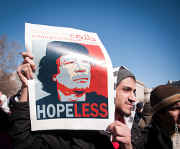
(Photo by Crethi Plethi)

Libya (ODM/MNN) ― On February 20, the first elections since the overthrow of Muammar Gaddaffi were held in Misrata, Libya's third-largest city.

Reform is coming slower than the revolutionaries want, but the National Transitional Council says elections served as a model for the June vote that will usher in a 200-member national assembly. The assembly will name a new government and select a panel to write a constitution.

In the meantime, there is a sense of freedom in Libya, which seems to be giving Christians new determination. An Open Doorsworker, who wants to stay anonymous, says, "The Christians in Libya are more open right now; they have more courage to share about their faith. But of course the freedom is still minimal."

At the beginning of 2011, before the revolution, Open Doors estimates there were about 180,000 expatriate Christians living in the country and just 180 indigenous believers. The vast majority of the Libyans are Sunni Muslim. However, as the dust settles post-revolution, it seems that many expatriates left the country, significantly reducing the numbers of believers.

The hostilities some Christians are reporting stem from racism connected to politics. "Sub-Saharan Africans have said that they are discriminated more openly. On the streets they hear people saying bad words to dark-skinned people, for example. Before the revolution, this didn't happen so strong and open", the Open Doors worker says. According to him, the racism has partly to do with the fact that Gaddaffi used sub-Saharan Africans to fight for him. As a result, members of the churches for the sub-Saharan Africans are trying to survive in an increasingly unfriendly environment.

Skepticism about the politics isn't helping. "Politicians are having a hard time at the moment. Nobody trusts them, and they can't do anything right in the view of the majority of the people. Nobody has any respect for them, and every decision is being criticized," the Open Doors worker says. "This might be understandable after so many years of oppression, but for the long run, this might be not a very constructive way of thinking for rebuilding the country."

Pray for all the Muslims that might be open to the Gospel, that they will meet Christians to help them. Pray for the expat churches that exist in Libya that they, even though it is forbidden, will find ways to reach out to locals.

SAT-7 programming responds to emotional toll of Syrian conflict

Syria (MNN) ― The physical cost of Syria's current state of violence has been great. Conservative estimates say that over 6,000 people have died during the last year's unrest. Still, most have so far avoided this fate. But no one has been able to escape the emotional toll the crisis demands.

As mortar shells and rockets fall on Homs, Syrians are asking why and how such devastation could occur. In response to this prolonged agony, SAT-7 programming is addressing how to cope with and respond to the events taking place.

SAT-7, a Christian satellite television service to North Africa and the Middle East, has certainly not been shy on the subject of Syria, or on comforting the nation's people. During difficult times, SAT-7 aims to transmit a message of comfort and encouragement. SAT-7 believes calling people to pray gives them a hope for the future that with God's power, can be better than today.

SAT-7 broadcasts a current events show called "Salt of the Earth." Recently, the program aired an episode about fears for Syria's future. The show host interviewed Bessam Kamel, a member of the General Secretariat of the Syrian National Counci. Kamel stressed the importance of being part of the solution to the problem. He also emphasized the priority of protecting religious minorities like Christians.

This was some comfort, but news broadcasts from other media outlets in the region have been showing images of people injured and dying. A LIVE SAT-7 broadcast of a sermon preached in Egypt spoke to the difficulty of understanding violence from a Christian perspective.

"We are called to beseech God to stop the spilling of blood, so that there will not be killing and victimization of others," the speaker charged. "And we should not be selfish and forget our brothers [and sisters] in Syria, for they are suffering too... As we pass through these difficult circumstances, we are called to be joyful."

Furthermore, in the series "The Revealer of Secrets", SAT-7 ARABIC is running a report called "Pray for Syria." It is running similar reports for Yemen, Egypt, Sudan, and Tunisia. The report begins with a background that familiarizes the viewer with basic facts about the country. This leads into a description of Syrian Christians' role and predicament in society.

"Christians live in a state of silence in the shadow of these circumstances. And as a result of this silence, incorrect concepts of Christianity dominate.... In spite of the spiritual chains and social barriers, the Word of God will continue. We pray for the Syrian people and the Church in Syria, that God will truly draw them near to Himself."