Showing posts with label mob violence. Show all posts

Thursday, February 16, 2012

20,000 Muslims Attempt to Kill Pastor and Torch Church in Egypt

By Jeremy Reynalds
Senior Correspondent for ASSIST News Service


EGYPT (ANS) -- A mob of nearly 20,000 radical Muslims, mainly Salafis, attempted recently to break into and torch the Church of St. Mary and St. Abram in the village of Meet Bashar, in Zagazig, Sharqia province.

St. Mary's Church in Meet Bashar, Egypt
According to a story by Mary Abdelmassih for the Assyrian International News agency (AINA), they were demanding the death of Rev. Guirgis Gameel, pastor of the church, who has been unable to leave his home.

AINA said nearly 100 terrorized Copts sought refuge inside the church, while Muslim rioters were pelting the church with stones in an effort to break into the church, assault the Copts and torch the building. A home of a Copt living near the church and the residence of a church staff member were torched, as well as three cars.

AINA said the mob demanded the return Rania of Khalil Ibrahim, 15, to her father. 

She has been held with the Security Directorate. Christian-born Rania had converted to Islam three months ago after her father, who had converted to Islam two years ago and took custody of her.

AINA said she had disappeared from the village last Saturday, after claiming to go shopping. According to Gameel, she had a disagreement with her father, who had arranged a marriage for her with a Muslim man.

Her father, Khalil Ibrahim, went to the police on Saturday and accused the priest of being behind her disappearance, and said she had gone to live with her Coptic mother.

AINA said a Salafi mob of 2000 went to the priest's home and destroyed his furniture and his car, surrounded the church and pelted it with stones. They demolished a large section of the church fence. In the evening security forces announced that they had found Rania in Cairo and that she was not abducted by Christians. She was brought to the police station in Meet Bashar.

“After hearing this news yesterday everyone was relieved,” AINA reported Coptic activist Waguih Jacob said.

He added, “However, the Copts noticed that the Muslims did not completely disperse, but were hovering in all streets.”

AINA said the few security forces stationed in front of the church were dismissed as the village seemed to return to peace.

But the mob became more angry when they heard that Rania refused to go back to live with her father, and returned in much greater numbers.

AINA reported some Coptic eyewitnesses said a number of Muslim villagers tried to prevent the Salafis from assaulting their Christian neighbors, and some stood as human shields to protect the church until security forces arrived.

Bishop Yuaness, Secretary to Pope Shenouda III, said that they have been in contact with authorities “at the highest levels.”

AINA said Marian Malak, a Coptic member of parliament, contacted Egyptian Prime Minister El-Ganzoury, who ordered sending reinforcements to contain the crisis.

Bishop Tadros Sedra, of Minia el Kamh and Zagazig Coptic diocese, said that military and police forces have arrived in great numbers and have dispersed Muslims from outside the church and Gameel’s home. He confirmed that security will stay in the village for at least two weeks.

AINA said US-based Coptic Solidarity International, issued a press release strongly urging the international community, through the United Nations Human Rights Council, to appoint a special rapporteur for the Copts in Egypt. That particularly in light of the recent evictions, property confiscations and attacks against Copts.


Jeremy Reynalds is Senior Correspondent for the ASSIST News Service, a freelance writer and also the founder and CEO of Joy Junction, New Mexico's largest emergency homeless shelter, http://www.joyjunction.org He has a master's degree in communication from the University of New Mexico, and a Ph.D. in intercultural education from Biola University in Los Angeles. His newest book is "Homeless in the City."


Additional details on "Homeless in the City" are available athttp://www.homelessinthecity.com. Reynalds lives in Albuquerque, New Mexico. For more information contact: Jeremy Reynalds at jeremyreynalds@comcast.net.

** You may republish this story with proper attribution.

Saturday, January 21, 2012

Muslims in Egypt Attack Church, Burn Christian Homes and Shops

By Michael Ireland
Senior International Correspondent, ASSIST News Service


CAIRO, EGYPT (ANS) -- A Muslim mob yesterday (Jan.19) attacked Copts in the Upper Egyptian village of Rahmaniya-Kebly, Nag Hammadi, Qena province, destroying and torching their homes, straw huts and shops, while chanting Allahu Akbar.

Mary Abdelmassih, an Egyptian journalist writing for the Assyrian International News Agency (AINA) --www.aina.org  -- says no one was reported killed or injured. According to reports, security forces were present but did not intervene and the fire brigade arrived 90 minutes late.

AINA reports that an eye-witness said a straw hut belonging to a Coptic Christian was torched to clear the area for a mosque. There are more than 300 mosques in the village and one church.

AINA says that according to Coptic residents, the reason behind the violence was the parliamentary elections. The Salafists wanted to prevent Copts, who number more than 50 percent of the inhabitants (20,000), from voting because they intended to vote for two moderate Muslims and not the Salafi candidates. "No Copt from Rahmaniya-Kebly was able to vote today, so the Salafists will win the elections," said a witness. Copts were forcefully prevented from voting.

AINA goes on to say that US-based WAY TV, which covered live yesterday’s Rahmaniya attacks, called commander Osama, head of security at Rahmaniya, who said "everything was OK" -- despite live pictures on TV of the burning homes.

AINA reported that Joseph Nasralla of WAY TV spoke to security and made them aware that the videos of the fires were being broadcast in the U.S. and Middle East, which caused the immediate dispatch of security vehicles. By late evening the violence had stopped.

In another incident yesterday, a large number of Salafis and members of the Muslim Brotherhood entered the Abu Makka church, in Bahteem, Shubra-el-Khayma, Qaliubia province, and informed the congregation that the church has no license and no one should pray in it. One Muslim said the 1,300 square meter church would be suitable for a mosque and a hospital.

AINA said Bishop Marcus of Shubra el Khayma was scheduled to inaugurate the incomplete church and celebrate the Epiphany mass in the evening.

However, according to Coptic witnesses the Bishop cancelled the festivities, which angered the congregation, who were not informed of the reason. A witness said the Muslim promised to be back Friday.


** Michael Ireland is the Senior International Correspondent for ANS. He is an international British freelance journalist who was formerly a reporter with a London (United Kingdom) newspaper and has been a frequent contributor to UCB UK, a British Christian radio station. While in the UK, Michael traveled to Canada and the United States, Albania,Yugoslavia, Holland, Germany,and Czechoslovakia. He has reported for ANS from Jamaica, Mexico, Nicaragua, Israel, Jordan, China,and Russia. Michael's volunteer involvement with ASSIST News Service is a sponsored ministry department -- 'Michael Ireland Media Missionary' (MIMM) -- of A.C.T. International of P.O.Box 1649, Brentwood, TN 37024-1649, at: Artists in Christian Testimony (A.C.T.) International where you can make a donation online under 'Donate' tab, then look for 'Michael Ireland Media Missionary' under 'Donation Category' to support his stated mission of 'Truth Through Christian Journalism.' Michael is a member in good standing of the National Writers Union, Society of Professional Journalists, Religion Newswriters Association, Evangelical Press Association and International Press Association. If you have a news or feature story idea for Michael, please contact him at: ANS Senior International Reporter

** You may republish this story with proper attribution.

Wednesday, January 4, 2012

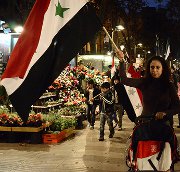
Pressure heats up for Assad

(Cover photo by Saleem Homsi.
 Story photo by Teresa Forn.)

Syria (MNN) ― Despite an ongoing investigation thrusting members of the Arab League right into the heart of the fighting in Syria, violence has not let up.

The Arab League has been threatening Syrian president Bashar Assad for months now and is finally in Syria assessing the situation. Since members of the League have been in the volatile nation, fighting has not only continued, but the Arab Parliament has actually advised the League members to leave Syria for their own safety, according to BBC News.

Tom Doyle with E3 Partners has been providing updates on the Syrian conflict since it began in early 2011. Doyle says now, "It is bloody, and we keep getting reports from our E3 leaders in Syria that say some of the things happening in broad daylight in the middle of the streets are unspeakable."

The Local Coordination Committee, an umbrella group of activists, has reported that since December 21--less than two weeks ago, 390 people have been killed. The total death toll throughout the clashes between Assad's regime and civilian rebels has surpassed 5,000.

Despite the treacherous outlook, the international response to the violence is growing stronger by the second. French president Nicolas Sarkozy reportedly demanded that Assad step down in a statement he made yesterday. On Monday, Israeli Defense Ministrer Ehud Barak went as far as to say that Assad only had "a few weeks" left to control Syria, according to Agence France-Presse.

Even as violence continues, Doyle agrees that Assad cannot hold on much longer.

"There's a Sunni majority within the country, and they've always despised the whole Alawite control of the government. But I think it's all come down to that fight. And I really just don't know if Assad is going to be able to hang on through this.

There is so much international outcry, and if there's international assistance, I think his days are over."

The Alawites, an Islamic sect in Syria, make up a mere 20% of the nation, says Doyle. Assad's family is Alawite, but the majority of the population is made up of Sunni Muslims. Those facts combined with extreme international pressure could push Assad to boiling.

There can only be speculation as to what will happen then.

In the midst of the turmoil, E3 Partners has seen tremendous church growth. The ministry has repeatedly heard of Muslims knocking on the doors of Christians in the night, looking for someone who is not taking part in the violence. 

Muslims all across the Middle East are hungry for Truth, says Doyle, and many have already come to Christ underground.

Fervent prayer is needed in Syria. Pray for boldness for the church, for guidance and stability for the nation, and for heart change among the people. You can also get behind specific church leaders working in Syria at the E3 Partners Web site. 

Saturday, December 3, 2011

Muslim Extremists Destroy Lives, Church Buildings in Nigeria

One woman, three girls killed as northeastern states of Yobe, Bauchi heat up.
By Obed Minchakpu
 
The blood-stained home of Samaila
 Darabo in Gargari, Bauchi state.
(Courtesy Compass News Direct)
GEIDAM, Nigeria, December 2 (Compass Direct News) – In Nigeria’s increasingly dangerous northeast, Muslim extremists in this town in Yobe state helped members of the Islamic terrorist sect Boko Haram destroy five church buildings last Saturday (Nov. 26), while previously in neighboring Bauchi state Islamic radicals killed four Christians, including three girls.
 
Boko Haram members’ weekend rampage in the Yobe state town of Geidam destroyed all Christian-owned businesses, as area Muslims pointed them out for the sect raiders, according to local Christians. Five of the eight church buildings in town were ruined, and the violence displaced about 700 Christians, sources said.
 
When Compass visited the town on Tuesday (Nov. 29), only two of the eight pastors in the town remained. The other six pastors and their families had fled.
 
The Rev. Amos Ajeje, 48, vice chairman of the Geidam chapter of the Christian Association of Nigeria, told Compass that local Muslims assisted Boko Haram members in carrying out the attacks on Christians. He said the attack by Boko Haram, which seeks to impose a stricter version of sharia (Islamic law) than that already in place in northern Nigeria and expand it to the rest of the country, had driven all other Christians from town.
 
Ruined interior of the Deeper Life
 Bible Church in Geidam, Yobe state.
(Courtesy Compass News Direct)
“There are no more Christians in this town,” Ajeje said. “All shops belonging to Christians have been looted and then destroyed by these Muslims. Many of these Christians who fled into bushes when the attack was going on have never returned.”
 
The Rev. Bitrus Mshelbara, pastor of the Church of Christ in Nigeria (COCIN) at Geidam, confirmed that local Muslims led the Boko Haram members to the church buildings and Christian-owned businesses.
 
“The Muslims in this town were going ‘round town pointing out church buildings and shops owned by Christians to members of Boko Haram, and they in turn bombed these churches and shops,” he said.
 
Destroyed in the attack were worship buildings belonging to St. Patrick’s Catholic Church, Emmanuel Anglican Church, Living Faith Church, Deeper Life Bible Church and Cherubim and Seraphim Church. These buildings were located in the Geidam areas of Kafela, Akodiri Street, and Low-Cost Housing Estate.
 
“Boko Haram members came in a convoy of cars last Saturday at about six o’clock in the evening,” Ajeje said. “They were well-armed. They attacked the police station. They exchanged gunshots with the police and overpowered them. After this they broke into the First Bank and removed money there, before they were joined by Muslims here to bomb churches. That is how the five churches were destroyed.”
 
Because of the attack, the three remaining churches in town were unable to hold worship services on Sunday (Nov. 27), he said.
 
“Our church members who ran away when the attack took place could not come back, so it was not possible for us to conduct worship services on Sunday,” Ajeje said. “Our fate is hanging in the balance because we do not know what will happen next.”
 
Pastor of an Evangelical Church Winning All (ECWA) congregation of about 120, Ajeje added that Boko Haram members set fire to a local government building and the town’s high court.
 
Ajeje’s ECWA church building was among the three remaining in Geidam.
 
“We thank God that no one was killed, but I must say that this has brought fear to Christians since we are a minority here,” he said. “In all we just have about 700 Christians in the town, and all are dependent on their small businesses to survive. With these businesses now destroyed, how will they survive if they remain here? I guess that must be the reason they have not returned since fleeing the town on the day of the attack.”
 
Mshelbara told Compass that his COCIN church building is standing only because of the pleas of a Muslim neighbor boy.
 
“My church was spared because of a son of my Muslim neighbor who was among the local Muslims that accompanied Boko Haram members as they burned down churches,” Mshelbara said. “He pleaded with them not to set fire on our church because burning down our church will affect their house, as their house shares walls with our church building. More so, our neighbor the Muslim was sick and was in his house at the time. Based on the pleas of the young Muslim man, our church was spared.”
 
At Emmanuel Anglican Church, Mshelbara said, a church program was underway at the time of the attack.
 
“But they were alerted, and they all escaped by jumping over the fence constructed around the church premises before Boko Haram members got there – you can see the destruction yourself,” Mshelbara said, pointing at the charred church building.
 
Christians at the Deeper Life Bible Church in the Low Cost Housing Estate area also escaped, he said.
 
“Deeper Life members were holding an evening service, too, when the attack by Boko Haram was going on,” Mshelbara said. “They too were alerted, and they all escaped from the church before it was destroyed.”
 
Peter Mgoni, secretary of the Geidam ECWA church, said the Muslims looted shops and churches before burning them.
 
“Boko Haram is an anti-Christian movement out to establish sharia in Nigeria,” he said. “This is the reason they attack churches, just as they attack government institutions. They know that they cannot establish sharia without first crippling the government, and that is the reason they attack the police, after which they now come for us Christians by destroying our churches and businesses.”
 
Gargari Killings
In neighboring Bauchi state, 48-year-old Samaila Darabo called the members of his household together for the evening family devotion in Gargari village on Nov. 17. He led them in the reading of the Bible and prayer, and shortly afterwards they went to bed.
 
At about 2 a.m., he was suddenly awakened by his barking dogs. He stepped out of his room only to be confronted with bright lights from different directions around his compound. Stunned, he blindly pushed away part of the mud-brick walls closest to his room. Climbing over the fence and bolting out, he escaped to alert other neighbors about a raid on the village.
 
The assailants were later identified as local Muslim extremists who came in groups to attack the village on Nov. 18. Darabo’s escape and warning are credited with saving the entire community except for some family members in three residential compounds. Darabo lost his 12-year-old daughter, Laraba Samaila, and his wife, Rifkatu Samaila. She was 48.
 
In another home, the Muslim extremists killed 11-year-old Gloria Zakka and 7-year-old Martha Zakka, daughters of Zakka Jumba, Darabo’s brother. After attacking these and another residential compound of the Christian community in Gargari in the Bogoro Local Government Area, the assailants withdrew.
 
Six other people were injured in the attack, including relatives of Darabo’s other brother, Harunna Jumba.
 
“I climbed a fenced wall just beside the door to my room, and in the process a part of the wall collapsed with me,” Darabo said. “The collapsing wall forced some of the attackers to move away from the spot, and this gave me the opportunity to escape.”
 
After alerting neighbors, they quickly contacted soldiers in nearby Gobbiya village, he said.
 
“By then, the attackers had already left, having set fire on my house and that of my brothers,” he said. “They killed my wife, Rifkatu, and my daughter, Laraba. They also attacked some of my family members with machetes and shot them too. My brother had two of his daughters, Gloria and Martha killed. That is the grave where we buried the four of them you are seeing over there.”
 
Receiving hospital treatment from injuries sustained in the attack were 2-month-old Matwi Mathias, Esther John, Rebecca Zakka, Yelshi Zakka, Sarauniya Samaila, and Mummy Zakka.
 
Aminu Gida, 38, told Compass that he was awakened by sounds of gunshots and the cries of children and women that night.
 
“The men who attacked us are Muslims whom we know live just across the river north of our village of Gargari,” Gida said. “They came in groups that night and started the attack from the western part of the village.”
 
Yakubu Lawal, 58, said attacks on Gargari village began as far back as 1991 and have become more regular. This year alone, he said, the community has been attacked about four times.
 
“The first attack was on June 28, when at about 10 a.m. six Christian girls from the village who were returning from their farms were attacked by a group of Muslim attackers,” he said. “They took one of the girls away and raped her in turns before leaving her to die in the bush.”
 
The girl survived and was found days later, he said. Two young Christian men were also attacked the same day while working on their farm, and the assailants also stole two cows, Lawal said.
 
The second attack on the village, Lawal said, came on July 6, when seven members of the community returning from Bogoro town were ambushed by another group of Muslims.
 
“Three of them were killed – Yohanna Godiya, Appollos Godiya and Rhoda Gashon,” Lawal said. “The remaining four were injured in the attack – the wife of the village pastor, Mrs. Talatu Karmus, and Rahila Gashon and Ruth Gashon. The fourth victim of the attack was a 6-month-old baby.”
 
On Oct. 8 at about 8 p.m., four members of the Christian community were returning from the neighboring village of Gobbiya when they were attacked by another group of Muslims, he said. They escaped unhurt, but before the Muslims withdrew from the village they set fire to the house of Joseph Ezekiel.
 
Ishaku Gambo, 58, pastor of the village COCIN congregation, told Compass the attacks have crippled worship. The church had an average attendance of about 200 at Sunday services; now only about 105 show up, he said.
 
“The reason is that some members have to keep watch over the village while church service is going on,” he said.
 
Gambo urged the Nigerian government to urgently find a lasting solution to attacks on Christian communities in northern Nigeria.
 
Another Village Attacked
In neighboring Tudun Wada Gobbiya Kazar village, Christians have been forced to flee, with more than 60 residents now living in Gobiyya town as displaced persons, Christians said.
 
Tudun Wada Gobbiya Kazar village was last attacked on Oct. 1, when its Christian village head, Bitrus Ramako, was killed. A member of the local ECWA in Gobbiya, Ramako was killed at about 10 p.m., area Christians said. Muslim assailants set fire to his house after killing him and then raided the entire village, forcing the Christian villagers out, they said.
 
Solomon Jingina, 41, pastor of the ECWA Church in Gobbiya, told Compass the displaced Christians are living outside their village without any form of assistance. Jingina said there is an urgent need for the Nigerian government to intervene.
 
“These 60 members of my church are now homeless, and they cannot return to the village because of the incessant attacks on them,” he said. “I want to appeal for the Nigerian government to address this problem of attacks on Christians, as this is threatening the peaceful co-existence of the people of this country.”
 
 
END
 
**********
Copyright 2011 Compass Direct News
 

Wednesday, November 30, 2011

Some violence reported in Congo elections; the worst is yet to come

Congo-Kinshasa (MNN) ―The nation's fears of election violence in Democratic Republic of Congo went mostly unrealized during Monday's and yesterday's polling.

There have been reports of gunmen at polls. As many as five people may have died on Monday, but the outcome could have been far worse.

President of Grace Ministries Sam Vinton says there have been reports of some skirmishes, but nothing as significant as the events that often surround African presidential elections.

"There's been no violence in the immediate areas where most of our churches are located," remarks Vinton, who says churches are praising God for the relative peace.

Still, the peace that has been characteristic of the last few days may only last so long. Vinton says, "The problems may [arise] when they begin announcing the count of the votes."

Many have speculated about various coups and scenarios that may take place if Joseph Kabila is not reelected as president.

Vinton disagrees. He says it's unlikely that a new president will actually change the political climate of Congo. He doubts very much that any new president will change the situation for Christians.

That's good news in the long-term. Still, immediate election violence is expected, according to missionary correspondents in Congo, says Vinton.

"Right now there are only 3 of 11 candidates who have any hope of winning." Vinton explains that violence between supporters of those three candidates is especially likely when votes are counted.

When will the count happen? Vinton says, "They don't expect to hear anything until next Monday."

Election disputes could easily affect ministry. Fighting would cause medical facilities to shut down, keep people from work, and stop people from traveling where they need to go. Believers are praying for peace to continue regardless of the election results.

Vinton asks for prayer throughout the next week in particular. Pray that Christians would lead the way in peace, and that people may be able to see the Prince of Peace shining through them. Pray that Christians would be good examples of integrity and of Christ's love for all during this transition, whatever violence may come their way. 

Tuesday, September 6, 2011

Christians in Pakistan speak up to stop violence in Karachi

‘Karachi is burning,’ says one Christian leader

By Ashfaq Fateh
Special to ASSIST News Service


KARACHI/LAHORE, PAKISTAN (ANS) -- Karachi is an economic hub, seaport, and the largest city in Pakistan, as well as the capital of the province of Sindh.


The never-ending violence in Karachi
The city, which has an estimated population of 13 to 15 million, while the total metropolitan area has a population of over 18 million, is home to a variety of people of different religions and ethnicity, and was once called “A city of peace and lights.”

But, for the last few years, the crime rate has been mounting with every passing day and over the past six months, due to various kinds of crimes, thousands of innocent people have been killed.

The Pakistan People’s Party (PPP), Mutihida Qumi Movement (MQM) and the Awami National Party (ANP), are the main parties in the Sindh Assembly and all three are the rulers.

However, there is no letup in violence and killings and all three parties are blaming each other, but still violence is growing. The writ of the local government is no more in the city and non-state actors are gaining power.

Pakistanis are worried about what is going on in this economic capital. The army busy is fighting against terrorism, while the government is struggling to eradicate poverty, resolve the power crises when electricity goes out for hours at a time, and improve social services.
However, the ethnic, sectarian and street crimes are occurring.

Atif Jamil Paagan addressing the rally (Photo: Ashfaq Fateh)
Finally, Christians, opposition parties, civil society and Islamic religious groups are raising voice to find ways to stop killings in Karachi.

One is Mr. Atif Jamil Paagan, a Christian leader and central Chairman of Pakistan Minorities Democratic Movement (PMDM), has now given a nationwide call during a rally at the Lahore Press Club to the people of religious minorities to march peacefully demanding to “restore peace” in Karachi to “save Pakistan” on September 03, 2011.

Addressing the rally, Mr. Paagan said, “Karachi is burning. In last six months, over two thousand innocents have been killed in target killings. Street crimes, kidnapping for ransom, robbery, land grabbing and many other server crimes are on rise.

“The key players in the legislative assemblies are part of the government and besides the ‘blame game’ nothing is happening. Karachi a backbone of the country and Pakistan’s economy is at stake. The bloodshed is on rise and Pakistan People’s Party (PPP), Awami National Party (ANP) and the Mutihida Qaumi Movement (MQM) are not serious. Former Home minister, Dr. Zulfiqar Mirza, has given the details of people involved in Karachi violence but the government is silent and making no progress to stop violence.”

Protestors at the rally (Photo: Ashfaq Fateh)


He went on to say, “Today Hindus, Christians, Sikhs and Dalits appeal the President and Prime Minister of Pakistan to take urgent action to stop the killings of innocents in Karachi and restore peace. Reconciliation and peace is very important for the prosperity of Pakistan.”

Rasheed Jalal, District, President Pakistan Muslim League (Nawaz) for the minorities wing said, “Religious minorities sometimes feel that their sufferings are bigger than others, such as persecution for their faith, violence, denial of basic rights to Christians and other religious minorities.

“Many who are arriving in Lahore from far flung areas during heavy rains, Christians and other religious minorities have shown that despite all of these issues, they express solidarity with their countrymen/women at a time when they are being killed”

The call at the gathering was well responded to by the religious communities of Hindus, Dalits, Sikhs, civil society members, and Islamic peace building groups.

The rally began at the Railways Servant Quarters and ended up at the Lahore Press Club. The demonstrators were holding the flags of PMDM and carrying cards demanding the government to stop debating non-issues and restore lasting peace in Karachi.

Part of the rally in front of the Lahore Press Club (Photo: Ashfaq Fateh)


An ANS-Pakistan team covered the whole program at which Munir Mall, a worker with PMDM and the organizer of what was called the “Karachi Peace rally” told ANS, “The rally is a message to the government and anti-state elements that Christians and other religious minorities are well aware of the problems of the country and cannot remained silent. Today, hundreds of people, including men, women, children who belongs to different faiths, are demanding with one voice, ‘We want peace in Karachi.’”

Minorities have dedicated September 11, 2011 a day of prayer to express solidarity with people of Karachi. Special peace prayers are to be said in churches, temples and other houses of worship and candles will be lit in memory of what were called the “Karachi martyrs.”

The demonstrators raised slogans such as, “We want Peace in Karachi,” “Save Karachi,” “Save the nation,” “May peace be in Karachi,” “May peace be in Pakistan,” “Long live Pakistan,” “Pakistani minorities are the sons and daughters of the soil,” as well as many others.

ANS observed a big national media attending the event including print and electronic were present to cover this great initiative of the Christians of Pakistan. The leading newspaper, including DAWN, Express Tribune, The Frontier Post, Jang Group and others, highlighted the PMDM rally on their main pages.

Ashfaq Fateh, 38, studied civic and human rights, at Pakistan's leading University, the Aga Khan University in Karachi. He has been working to promote peace, human rights and particularly for Christian's rights. He has also been working against the discriminatory laws prevailing in Pakistan. His wife, Rafia Salomi, is serving as deputy director for Society for Human Development, popularly known as Human Development Center, an icon of Christian's rights in Pakistan since 1984.

** You may republish this story with proper attribution.

Friday, August 5, 2011

Ramadan attacks hit, more expected


(Story photo by Chris Brown) [Cover photo by Joe Coyle]


International (MNN) ―Reports of violence and threats of violence have come from all over the Muslim world since the start of Ramadan on Monday August 1.

In Pakistan, at least 10 have been killed since the Muslim holy month began. A Singaporean news source reports that a sect of minority Muslims in Indonesia fear for their lives in the face of Islamic extremists during Ramadan.
Christians throughout the world are at high risk.

It's typical for violence to heighten during Ramadan throughout Muslim cultures worldwide, but the flare-ups have been worsening year by year. One expert on Islam told Mission Network News that there are two main reasons for this: religion and politics.

Fouad Masri, founder of the Crescent Project, says devout Muslims spend the month of Ramadan fasting daily, praying, chanting the Qur'an, reading the Qur'an, taking trips to the mosque, and proving their devotion to God. Masri attributes much of the violence to a sense of cleansing that some Muslims feel necessary during what's considered the holiest of months.

"Because it's a holy month, if you (as a Muslim) touch someone who is not Muslim, that defiles you," explains Masri. "Now the violence happens because you want to cleanse the society. These non-Muslims are probably eating while they're supposed to be fasting. You want to show God that you are so zealous for Him and for Islam, that you are willing to kill them or expel them from your community."

Masri says it is a matter of seeing impurity as external and religion as external, rather than an internal, heart devotion.
That's the religious aspect, but it doesn't seem to explain why violence would be increasing over the years. For that issue, the tables turn to politics.

"Islam is a political system," says Masri. "They need to take charge of the political structure, and as they see themselves losing in the political arena, they need to bring up political issues across the Muslim world--from Morocco all the way to Indonesia."

Unlike Christianity, says Masri, Islamic communities bring up more political issues as opposed to moral. "The whole system there is in upheaval, politically. So you have the mosque or the elders of the religion siding with one group or the other. In the recent decade, they've seen that there is the concept of jihad on the right, through terrorism--groups like al Qaeda who are propagating jihad more and more."

As the rift between Sunni and Shiite deepens, violence is increasingly used as a solution, as well. Masri says there are no verses in the Qur'an that allude to reconciliation, and "violence is an easy way to get rid of things. Communication, discussion, dialogue takes time."

The increase in violence is enough to cause believers in Muslim nations to lay low, and with good reason. They have often been the subject of extremists' cleansings or have been scapegoats for other matters during Ramadan.

Masri, who grew up during wartime in Lebanon, says that the Lord uses His people during Ramadan, as well as other times, to share the Good News.

"The way you share the Gospel, and your activities, change. But you find that the Holy Spirit opens more doors.
 Sometimes you'll be sharing the Gospel when bombs are flying. Or maybe there's a car bomb that explodes, and then you're able to minister to the neighbors and to the injured people," notes Masri.
The amazing thing, especially during Ramadan, is that many Muslims seem to be open to hearing the Gospel. They are drawn to the peace that characterizes the believers around them.

"So many times we look at the situation through temporal eyes, and we say, ‘Wait a second, there's violence. We should lay low. We should probably not share.' And suddenly, the Holy Spirit opens huge doors for us, maybe through these activities around us," says Masri. "The violence proves that Islam has not solved the human problem."

Pray that believers in Muslim nations would be bold this month. Pray for God to cause many to hunger for the Truth during Ramadan. Pray that those who are seeking another truth would find the only Truth.

For a full prayer calendar during the month of Ramadan, click here. 

Monday, August 1, 2011

Sri Lankan Church Bloodied by Mob Attacks

The homes of several Sri Lankan
 Christian were attacked in mob
 violence. (Photo courtesy of Uthavi)

Sri Lanka (MNN) ― Home destruction and violent beatings have Sri Lankan Christians on edge. According to Voice of the Martyrs, Canada, several attacks on Christians throughout Sri Lanka have taken place these last few weeks in an escalation of persecution.

A pastor was brutally attacked and beaten in the Ampara District on Sri Lanka's eastern coast after attending a meeting about land distribution. A Buddhist monk called the pastor and several others to the meeting on July 10.

During the meeting, the Christian pastor was brutalized by the monk and others there. The monk kicked the pastor repeatedly in his stomach and arms, causing serious injuries.

Then while the pastor was escaping to his home, his attackers followed him and verbally abused him and his family members.

Sri Lanka is predominantly a Buddhist country with 70% of the population following that religion. The Christian minority has experienced an increase in persecution since 2005, especially at the hands of militant Buddhists.

Another serious persecution case occurred in the Badulla District in southeastern Sri Lanka on July 19. That evening, a large mob of approximately 50 people assaulted five Christian families in their homes.

The mob hurled stones at their roofs and smashed windows using clubs and rocks. The terrified families fled into the jungles for protection from the angry mob.

Additionally, a grocery store owned by one of the Christians was destroyed and vandalized. The store owner was seriously injured in the attack.

There are reports of talk to force these families either to deny their faith or to leave the village.
Please pray for healing and strength for the persecuted Christians.

Ephesians 6:18-20 encourages us to "pray in the Spirit on all occasions with all kinds of prayers and requests. With this in mind, be alert and always keep on praying for all the Lord's people. Pray also for me, that whenever I speak, words may be given me so that I will fearlessly make known the mystery of the Gospel, for which I am an ambassador in chains. Pray that I may declare it fearlessly, as I should."