Showing posts with label cairo. Show all posts

Monday, September 2, 2013

You can help persecuted believers in Egypt

(Image courtesy Bible Society of Egypt)
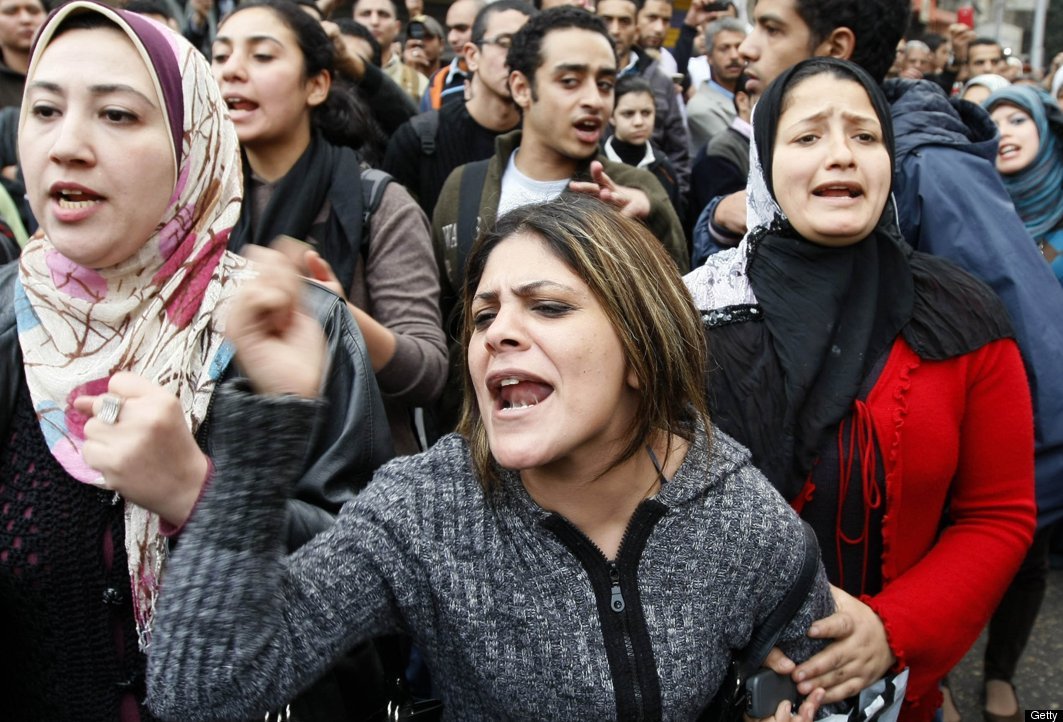
Egypt (MNN) ― Friday remains a dangerous day of the week in Egypt. Last week's Muslim Brotherhood call for protests drew some 10,000 people to Cairo alone.

There are protests in the streets, mass killings, and the burning of towns and villages over differing opinions of religion and politics. More than 1,000 people have died, and an estimated 3,500 people have been injured.

Christian Aid Mission, your link to indigenous missions, says there's a way you can help Egypt's Persecuted Church.

So far, Christian Aid says 80 churches, two bible bookstores, three Christian schools, and countless homes, businesses, and property have been vandalized or destroyed. Christian Aid supports several ministries that are sharing the Gospel and reaching out to unbelievers despite violent blows dealt specifically to them.

One of those ministries, the Bible Society of Egypt, watched two of their bookstores go up in flames during the first wave of attacks in mid-August.

“The attackers demolished the metal doors protecting the bookshops, broke the store windows behind them, and set the bookshops on fire," said Ministry Director Ramez Atallah.

"They did the same to many stores on those streets, as well as demolishing many parked cars.”

The Bible stores are located in the cities of Minia and Assiut in southern Egypt. Christians in those two cities have no other source of Bibles, and Atallah is determined to rebuild as the bookstores are in strategic locations.

In addition, the ministry is producing print and audio-visual Scripture selections to address the present crisis both for comfort and to challenge believers and unbelievers during this difficult time.

Egyptian believers are encouraging their distraught brothers and sisters not to seek retaliation in the wake of the attacks. Instead, they ask for Christians in other parts of the Middle East and around the world to offer their support and prayers.

Please pray for Egypt's violence to end. Pray that many will turn to the Lord for peace and accept Him as Lord and Savior. Pray protection for all Christian properties across the nation.

Thursday, December 6, 2012

Clashes build in Egypt over constitutional crisis


Egypt (MNN) ― The clash was inevitable. 

After days of protests where thousands of people vented their spleens over President Mohamed Morsi's power plays and the passage of a Sharia-based draft constitution, Morsi's supporters came out en masse. 

The two sides pelted each other with rocks, firebombs, and fought with sticks. There seemed to be little military or police intervention as the president's supporters fought with the opposition in the streets.

Despite the unrest, plans for a December 15 referendum on the draft will go move on schedule. Critics say the Upper House of Parliament rushed the draft through passage and there are growing concerns that it does not protect political and religious freedoms and the rights of women.

Christian Aid Mission Africa director, Rae Burnett notes that "most Egyptians are actually secularists. Then, of course, they have a wide Christian community which has been suffering for years but hasn't really said anything because they weren't killing them. They were just keeping them out of the mainstream of society."

In terms of trading one dictator for another, Burnett says under the old regime, "At least they were able to function as churches and do some evangelism as long as they didn't get into the Muslim community, but now they are really afraid because Sharia law is brutal. It's horrifying, and it's not something that secular Muslims want either because it infringes (totally) on their lifestyle." 

The more recent moves will change the face of Egypt for a long time. "Our situation here is getting worse day by day," reports an Egyptian ministry leader supported by Christian Aid. Indigenous ministries are growing more concerned each day as they watch radical Islam gain control in Egypt. 

In a communique shared Wednesday with Burnett, he wrote, [sic] "The expected war has begun. Right now, while I'm writing, there is a war between the brotherhood army and the protesters. It is expected for many to die in a sea of blood.

They attack them and call the victorious shouts of wars as if they attack enemies. And they're throwing gas bombs and fire on the protests. Also one of the Islamic elders call on satellite channels to take revenge from Christians as they are the reason for not applying Sharia until now. Situation is so dark and desperate. Please pray for us." 

Every day there is more and more evidence of what life could look like if Sharia takes over. Sharia calls for one thing: "Either conversion or death to the enemies of Islam, which is anybody who is not a Muslim. It's very scary because Egypt is a very large and influential country." Although Christians have already been suffering economic and educational persecution for many years, this is different. Burnett explains, "The native Egyptian ministries are really asking for our prayers and also our help, because they're really in financial difficulty."

Many Christians face economic and educational discrimination. However, Burnett says the people they help "have no means of support. They don't work (they're missionaries anyway), but even if they wanted a job, who is going to hire a Christian to work in an Islamic society? They [Muslims] don't do it."

The ministry leader shared that in an earlier demonstration, "Mobs were chanting, 'We want Islam,' and one demonstrator noted, 'It is our country, and those who do not like our law or decisions should leave.' [The demonstrator] then led the crowd to insult badly those who oppose Sharia, singling out and threatening Christians though they were not present"

Tens of thousands of Christians have fled the country due to the increasing danger of being attacked or killed, or their homes and businesses ransacked or set on fire. There have been numerous accounts of attacks where Christians face not only the physical violence of being attacked, but also being arrested for the attack. 

Burnett, however, says most of the Christians they're helping are determined to remain. "The people that we're helping don't have any buildings, they don't have any properties, (other than we've enabled them to buy a flat), and they are not denominational. They are independent, indigenous ministry leaders. They have no thought, whatsoever, of leaving."

Aside from helping them financially, Burnett says they're asking for prayer. How can we pray? "I would say, just the way I always want people to pray for me: that I would grow in strength of my relationship with the Lord, that I would have His will and His power to be light and life before people, that I would be willing to lay down my life."

The ministry leader adds, "There is widespread talk of continuing the revolution for democracy. Some have even declared they will not be satisfied unless they get rid of that president like they did before. We continue our work of discipleship and neighborhood evangelism, and we are so grateful for all of your prayer and financial support in these dangerous times. It is keeping us alive. Please relay our thanks to all who are helping us."

Tuesday, September 18, 2012

Believers demand response for anti-Christian actions

(Image courtesy of LiveLeak.com)

Egypt (MNN) ― Digital politics editor Chris Stirewalt said recently on FoxNews.com, "This is a very bad time to be an American in a Muslim country." Recent chats with missions organizations andan article from the Assyrian International News Agency (AINA) indicate that being a Christian in a Muslim country is even worse.

"It's not the people that are making the movies or the cartoons in the Western world that pay the price for their enjoyment of free speech," SAT-7 CEO Terry Ascott told MNN's Greg Yoder last week. "It is the Christians in the Middle East that bear the brunt of the reaction that inevitably comes."

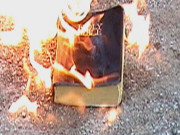
Case in point: a Muslim cleric named Abu Islam tore the Bible and burned its pages last Tuesday, September 11. His actions were met with loud approval from thousands of Muslims gathered to protest outside the U.S. Embassy in Cairo. The cleric's real name is Ahmed Abdullah.

"Next time I will make my grandson urinate on [the Bible]," Abdullah reportedly told an interviewer. "As the saying goes, 'an eye for an eye and tooth for a tooth,' and the starter is at fault."

A video shows Abdullah tearing the Bible. The AINA article contained a rough translation of the video's contents, shown below:

  • 0:02 "...the overwhelming Book, the Book of Truth and Peace. The place for these words and this book is over the heads because it is the real inspiration..." (He places the Koran on his head) voices chanting Allahu Akbar.

  • 0:30 He Says: "...message to the Egyptian Christians. Out of respect and politeness to the Egyptian Christians, we will not do the same like what they did to our God's book. We will be generous towards you today and say we will respect you momentarily. We will respect this book which is in the Arabic language.

  • 0:54 Demonstrators' chants "Coming, Coming O Islam" 1:09 Abu Islam holds another Bible and says: "This is the book the dog Terry believes in, as well as those dogs with him the Egyptian Christians in America."

  • 1:19 Abu Islam: "Today I can only TEAR IT APART. He starts tearing the Bible and throwing the leaves towards the mob, amid chants:"Allahu Akbar and Khaybar, Khaybar, O Jews, the army of Mohammad is coming."

  • 2:06 Abu Islam saying: "...to all the cross worshippers around the world, we will not keep quiet. Today, we tore it."

  • 2:13 A man in blue beside him burns the Bible raising it for everyone to see. Abu Islam: "Salamu Aleycom (Peace be with you)"and leaves, with mob chanting: "Khaybar, Khaybar, O Jews, the army of Mohammad is coming." "Governing, governing, O Koran." "Coming, Coming O Islam."

In the story carried by AINA, Mary Abdelmassih said multiple complaints were filed by Coptic organizations within Cairo. Dr. Mustafa Maraghy, law professor at Cairo University and chairman of the Coptic Coalition, filed a complaint citing Abdullah for "contempt of religion, disturbing public security and peace." A lawyer with the Copts of Egypt Coalition filed a complaint against Abdullah for damaging the Bible and for previous insults made to Christianity through books and his Islamic Nation TV channel.

Abdelmassih also stated that the Maspero Youth Union (MYU) had called upon President Morsi to "intervene immediately." Magdy Saber, an MYU spokesman, said officials should take action necessary to prevent trouble.
"If we condemn the file-makers…who live outside Egypt," he said, "we should also condemn this disgraceful act in Egypt, stressing the need to punish Abu Islam for his irresponsible actions."

MYU is a group of young Coptic Christians who played a key role in delivering information to the world following attacks on Christians last fall. On October 9, 2011, Christian protestors marching peacefully toward the television and radio broadcasting building near downtown Cairo were attacked by the army and an extremist mob. The attacks left 26 dead and wounded hundreds.

Pray for Egyptian Christians as violence spreads. Ask God to protect Christian ministries in this area.


Tuesday, February 14, 2012

Muslim government leaders play their hand

Egypt (MNN) ― Egypt is on a difficult path to change. 

Parliament spent its first week trying to settle in with challenges and riots taking place just outside the main chambers. The Muslim Brotherhood is expected to reveal the names of a coalition government as soon as it's asked to form a new leadership.

That move alone is causing some Christians concern. While in Egypt, we spoke with a community development ministry leader who was involved with a meeting last week with the Ministers of the new government.

For security reasons, we'll call him "Khalid." What he witnessed changed his optimistic view of what the new Egypt will look like for Christians. He says, "The Minister himself is a very Muslim guy with a thick beard and a stamp on his face, and two or three men with the same beard, and four or five veiled ladies. He was holding in his hands a necklace counting the names of God while he is leading the conversation between us."

Not only that, but "the General Assembly of the Parliament [wears] full beards. The president of the Parliament stopped one of the audiences because this guy tried to read the Quran in the Parliament." Khalid went on to say that "there is a verse in the Quran that says, 'If someone reads the Quran, leave him until he finishes the verse.' So he has to leave him...and another guy asked for (Muslim) prayer for the whole [assembly]."   

Never before has a Muslim call to prayer been answered inside the Parliament building during a session. "For the first time in Egypt, we see this. Because of this, we know that lots of suffering will come from this--especially because the leadership says [they will begin using Sharia] to rule the country."

When asked when Sharia was likely to be implemented, Khalid wryly noted, "Now, there are lots of poor people [who steal to eat]. They can't cut the hands off of millions of people, so they said that when we [recover more economically], they will [implement Sharia]."

For community development groups that are noted for their open Gospel content, what will the future hold? It could become very difficult for their teams. With the government narrowing focus on Non-Government Organizations, it's possible they're already under scrutiny. However, that won't stop them. Khalid says, "The Bible said the Spirit inside us will lead us to pray. I think we will ask the Lord to give us wisdom and to give us [strength] and to help us."

Thursday, February 9, 2012

Whose Revolution is it?

Egypt (MNN) ― Everybody loves the underdog. That's part of the magnetic draw of Egypt's ongoing Revolution. 

There's a thrill of an uprising, the rooting for progress and the inevitable triumph should the downtrodden succeed in changing anything as seemingly immovable as government.

Pictures of nearly nightly protests reveal something unique in Egypt's demand for change. Church pastor Fawzi Wahib explains, "65% of our population is under the age of 25. So, most of those you see them interviewing in the media--on TV and in the newspaper--are over 50. There is a huge gap and misunderstanding, IF there is any understanding between the two generations."

Wahib is a well-known face in the Revolution, even laboring under  the nickname, "Pastor of the Revolution," because of a message he gave in the early part of uprisings. He says that while the revolution is for Egypt, it's being led by the cream of the crop. "Those who consider themselves wise and try to make a plan for the future, are missing the point entirely. 

These people of 25 and less have seen the dream come close to their hand, but all of a sudden, somebody came and took it away from them. They are willing to die to get this dream back and not let anybody take it from their hands."

Anger and frustration over not being heard and demands not being met has led to more waves of young patriots trying to effect some kind of change for the future of a sustainable country. "I think no one is going to stand against these waves of young people seeking freedom."

Wahib goes on to say that the passion shared for a new Egypt is contagious. The young adults want a country that will live up to its own public relations. Those confronting the police lines this week doubt the direction of the leadership and promises of the government. They're now calling for early elections, and "next week, on February 11, there is a call for a civilian's strike on the whole nation."

Students leading this movement represent all eight universities in Cairo. "Now you get the best educated people that are connected with real life who are leading this movement, and it gives you a clue about who is leading and where we are heading."

Among the more obvious demands: a civilian government and a plan to tackle a 35% unemployment rate (for those under 25) and growing economic distress. It all boils down to hope. Wahib said that desire was palpable on the "Day of Rage" in 2011 when he was called up on the stage.

He knew one misspoken word could destroy not only him, but also the credibility of Christians in the society. Suddenly, Isaiah 61:1 came to mind.   
The Spirit of the Sovereign LORD is on me,
   because the LORD has anointed me
   to proclaim good news to the poor.
He has sent me to bind up the brokenhearted,
   to proclaim freedom for the captives
   and release from darkness for the prisoners.

The crowd responded enthusiastically when he explained the freedom of hope. "'You know why Jesus came? He came to set the captive free. How many Egyptians are still captive until today? Jesus is still with us in the Square, because He wants to set the captive free!' Now, if you are totally politically motivated, then you understand the message."

Moments like that opened a lot of opportunities for the Church body to engage the community. Wahib says the whole team of pastors knew what the potential was. While they didn't plan a specific outreach campaign, they were poised to respond. First, they opened their doors to those who needed respite. "The Church became like a refuge. Muslims love to come into the church and sit. They find peace. Over all this, we had hundreds of contacts where we shared the Gospel without telling them it was evangelism."

Then, they responded with a field hospital for the wounded who were protesting right outside the church compound on Tahrir Square. That has been the pattern for over a year. It's obvious the Holy Spirit is moving. Hundreds are receiving visions and dreams and coming to Christ that way. The biggest issue now is how to disciple the hundreds that are coming. 

Actually, the bigger "problem," says Wahib, is what they'll do with the thousands they're expecting to see before Revolution ends. Wahib says the church leadership is also part of the group that was getting a strong message that pointed to unity and revival.

Revival, Wahib says, begins in revolution.

Wednesday, February 8, 2012

Egypt's fight for Freedom takes on a new angle

(Photo courtesy SAT 7) Prayer
meeting at the Cave Church.
Egypt(MNN) ― There are a lot of headlines proclaiming the fury of Tahrir Square, set in the heart of downtown Cairo.

"Revolution" is on people's lips, but a new word is joining that plea for the freedom of Tahrir, and that is "Revival."

On our first night in Cairo, we met with a Coptic Church partner in the basement of a ministry facility where he'd just wrapped up some teaching. His first answer to our questions about the riots was: "The barrier of fear has been demolished."

That's quite a different assessment of what's going on from the lips of others. There's word that people are angry over their revolution being stolen by the Islamists; people are full of despair because the city is still in chaos. Many of the images we see about Cairo right now are full of despair, fear and defiance.

Yet, this church leader insists there is something significant on the wing. Through a translator, he announced, "There is a big revival happening in the Orthodox Church -- not only in the Orthodox Church, but in all of the Egyptian Church."

That seems to run counter to other reports of a mass exodus of Egyptian Christians seeking asylum anywhere that seems safer. He answered that question with this hope: "The Lord is using the people, the congregation, more than the leaders in this revival."

The movement began to coalesce two years ago when a call to unity started to resonate across denominational lines. "The start of this revival was a prayer meeting where the people gathered together to pray seeking this revival. People from different churches gathered together to pray together."

Then, he says, in late 2010, "Just before the Revolution, God was telling us that something awesome was going to happen in Egypt. Although we are in different areas as leaders in the church, the Lord was sending the same message to everybody."

That message was this: "By the end of 2010, something great will happen." That was based off of Jeremiah 46 and Daniel 7 and a promise from God to allow Christians to take over the land. Indeed, God fulfilled that prophecy, but not in the way you might think.

In the first 20 minutes of 2011, a suicide bomber attacked The Saint's Church in Alexandria. At least 21 people were killed and 70 hurt. Then, "Sometime later, the 25th of January, the Revolution started. We saw the incidents happening, but we were telling ourselves that something spiritual was going to happen…a big spiritual event."

As the events unfolded, the church leaders who had given themselves to prayer, unity and revival began to teach confidently. Their boldness was picked up by the congregations who then began to take prayer much more seriously. 

That led to a prayer meeting. At a time of emergency, this church leader says, "About 50,000 people gathered together in the (Cave) church to pray for 12 hours."

Revival began to be the cry of their hearts. This Coptic Gospel partner along with others who were of like mind since the movement began two years ago also spent time teaching about the elements of revival to their congregations, emphasizing repentance, unity, humility, understanding, and a return to the authority of the Bible, among other things.
He also shared that he believes the change that will bring true liberty to Egypt won't come from the political side of things. It will come from the spiritual revolution.

Healing has begun in the freedom in Christ among Christians. It gives them the strength they need to persevere, because, as this pastor goes on to say, there are still a lot of obstacles to overcome. "There were many things against the church itself. Churches were being burnt, but the Lord has poured in an overflow of love. The outward thing that happened was that people, although they felt threatened by others, they went in and joined and started giving love to others. They even participated in Tahrir Square during the Revolution."

The story of Tahrir, or Freedom in Egypt, is ongoing. But, says this follower of Christ, it's not for Egypt alone. He's hoping Egypt will lead a global movement by her example. "I believe what happens here is transferring Egypt to the outside world."

Friday, January 13, 2012

Christians hold worship service in Tahrir Square to kick off New Year

Egypt (MNN) ― Thousands of Christians started out the New Year taking a risk in Egypt.

Tahrir Square in Cairo has been the hub for all sorts of protests and even atrocities in Egypt over the last year. But a church near the Square was ready to turn it into something else.

A New Year's Eve praise and worship service was scheduled to be held at Kasr El Dobara Church near Tahrir Square. The church body was hoping to better "share with those who need to understand our hope more fully." What better place to go than to the nearby Square?

According to SAT-7, a satellite television service for Christians in the Middle East and North Africa, between 5,000 and 10,000 people joined the worship service as it moved from the church to the Square. The congregation calmly proceeded down the street holding candles and singing to God.

All went peacefully as Christians and non-Christians alike gathered to pray and call out to God. At least one believer was confident the event would be peaceful, noting, "It'll be peaceful because we've been praying a lot for this."

Thousands more across the nation were able to gather to pray for the country when SAT-7 was able to broadcast the service via satellite television.

Egypt remains in turmoil, but many have now been alerted to the words of Christ. Pray for many to turn to the Lord as a result of this event and other SAT-7 programming.