Showing posts with label Jordan. Show all posts

Monday, October 1, 2012

Jordan may be next for Muslim Brotherhood

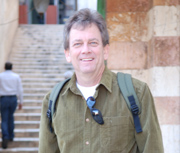
Tom Doyle with e3 Partners says Jordan could
 be next on the Muslim Brotherhood hit list.

Jordan (MNN) ― The Muslim Brotherhood has seen incredible growth over the last two years as they've had a hand in government overthrows in Egypt, Syria and Libya. The extremist organization is involved in other nations, as well. Now, Jordan is being threatened.

According to reports, Jordan's Muslim Brotherhood is threatening Jordan's King Abdullah. Reports suggest the king has until October to agree to their demand of transforming that nation into a constitutional monarchy, or face an Arab Spring street pressure.

Middle East expert with e3 Partners Tom Doyle says this is troubling. He says Israel could be surrounded: "Lebanon, which Hezbollah has now. Syria, which is in a civil war, but always ready to go to war against Israel. Then there's Egypt to the south. And, even in southern Israel, Hamas is controlling Gaza. The only missing piece of the puzzle has been Jordan."

Doyle says this is a country at risk, and hard-line Islam is already thriving in Jordan. "One of the tell-tell signs in the Middle East as to how fundamental a Muslim country is: the number of honor killings. Per capita, Jordan is way up on the chart--the leader in that. So that just tells us there are numerous groups taking the Quran literally."

Does Doyle think the possible changes will affect e3's work? "If Jordan goes very fundamental Islamic, it will accelerate the work of the church because more people are going to hate the changes that come to Jordan which has been a relatively free country."

The changes in the Middle East are sobering, especially Iran's saber rattling. Doyle says, "We haven't had  leaders since Adolph Hitler that boasted about wiping out the Jews like [Iran's President Mahmoud] Ahmadinejad and the ayatollah are now. So these have extreme prophetic ramifications."

Doyle says as Christians hear the news, we need to make sure we're sharing Christ with Muslims, wherever we are. "Jesus never called us to be Christians: He called us to be disciples --over 250 times. That's what we're looking for."

Doyle continues, "In the midst of this, in the midst of all the bad news you're going to see on CNN and Fox, it is the greatest harvest time for Muslims in 14 centuries." Many of them are coming to Christ through dreams and visions.


Tuesday, September 11, 2012

Jordanian police arrest suspect in Christian teacher murder

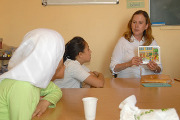
Cheryll Harvey teaching. (Image courtesy of the
Southern Baptist International Mission Board)

Jordan (IMB/MNN) ―Jordanian authorities have arrested a suspect in the murder of 55-year-old Cheryll Harvey, a Southern Baptist representative in Irbid, Jordan.

A veteran teacher, Harvey's body was discovered in her apartment on September 4. Police reports indicate a 17-year-old Jordanian man confessed to stabbing her to death when she caught him stealing from her purse. Authorities say there had been some association between the two, as Harvey paid him for odd jobs on occasion. A trial date has yet to be set.

A Texas native, Harvey worked in Jordan for 24 years teaching English and other subjects. She founded the ESL language center a decade ago, where she taught in Irbid--Jordan's second-largest city and home to several universities. Her work was in connection with the Jordan Baptist Society. Harvey also had taught primary school-age children at the Jordan Baptist School.

According to a press release from the Baptist Press, teaching was a passion for Harvey. For her, it was a way to express the love of Christ to generations of Jordanian students.

"Cheryll was known throughout the village," recalled a co-worker. "She visited in the homes of all of her students. She even showed up at students' homes when they weren't expecting her.... Cheryll was all about the people. She spent a large portion of every year visiting her students, making sure that she went into the home of every single student."

A colleague asked Southern Baptists to pray for the many people touched by Harvey's life. "Cheryll was a gentle person who loved Jesus," he said. "She showed that love to Jordanians: first to the many children she taught in Ajloun and their families, and then to those in Irbid as she taught English... She connected with her people at the heart level. We pray that her witness continues to bear much fruit... Cheryll's life has crossed the finish line. She was faithful through the end of this life and to the beginning of her real life."

IMB President Tom Elliff also appealed for prayer.

"We pray for her immediate family members in Texas and for her family members and friends around the world, but especially in Jordan," Elliff said. "The impact of Cheryll's life will live on for eternity. For Cheryll's assailant and his family, we pray God's mercy and grace to invade the dark corners of his heart. For us, Cheryll's death brings us face to face with the urgent importance of our work. With every word, thought and action we must glorify the One who purchased our salvation."

Harvey is survived by two brothers who reside in Texas. Funeral arrangements are incomplete pending the ongoing police investigation of her death. It was not immediately clear if she would be buried in Jordan, or if her body will be repatriated to the United States.


Friday, September 7, 2012

Christian worker murdered in Jordan


Jordan (IMB) ― Jordanian authorities are investigating the death of Southern Baptist worker Cheryll Harvey whose body was discovered in her apartment in Irbid, Jordan, on Tuesday, Sept. 4. Foul play has been confirmed in the death of the 55-year-old single woman from Texas.

Harvey had served the Jordanian people for 24 years, demonstrating the love of Jesus Christ through teaching English and other subjects in connection with the Jordan Baptist Society.

"Cheryll was greatly loved by both our personnel in the Middle East and by her many students," IMB President Tom Elliff said. "We are faced once again with a sobering reminder of the brevity of life and the importance of faithfully serving the Lord to the very end of our time on earth. Cheryll has left for us a great example that we should follow.

"She...will always be remembered for her quiet and unassuming spirit, as well as her passion for sharing the Good News," Elliff said.

Harvey was a member of College Heights Baptist Church in Plainview, Texas, and grew up attending First Baptist Church in Sudan, Texas. Family and colleagues in the United States have been notified and await word about the circumstances surrounding her death. Harvey is survived by two brothers who reside in Texas.

"As with any event such as this, it is imperative that we remember Cheryll's surviving family members and friends," Elliff said, "and that we lift them up in prayer during these days. We best honor her by giving honor to the Lord Whom she so faithfully served."

Robert Roecker, pastor of First Baptist Sudan, said the church is in a "state of shock." Harvey had visited her childhood church several times since Roecker became pastor, offering slideshows of her work in the Middle East.

A friend of Harvey's relayed to him that "Cheryll talked about how when she retired she might just stay in Jordan. She just really loved it there and loved the people."

"The thing that always astounded us was when you heard her speak she was just a meek and mild person with just a soft voice," Roecker recalled. "It's not the picture you have in your mind of someone who is on the front lines in Jordan. To have that courage and faith was amazing to us. The folks who knew her here were always saying how surprised they were at what was God was able to do through her."

LaDelta Vernon, Harvey's third-grade teacher who would often talk to her when Harvey came home on occasional furloughs, said she always imagined that the quiet, well-behaved girl with the distinctive laugh would grow up and raise three daughters. As it turned out, she never married. She was a helper, Vernon said, so her teaching English wasn't a surprise. Her teaching it in the Middle East was, however.

"She was a good student. If she was your friend, she was your best friend. She didn't talk behind people's back. She was just a sweet, sweet girl," Vernon said. "She was doing what she wanted to do, what God called her to do."


Friday, August 31, 2012

Syrian refugee crisis hits Jordan

Hussein Malla\AP

Jordan (MNN) ― The violence continues in Syria, and now a border situation is causing a refugee crisis.

Bill Bray with Christian Aid Mission says, "Early in the week the Turks closed their border, and it's created a lot of panic. The fighting on the ground is horrific. A lot of these [refugees] are widows and children. This is a real crisis."

Jordanian native missionary leaders say they are being overwhelmed by a new surge of terrified Syrian refugees. "They are coming under the fences every night--2,500 to 3,000 at a time since the border with Turkey closed two days ago," says an indigenous leader of one of the main mission groups who asked not to be identified for security reasons.

"There are already 180,000 refugees here from Syria, and they are growing every day. This is a very, very intense time for us." The Christians are responding as good Samaritans to the desperate refugees, helping them find food and shelter. Most are women and children.

The indigenous leaders asked Christian Aid Mission and others in the USA to help send more immediate financial aid so that food, medicine, and clothing can be purchased on the local market for free distribution to the refugees.

"The refugees are only dressed in light, summer wear and have nothing but the clothes on their backs," he said. "They don't want to enter government camps where there is food and water shortages. Instead, they are coming to us for food and clothing."

Winter is coming, he added, and at least $150,000 will be needed now to keep food parcels going out, supply blankets and winter clothing.

Like all the other front line states, Jordan has officially closed its borders to Syrian refugees and is trying to resist pressure by Sunni Jihadists from nearby Saudi and Qatar. The Islamic Jihad wants to divide up Syrian territory under various militias in order to help bring down the regime of President Bashar al-Assad, an Alawite Muslim who is accused of many atrocities but has protected the Christian minority.

A special fund has been set up by Christian Aid coded 400REF to aid the Syrian Christians during this time of crisis. 

Offerings for the suffering believers of Syria are being collected by phone at 800-977-5650 or at the Christian Aid Mission Web site: www.ChristianAid.or.

"We want to thank you Americans from the bottom of our hearts," said the Jordanian native missionary. "Your prayer and support is helping us befriend, love, and supply aid to these people. Discipleship requires an investment of time, resources, and courage, which we trust the Lord to provide to us."

Bray says, "The biggest thing they need right now is cash immediately to purchase food, medicines, and warm clothing."
A nearby pastor said, "I feel like finally, for the first time, we are doing outreach successfully."

Among the biggest needs they face:

• $70 each to sponsor the education of one child
• $45 each to supply medications for a refugee family
• $12 each for Arabic Bibles
• $55 each for food packets
• $180 per share of rent if a family shares an apartment with several other families

All the Syrian refugees told Christian Aid Mission reporters that they fled Syria after family members were killed. "We lost it all in Syria," said one woman. "I feared for my children, but here in Jordan they can play without being shot! I worry for my family that didn't make it out. I lost friends and loved ones. I've lost all hope."

Just crossing the border can be deadly. "We waited until nightfall, climbed through a barbed-wire fence under heavy gunfire with our husbands and kids. Our husbands didn't make it across."

Another said she came because "I couldn't sleep at night as I watched over my kids thinking this is our last night."

Bray says workers supported by Christian Aid Mission are using this for the Gospel sake. "In the midst of it, they're doing a lot of child evangelism and children's classes. This provides a lot of context in which to do a lot of Christian outreach."

Christian Aid Mission has been supporting indigenous missions in Syria and the front line states of Lebanon, Iraq, Jordan, and Turkey for decades. "We already had an indigenous network in place before the fighting began," said a Christian Aid Mission spokesperson in Charlottesville, Virginia. "We are able to get help to the field quickly."


Wednesday, July 18, 2012

Syria's war: civil, regional, or world?


Syria (MNN) ― Daily attacks. Piles of bodies. Scurrying refugees. There's still no end in sight for the human tragedy taking place in Syria. In fact, things may just be getting started.

Analysts have long been suggesting Syria's regime-versus-rebels battle is a civil war. The Red Cross now has actually officially declared the conflict a civil war. But it could be turning into something much greater.

Tom Doyle with E3 Partners returned from Jordan earlier this week. While there, he was mainly meeting with some of the 130,000 Syrian refugees who have fled to Jordan for solace. Speaking with Syrians who had just recently escaped with their lives only solidified the severity of the conflict for Doyle, a Middle East and North Africa expert.

Doyle says with other nations in on the conflict, things could be taking an ugly turn.

"You've got Iran sending arms, money, aid--everything to the government to keep the Bashar Assad regime propped up. Russia has been supportive. China even said that they were supportive of Assad. So you've got that side that's strong," Doyle explains. "Then, you've got the Sunni Muslims that are backed by other Arab countries. If the United States would get involved in this, it at least would be a regional war, but this could even spiral into a world war."

With Syria potentially a world war away from ending its disputes, the distribution of humanitarian aid -- and, more than that, the Gospel -- is crucial.

E3 is responding in Jordan with blankets, food, clothing and the saving message of Christ. It may seem inconsequential in the light of civil and potentially world war, but after being in Jordan, Doyle says it's clear that the work has been absolutely transformative. Even some radicals are changing their ways as a result.

"We do know of some Sunni Muslims that had been involved in radical activities: now that they're in Jordan and away from those terrible front-lines, they have ended up praying to receive Christ as Savior," explains Doyle.

It's probably best that believers stay out of the Syria mess politically, Doyle says, but we do need to pray for peace. And in the end, it's stories like this that truly explain the significance of what e3 and other Christian groups are doing:

"One woman -- I'll never forget this woman -- said, ‘When we fled Syria and went into one of these refugee camps, we retreated like we weren't human,'" says Doyle. The woman went on to say, "'But the Bible people came.' (She called Christians the Bible people.) ‘They showed us love, and they gave us food, and they gave us everything we needed for our children. Now we have this great relationship with them.' And this woman looked at me (and she's fully covered as a Muslim woman), and she said, ‘I want you to know: I love Jesus now.'"

Many friends of Mission Network News have already committed to support victims of this crisis financially or through prayer. If you feel led to help e3 continue reaching out, click here. 


Tuesday, November 15, 2011

Jordan’s king calls on Syria’s President Assad to step down

King Abdullah’s comments came in an exclusive BBC interview

By Michael Ireland
Senior International Correspondent, ASSIST News Service


BEIRUT, LEBANON (ANS) -- Jordan's King Abdullah II has become the first Arab leader to openly say Syrian President Bashar al-Assad should stand down in the interest of his country.
King Abdullah of Jordan addresses the general debate at the 66th session of the United Nations General Assembly at United Nations headquarters in New York on September 21, 2011. (Photo credit: Jason Szenes / EPA
via msnbc website).
King Abdullah told the British Broadcasting Corporation (BBC) that if he were in Assad's position, he would make sure "whoever comes behind me has the ability to change the status quo."

In an exclusive interview with the BBC, King Abdullah urged President Assad to begin talks on an orderly transition of power.

The BBC reports that many Arab leaders have condemned the crackdown on months of protests in Syria. Dozens of deaths are reported in the latest unrest on Monday.

The BBC said both the Saudi and Qatari ambassadors left Damascus in protest at the repression. The Arab League voted on Saturday to suspend Syria's membership.

However, King Abdullah went further than other Arab leaders in his exclusive interview with BBC World News television.

"If Bashar has the interest of his country [at heart] he would step down, but he would also create an ability to reach out and start a new phase of Syrian political life," he said.

"That's the only way I would see it work and I don't think people are asking that question," he added.
King Abdullah warned there would be "more of the same" if whoever replaced President Assad did not change the status quo.

The BBC says Jordan, which borders Syria, has been increasingly critical of the crackdown on anti-government protesters.

The BBC stated that many Western powers have urged President Assad to stand down. Both the European Union (EU) and the US have said he has lost legitimacy but have ruled out military intervention.

The EU on Monday tightened sanctions on Syria, the BBC said, reporting that EU foreign ministers meeting in Brussels added 18 Syrian officials to a list of people affected by a travel ban and asset freeze.

The BBC said the ministers also approved moves to prevent Syria getting funds from the European Investment Bank.

French Foreign Minister Alain Juppe said he hoped the UN would finally impose its own sanctions on Syria. Russia and China last month vetoed a Western-sponsored resolution condemning Damascus. The BBC also reported that earlier on Monday, Syrian Foreign Minister Walid al-Muallem reacted defiantly to the Arab League's suspension. He said the decision was illegal, and vowed to overcome "conspiracies" against Damascus.

The Arab League is set to hold another meeting to discuss Syria on Wednesday.

The BBC said Russia on Monday condemned the suspension. "Someone really does not want the Syrians to agree among themselves," Foreign Minister Sergei Lavrov said in Moscow.

In the latest Syrian violence, the Local Co-ordination Committees -- a network of opponents to President Assad's rule -- said 40 people had been killed on Monday, including 20 in the restive southern province of Deraa.

There are also reports that about 20 members of the security forces were killed in a clash with defectors from the Syrian army, the BBC said.

The BBC reported that such claims are impossible to verify as the Syrian government has severely restricted access for foreign journalists.

The BBC also explained that the UN says more than 3,500 people have died since the start of the protests in March while the Syrian authorities blame the violence on terrorists.

Key Quotes from King Abdullah’s BBC Interview

On Assad stepping down:

"If I were in his shoes, I would step down. If it was me, I would step down and make sure whoever comes behind me has the ability to change the status quo that we're seeing. Again, I don't think the system allows for that, so if Bashar has the interests of his country, he would step down but he would also create an ability to reach out and start a new phase of Syrian political life."

On a successor:

"This is the first time where I think most leaders in the Middle East don't have a clear answer on Syria. If Bashar was to step down, he needs to step down with changing the way the system deals with its people, so if he was to say 'I'm going to step down but let's have new elections, let's reach out to the people, let's get this as a national dialogue', then it would work. But if you're just going to remove one person and put another person in, I think that you'll continue to see more of the same."

On who's in charge:

"If you understand Syrian politics, he's in front, and the image of Syria is President Bashar. Having said that, both his brother and brother-in-law are very active on military side. So at the end of the day, like all leaders in Middle East, we're in the driving seat, we have to shoulder the responsibility for what happens in that country. But I don't think it is a one-man show, I think there is a team there, and again there is a system that has expectations of whoever is in the driver seat unfortunately."

On violence:

"Whenever you exert violence on your own people it is never going to end well, and so as far as I am concerned, yes there will be an expiration date, but again it is almost impossible for anybody to predict if it would be six weeks, six months or six years."

On reform:

"I honestly believe that he has reform in his blood. The vision that he had for Syria the times that I met him was very encouraging. I think the challenge is does the system allow for reform? So even, as you said, if Bashar was not on the scene, if the regime brings in someone else, does that person get it and realise the world has changed? And that is where I have my doubts."

On attempts at dialogue:

"Well I have spoken to him [Bashar al-Assad] twice earlier this year expressing our frustration and concerns about what was going on in Syria... I even sent the chief of the Royal Court in the late spring to see him again to see if we can't work together in bringing the violence down in Syria. And it became very clear to me that they were not interested in dialogue with Jordan or a lot of other countries unfortunately."

On Middle East politics:

"If Syria is kept in isolation, you are going to continue to see what is going on pretty much the same. However there are other forces at play, there is still the Arab peace proposal between the Israelis and the Palestinians. You have the Arab Spring in general. Recently we have maybe some hype moved on the Iranian portfolio because of the nuclear issue. The Turks are taking more aggressive stands in the north. What's going to happen in Lebanon? As you well know the Middle East is a mosaic of things and I think the problems that are challenging leaders in the Middle East is if there is life after Bashar what is that? And I think a lot of people are concerned because the unknown is scaring them more than the known."

In analysis of the Syrian conflict on the BBC website, Lyse Doucet of BBC News says that King Abdullah's remarks, coupled with the Arab League's decision to suspend Damascus, mark a turning point in the Arab world's approach to Syria.

Doucet writes: “But Jordan's monarch was emphatic that President Assad stepping down was not enough. His call to the Syrian leader was about changing a ‘system.’ He admitted that no-one was clear how to do that, and the Syrian regime still believed it was ‘in a fairly comfortable position.’

"King Abdullah, like many others, also emphasized there was great concern about ‘life after Bashar.’ He warned that any outside intervention in Syria would open ‘Pandora's box.’
“The relationship between two Arab leaders, seen as a new generation when they took over from their fathers, has been under growing strain.

"But King Abdullah said he still believed the Syrian leader had ‘reform in his blood.’ He had reached out to him earlier this year, even if, as he admitted, Jordan was not ‘by any means... a perfect story.’"

Timeline of Growing Foreign Pressure on Syria:

June 10: Turkish PM condemns the "savagery" of the response to the unrest
July 19: Qatar closes its embassy in Damascus after an attack by Assad loyalists
August 8: Saudi Arabia condemns crackdown and recalls its envoy in Damascus
August 10: US imposes new sanctions on Syrian telecom companies and banks
August 18: US, UK, Germany and France call on President Assad to step down; US imposes full ban on oil imports
November 12: Arab League suspends Syria from the organization
November 14: Jordanian king openly urges Assad to go; EU tightens sanctions

** Michael Ireland is the Senior International Correspondent for ANS. He is an international British freelance journalist who was formerly a reporter with a London (United Kingdom) newspaper and has been a frequent contributor to UCB UK, a British Christian radio station. While in the UK, Michael traveled to Canada and the United States, Albania,Yugoslavia, Holland, Germany,and Czechoslovakia. He has reported for ANS from Jamaica, Mexico, Nicaragua, Israel, Jordan, China,and Russia. Michael's volunteer involvement with ASSIST News Service is a sponsored ministry department -- 'Michael Ireland Media Missionary' (MIMM) -- of A.C.T. International of P.O.Box 1649, Brentwood, TN 37024-1649, at: Artists in Christian Testimony (A.C.T.) International where you can make a donation online under 'Donate' tab, then look for 'Michael Ireland Media Missionary' under 'Donation Category' to support his stated mission of 'Truth Through Christian Journalism.' Michael is a member in good standing of the National Writers Union, Society of Professional Journalists, Religion Newswriters Association, Evangelical Press Association and International Press Association. If you have a news or feature story idea for Michael, please contact him at: ANS Senior International Reporter

** You may republish this story with proper attribution.