Tuesday, October 23, 2012

Another Christian teenager held for blasphemy in Pakistan

By Dan Wooding
Founder of ASSIST Ministries

KARACHI, PAKISTAN (ANS) -- A Muslim mob ransacked the home of a 16-year-old Christian boy accused of sending a blasphemous text message; he has been charged with Pakistan's most serious "blasphemy" offence, which carries the death penalty.

A mob burning belongings of Ryan Stanten, a Christian boy accused of sending anti-Islam texts to his Muslim neighbors, in Karachi
According to Barnabas Fund (www.barnabasfund.org), Ryan Stanten allegedly forwarded on Tuesday. 

October 9, 2012, a text containing material deemed offensive to Islam. It was sent to fellow residents of a middle-class colony in Gulshan-e-Iqbal, Karachi, for employees of a gas company.

The 16-year-old was brought before the gas company boss and a local imam; Ryan told them that he had received the text message from someone else and then forwarded it to Muslim friends without reading it.

"The following day, an angry Muslim mob led by Islamic clerics attacked the home where Ryan lives with his mother, Rubina Bryan," said a spokesperson for the UK-based group. "They ransacked the property and set fire to numerous household items, including a bed, washing machine and fridge, after dragging them into the street. The assailants also shouted insults against the Christian family, who had already abandoned the house.

"The police arrived at the scene and tried to appease the protestors by assuring them that a case would be registered".

Barnabas Fund went on to say that Ryan was subsequently detained and charged with the most serious blasphemy offence in the Pakistan Penal Code, section 295-C, which carries the death penalty for using derogatory remarks against Muhammad. He was also charged under the country's Anti-Terrorism Act and Telegraph Act.

His mother has reportedly been dismissed from her job at the gas company.

The case against Ryan Stanten follows that of compatriot Rimsha Masih, a 14-year-old Christian girl detained on a blasphemy charge in August. She has been released on bail pending her next court appearance.


Authorities Close Down Churches in Aceh, Indonesia

By Jeremy Reynalds
Senior Correspondent for ASSIST News Service

NEW DELHI, INDIA (ANS) -- At the prompting of Islamic extremists, authorities in Indonesia's Aceh Province have forbidden nine churches to worship, saying they are "illegal."

According to a story by Morning Star News, Illiza Sa'aduddin Djamal, deputy mayor of Banda Aceh, capital of Aceh Province, called pastors of nine churches and five Buddhist monasteries for a meeting on Oct. 15, said Veryanto Sitohang, head of rights group United North Sumatra Alliance.

Representatives from five of the nine churches attended the meeting. Morning Star News reported they were forced to sign an "agreement" saying they would stop all activities because they did not have official permits.
Those permits are obtainable only by meeting very difficult requirements from local governments, Sitohang told Morning Star News. The other four churches will also be told to sign the agreement soon, he added.

Sitohang said that the Aceh official told the church leaders that if they did not sign the agreement, the government would not be responsible for their security.

"The agreement was projected as a measure to protect the safety of the religious minorities," Morning Star News reported Sitohang said.

All nine churches were registered with Indonesia's Department of Religion, Sitohang said. However, officials in Aceh also require local licensing that is difficult to obtain and selectively enforced, thus providing a pretext for local Islamists to close down churches.

Morning Star News reported that even compliance with local regulations does not guarantee that a church will be allowed to function. However, authorities and extremist groups also cite 1979 and 2001 agreements between Muslims and Christians stipulating that only one church be built in each district. Those agreements were cited when Aceh Singkil closed down churches in May.

Morning Star News reported the Aceh official said on Oct. 15 that the nine churches should take their congregations to the four "official" churches in the city for Sunday services.

"But this is not feasible, because these congregations come from different backgrounds," said Sitohang.

Morning Star News said on Oct. 12, a prominent Muslim cleric, Teungku Usman Kuta Krueng, a.k.a. Abu Kuta Krueng, asked the mayor of Banda Aceh to stop the activities of "illegal" churches and Buddhist monasteries, according to the local newspaper Serambi Indonesia. The cleric had been briefed about the churches and monasteries by the extremist Islamic Defenders Front (locally known as the FPI).

After Monday's meeting, Morning Star News reported, the Aceh division of the FPI said its members would keep an eye on all the "illegal" churches to prevent them from violating the "agreement."

The closed churches had been operating for years.

"The religious atmosphere in the city is tense, and we do not know where we will go on Sunday for worship," a pastor speaking on condition of anonymity told Morning Star News. "We are confused. The government must provide us with some solution."

Aceh is a special region that has the highest proportion of Muslims in Indonesia and is partially governed by sharia (Islamic law). Gubernatorial Regulation No. 25/2007 makes it extremely difficult for non-Muslim groups to get permits for building a new house of worship. A petition must be signed by at least 150 worshipers who must provide copies of their identity cards. It must also be supported by 120 other local residents.

Morning Star News said among the churches closed were the Surabaya Pentecostal Church (Gereja Pentakosta Pusat Surabaya); Bethel Church of Indonesia (Gereja Bethel Indonesia); the Pentecostal Church of Indonesia (Gereja Pentakosta di Indonesia); the Christian Congregation of Indonesia (Jemaat Kristen Indonesia); the Holy Christian Church of Indonesia (Gereja Kristen Kudus Indonesia); the Victory of Faith Church of Indonesia (Gereja Kemenangan Iman Indonesia); and the Tabernacle of David Christian Church (Gereja Kristen Kemah Daud).

About 98 percent of the population in the city of Banda Aceh is Muslim. Aceh Province has 4.4 million Muslims, a little over 50,000 Protestants and about 3,300 Catholics, according to the Central Statistics Agency.

In May, Morning Star News reported, 17 churches in Aceh's Singkil Regency were closed down by the local administration. These closures were ordered by Regent Razali A.R. in a letter signed on April 30, which asked members of the congregations themselves to tear down the church buildings. The order came following a protest by members of the FPI at the regency office the same day.

Morning Star News said Aceh turned more intolerant after the election of a hard-line Islamic governor in April. The FPI has said authorities in all areas in Aceh should close down "illegal" churches.

Morning Star News said closures of and attacks on churches are not uncommon in other parts of Indonesia either. The Gereja Kristen Indonesia (the GKI Yasmin Church) in the city of Bogor and the Philadelphia Batak Christian Protestant Church in Bekasi, both near Jakarta in West Java Province, remain sealed by their respective authorities for months despite Supreme Court orders in their favor.

Morning Star News said with about 210 million Muslims, Indonesia is home to the world's largest Muslim population. While the majority of the Muslims are from the Shafi'i school of the Islamic jurisdiction, which is considered fairly moderate, Salafi and Muslim Brotherhood approaches to Islam took root in 1942 during the Indonesian War of Independence from the Dutch Empire.

Two Churches Raided in Kazakhstan

By Jeremy Reynalds
Senior Correspondent for ASSIST News Service

Kazakh President Nursultan Nazarbayev
 signed the new laws in October 2011

KAZAKHSTAN (ANS) -- Two unrelated Protestant churches in different parts of Kazakhstan were raided in early October, reportedly over a criminal case launched 15 months ago.

Kazakhstan is a country in Central Asia and Eastern Europe.

According to a story by Mushfig Bayram of Forum 18 News Service, the case follows a complaint by the mother of a member of Astana's Grace Church that it harmed her health. These allegations were denied by church members to Forum 18.

Forum 18 reported masked police searched the church, and seized computers, valuables and religious books they insisted were "extremist," although they were unable to explain what was extremist or who had said they were. Police requested church members to give blood samples, so they could see if the church uses "hallucinogenic" substances for communion.

Nine days later the unrelated New Life Church in Oral (Uralsk) was raided in the same case.

Asked by Forum 18 why masked police broke into Grace Church in a manner church members found threatening, Senior Investigator Vyacheslav Glazkov adamantly denied the charge. He said, "We did not threaten anyone; we just made a search."

Members of both churches fear the authorities will use the case to prevent them gaining the mandatory re-registration for religious communities to be allowed to continue operating after Oct. 25.

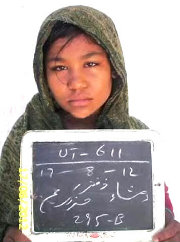
Rimsha Masih's case extended

Police picture of Rimsha Masih after her
 arrest. (Photo Courtesy of ANS)
Pakistan (MNN) ― 14-year-old Rimsha Masih was arrested two months ago, accused of committing blasphemy. Her court case has been extended to November 14, 2012, a month away. 

According to an Assist News correspondent in Pakistan, the Islamabad High Court (IHC) has extended her stay during the hearing of the petition. "The court extended the stay in order to first decide on the petition for quashing the First Informational Report (FIR). During Wednesday's hearing of Rimsha's petition, Chaudhry Abdul Aziz, Advocate, submitted his power of attorney on behalf of Malik Ummad, the accuser."

In the petition filed, Rimsha's lawyer had said that it was the Imam, Khalid Jadoon Chishti, who fabricated the charge of blasphemy. His reason, according to the lawyer, was that he wanted the Christian community to vacate the area. That is exactly what happened, too. 

Living in a country where 97% of the population is Muslim, allegations of blasphemy can create public fury. Pakistan is #10 on the Open Doors World Watch List for persecution of Christians. Rimsha's arrest made hundreds of Christians in her neighborhood flee in fear for their lives. 

Hafiz Zubair, prosecution witness, recorded on August 31 that the Imam put pages of the Holy Quran in the shopping bag. In doing so, it made a case against the Christians. 

To make the case even stranger, three witnesses testified against Imam. According to DawnNews, soon after, they withdrew their testimonies. The witnesses stated that they had been forced into recording statements by the police. 
Two witnesses recorded separate statements saying they saw Jadoon putting some pages of the Holy Quran in a plastic bag, tearing them. 

The court delayed the hearing in Jadoon's bail plea until October 3. On the 11th of October, he was granted bail, six weeks after his arrest. His bail was set at 200,000 rupees ($2,065 US) after witnesses again retracted their statements early in October. 

In the beginning of September, Rimsha was granted bail. Under protective custody, she was airlifted to an unspecified location. She now has to wait until November 14 for her next court date. 


Iran: Two More House Church Members Arrested In Shiraz

By Dan Wooding
Founder of ASSIST Ministries

SHIRAZ, IRAN (ANS) -- Two members of the Church of Iran, who belong to a house church that was raided on Friday October 12, 2012, by security forces, were arrested today in the city of Shiraz in Fars Province. Their arrest came after they were summoned to the Intelligence Ministry's detention centre, Pelak (Plaque 100), where seven other members of their house church are currently being held.

Map of Iran showing Shiraz
According to Christian Solidarity Worldwide (CSW) Afsar Bahmani, a middle aged woman in need of specialist medication due to heart and kidney complications, was detained at around 1pm along with a man named Massoud Rezaie, after responding to the summons.

Both are converts and long standing Christians. Mrs. Bahami was present during the raid of their house church on 12 October which resulted in the arrest of seven members, but was not detained at that time.

These arrests are occurring against the backdrop of a sharp upsurge in the harassment and persecution of Christians, particularly converts.

Christian Solidarity Worldwide has received reports of a significant increase in arrests during recent weeks.
Pastor Benham Irani with his family. (Courtesy Present Truth Ministries).


CSW has also been informed that another member of the Church of Iran, Pastor Benham Irani, remains in critical condition in Ghezel Hesar Prison, where he has been denied adequate treatment for severe stomach ulcers and colon complications.

CSW's Chief Executive Mervyn Thomas said, "CSW is deeply concerned about the arrests of Mrs Bahmani and Mr Rezaie, which appear to be part of a renewed wave of arrests of house church members in Shiraz.

We are particularly concerned for Mrs. Bahmani's health and for Pastor Irani, whose condition continues to deteriorate. The harassment and arrest of religious minorities solely on account of their faith contravenes international covenants to which Iran is a signatory, including the International Covenant on Civil and Political Rights (ICCPR), which guarantees the right to freedom of religion.

"We call on the Iranian authorities to ensure that Mrs. Bahmani and Pastor Irani are allowed access to specialist medical care. We also urge the Iranian government to uphold the rule of law and to release all who have been detained on account of their faith immediately and unconditionally."

Christian Solidarity Worldwide (CSW) is a Christian organisation working for religious freedom through advocacy and human rights, in the pursuit of justice.


New Report Documents Government of Sudan's Starvation Warfare Against Its Own People

By Jeremy Reynalds
Senior Correspondent for ASSIST News Service

SOUTH KORDOFAN, SUDAN (ANS) -- Food security conditions in South Kordofan, Sudan are dramatically declining, and malnutrition among children in the rebel-held areas of the conflict-torn state is on the rise.
An estimated 500,000 people in Sudan's South Kordofan state are at risk of starvation if food aid is not delivered
to the conflict zone. These children were in
Kadugli, South Kordofan on Oct. 21, 2011
(Via www.globalpost.com) 
That's according to a news release from the Enough Project, showing findings from the first international rapid food security and nutritional assessment conducted in South Kordofan since 2011.

According to the assessment, the prevalence of malnutrition among children in South Kordofan is "serious" bordering on "critical"-the worst or most dire World Health Organization malnutrition classification. The amount of households surviving on one meal per day has jumped to a staggering 81.5 percent, compared to only 9.5 percent one year ago, and zero percent two years ago.

According to the news release, more than 65 percent of households in South Kordofan have less than one week's worth of food. This is a problem, because food is not readily available for purchase in the area, and incomes are scarce or non-existent.
In addition, the news release stated, as a result of ongoing bombardment by the Sudan Armed Forces, the harvest this year is expected to be low-yielding and will run out quickly, leading to only a temporary improvement in the conditions there.

John Prendergast, Enough Project Co-founder, said in the news release, "The assessment's findings indicate that the situation in South Kordofan today is similar to the conditions leading up to the Horn of Africa famine in 2011. If the international community does not respond to these early warning indicators in South Kordofan, the situation could have devastating consequences for hundreds of thousands of people."
The news release said the nutritional assessment was carried out by an international non-governmental organization but, due to security reasons, the organization requested to remain anonymous and asked the Enough Project to publish the report.
According to the news release, the Enough Project was responsible for the report's final production and distribution, and had the assessment vetted by experts at Johns Hopkins Bloomberg School of Public Health who found its findings to be credible.

Jennifer Christian, Enough Project Sudan policy analyst, said in the news release, "The rapid food security and nutritional assessment corroborates existing evidence of the humanitarian crisis unfolding in South Kordofan."
She added, "Given the government of Sudan's failure to comply with the terms of U.N. Security Council Resolution 2046, the U.N. Security Council must enact measures against Sudanese government officials responsible for the denial of aid into Blue Nile and South Kordofan states, and call on U.N. member States to take all measures necessary to deliver aid should the government of Sudan continue to ignore its obligations."

Enough is a project of the Center for American Progress to end genocide and crimes against humanity. Founded in 2007, the Enough Project focuses on crises in Sudan, eastern Congo, and areas of Africa affected by the Lord's Resistance Army.