Wednesday, October 10, 2012

Rimsha and family will stay in Pakistan, lawyer says


Other dislocated Christians report mixed success with relocation


LAHORE, Pakistan, Oct. 10 (Open Doors News) — Rimsha Masih and her family will remain in Pakistan after her legal ordeal is over, one of her lawyers says.

The teen-aged Pakistani girl, whose arrest in August on suspicion of desecrating Islamic texts, is due to appear in an Islamabad juvenile court Oct. 17. Originally charged in regular court where the potential penalty is life imprisonment, the girl’s case was transferred to the juvenile court after her age was certified and evidence surfaced that she was framed by a local imam.

“We will ask the judge to quash the charges against her,” attorney Tahir Naveed told Open Doors News.

And then, he said, the girl’s family will try to settle back into something resembling a normal life.

“The family will live in Pakistan and they have already voiced their intention publicly,” Naveed said. “For now it’s certain that the family of Mizrek Masih will not seek asylum outside Pakistan. We will relocate them and also help in arranging employment for the father.”
A report surfaced Tuesday that the family had been secreted away to Norway. But the minister of the Ministry of National Harmony, Paul Bhatti, denied the report.

"There's no truth in rumors that Rimsha has been moved to Norway,” Bhatti told Open Doors News. “Mizrek Masih's family is in Pakistan and in our protection and they will be produced in court, if required.” He said he is hopeful Rimsha would be cleared from charges at her Oct. 17 hearing.

Other Christians who fled Islamabad’s Meherabadi neighborhood to avoid Muslim anger over Rimsha’s alleged offense have tried to return home, too. Naveed, who is a member Punjab state Legislative Assembly, said his All Pakistan Minorities Alliance party is looking after the needs of returning Christians and that relations with Muslims are calm.

Not everyone sees it that way. “Some members of Rimsha’s congregation, who gathered last Sunday for worship at the church in the affected area, were stopped from playing the harmonium and tablas when they were singing hymns,” said a Christian pastor identified as Ahsraf, who said he provided shelter to several Christians fleeing from Meherabadi at his church in Islamabad’s Sector G-8. “The tension is pretty much out there,”

Ashraf said about 450 Christians took shelter in the 66 Quarters area of Awami Colony in the suburbs of the Islamabad.

“The Ministry for National Harmony promised to look after them but they were left high and dry,” he said. Some staged protests demanding that the ministry find them a safer settlement.

Arif Masih, a former resident of the area, said soon after Rimsha’s arrest a number of Christian organizations jumped in to offer shelter, “but most of them abandoned us one after the other.”

“Only a couple of organizations have helped to some extent,” he said. “One organization has agreed to finance resettling of about 25 families and they’ve said that they will rent out homes for another 75 families. It’s yet to be seen when this happens. The other organization resettled 10 families and left.”

Christians who live some streets away from Rimsha’s home have returned to their homes, while those who lived closer to her home have preferred to relocate, said Napolean Qayyum, a field director for World Vision in Progress, which describes itself as “a ground organization working for the rights of religious minorities in Pakistan.”

National Harmony Minister Bhatti said he had formed a committee to look into the matter, and the situation would be resolved soon.

"Almost 90 percent of Meherabadi's Christians were living in rented homes, Bhatti said. “While many have returned to their previous abodes, some want to relocate to other areas for which the government is considering some proposals.” 

For a moment, Pakistani Christians may have thought the apparent collapse of the case had opened a narrow window of opportunity to weaken the country’s anti-blasphemy law. Pakistan’s president, Asif Ali Zardari, used the Rimsha arrest as an opportunity to insist the blasphemy law must not be used as a cover to settle personal scores. Naveed said his party had started consulting other parties on proposals to reopen and reinvestigate all blasphemy cases.
That window slammed shut on Sept. 11, when a portion of the Islamic world erupted in outrage over the anti-Islam Internet video “Innocence of Muslims,” which portrays Muhammad as a womanizer and false prophet.
“Much progress had been made,” Naveed said, “but this film brushed everything aside.” The turmoil scuttled plans to bring the Masih family back to their home for a temporary visit, he said.

Bhatti, too, said the video undermined efforts being made to promote religious harmony.

“A church was burned down in Mardan by an anti-film mob,” he said. “They also burned down an adjacent school and a library, while the provincial government played the role of a silent spectator. Twenty-six people died in countrywide violent riots that day. The entire debate shifted to the film issue. A setback, indeed.”

This week in Islamabad, attention turns to Khalid Jadoon, imam of Meherabadi mosque, who is due in court Oct. 11, where he faces allegations that he planted the damaged religious texts into a bag Rimsha was carrying, to create a pretext for reporting her to police.

Three witness whose original testimony provided police with the evidence to arrest Jadoon recanted at an Oct. 1 court hearing. The witnesses, Khurram Shahzad, Hafiz Mohammad Owais and a man identified by the name Danish, told the judge the police had tortured them into recording their incriminating statements.

The Ramna police had recorded the statements of Owais, Shahzad and Danish under Section 161 of Criminal Procedure Code, in which they had endorsed the statement of Hafiz Zubair, a prayer caller at the same mosque who had testified against Jadoon before a magistrate.

On Sept. 23, sub-Inspector Munir Jaffri, the investigation officer in the blasphemy case, asked the court to clear Rimsha of the charge against her and instead charge Jadoon. Rimsha was granted bail and a day later was airlifted from Adiala jail in Rawalpindi to an undisclosed location.

Naveed said the backtracking of the witnesses would not cause much harm to Rimsha’s case because her innocence has been established.

“The prosecution is trying its best to save Jadoon, but the case against him is watertight,” he said.
If so, it might open another window of opportunity.

“This is the first case of its kind when a person charged under the strict blasphemy laws is exonerated from the accusation,” Naveed said. “This case has also brought for the first time a debate on how these laws are misused to target innocent people.”

END
**********
Copyright 2012 Open Doors News

Venezuelan course of action likely worsens for religious freedoms

(Photos by Brian Russell)

Venezuela (MNN) ― In a re-election to another six-year term, Venezuela's President Hugo Chavez defeated Henrique Capriles by a 10% point margin in the presidential election.

The win marks Chavez's fourth presidential election victory since 1998. It also means more of the same leftist-leaning policies. Some of these have earned Venezuela a dubious reputation.

In fact, the 2012 U.S. Commission on International Religious Freedom Watch List includes Afghanistan, Belarus, Cuba, India, Indonesia, Laos, Russia, Somalia, and Venezuela. Venezuela has been on USCIRF's Watch List since 2009.

According to the USCIRF, "The Watch List provides advance warning of negative trends that could develop into severe violations of religious freedom, thereby providing policymakers with the opportunity to engage early and increasing the likelihood of preventing or diminishing the violations." 

In that report, investigators found continued violations of freedom of religion. These included: government failure to hold accountable those behind attacks on religious leaders and houses of worship, virulent rhetoric from President Hugo Chavez, government officials, state media, and pro-Chavez media directed episodically against the certain faith-based communities.

Since President Chavez first came to office in 1998, there has been a steady increase of government rhetoric, and in some cases government actions, against the faith-based groups thought to have ties with the West. 

Greg Musselman, spokesman for Voice of the Martyrs Canada,says it's not likely things will change in the direction of more freedom. "Chavez, being close with the Castro (Cuban regime), would have similar kinds of policies against the Church, which would be having more control over the church. And if they didn't go along with the policies of the government, or if they were in any way seen even preaching the Gospel--which will conflict with an ideology like Hugo Chavez, that could cause problems for the Church." 

As Chavez flexed his muscle over the economy, non-governmental organizations, and society, he simultaneously seemed to be backtracking on democracy and respect for human rights. There are no official restrictions on religious practice, but Chavez' actions have created a hostile ministry environment. Musselman explains, "It's more of subtle persecution. It's still things that are happening against the Church. It's a church leader who has a second job and may lose his job." 

That is likely to continue if Chavez continues to trend the way he's been going. "If things do get more difficult, pray that the church would be strengthened, that believers would be prepared for churches to close down."

One of the more obvious manifestations of Chavez ideology was seen in November 2005. President Chavez gave all New Tribes missionaries ninety days to leave tribal areas of the country. The order effectively revoked a forty-year-old permit given to the mission.

After so many years' presence for NTM, what changed? Musselman says it was a rise in nationalistic fervor. "Christianity can often be labeled as ‘Americanism' or ‘coming from the West.' If he would view missionaries as ‘westerners' in some way, undermining his control, he would be in much opposition of that." NTM appealed the order, but the Supreme Court allowed it to stand, leading to the relocation of missionaries in the tribal areas in February 2006. 

In the meantime, there have been scattered reports of church bombings and other assaults, and slow justice. That's another hallmark of a country that's steadily moving toward unfriendly territory for Christians. First, says Musselman, "That may not be bad for the church because it'll cleanse it. There has been quite a compromise amongst many of the leaders." 

Second, Musselman spoke with a prominent church leader in Venezuela: Nelson Castro (no relation to Cuba's Fidel Castro), a former colonel who served with Hugo Chavez. He understands Chavez' ideology which is why "he expects things will get worse in Venezuela, and there will be closing down of churches. In his opinion, the Church has started to go underground."

As that begins to unfold, Musselman says, "The main prayer request is that the church would be strong, that they would continue to preach the Gospel, certainly in humility and love, but not compromise as has been the case in the last number of years." 


Controversy Flares Over Number Of Christians In Egypt

By Jeremy Reynalds
Senior Correspondent for ASSIST News Service

EGYPT (ANS) -- The number of Christians in Egypt has for a long time been a tightly held secret by the authorities.

The range is from over 25,000,000 according to some Copts, to 3,000,000 according to the Muslim Salafists.
According to a story by Mary Abdelmassih of the Assyrian International News Agency (AINA), the Coptic Orthodox Church has always known the number of Copts from its church database. The secrecy follows the policy of the late Pope Shenouda III; that Copts may not be counted and treated as mere numbers because they are part of the fabric of society.

AINA said Pope Shenouda was against the idea of setting a quota system for the Copts in parliament and other high level posts.

After 26 years of silence, AINA said, an unexpected announcement of the official population count of Egypt's Christians was made last week on Al-Tahrir TV by Major-General al-Guindi, head of Egypt's Central Agency for Public Mobilization and Statistics.

AINA reported he said that the number of Christian in Egypt was not more than 5,130,000 out of a current population of 83,150,000. He added that the low number of Christians is because of low birth rate, high immigration and the highest income level.

This announcement, which according to AINA prompted a wide debate, was heavily criticized by Copts and especially by the Coptic Church. It was covered by all media. Some supported the 5 million number, while some found it surprisingly low.

AINA said those in support of the low numbers say the 2011 Pew Research Center's Forum on Religion and Public Life study revealed the Christian population is 5.3 percent (4.3 million out of 80 million).

The Ibn Khaldoun Center for Development studies puts the number of Copt at 8 to 8.5 million, nearly 10 percent, and said that if the church has other numbers then these should be published so that they could discuss and verify them.

AINA said the importance of the number of Copts at this time is viewed by many as an important political issue, and the announcement comes in conjunction with the process of drafting the constitution.

According to AINA, it is seen as an attempt to marginalize Copts and to suggest they are a minority not entitled to participate in decision-making. Hard-line Muslims believe that the voice of the Copts is growing stronger and disproportionate to their number as a minority, especially in the Coptic fight against Sharia within the committee drafting the new Constitution.

AINA said Anba Pachomius, acting Patriarch of the Orthodox Church, rejected the census results, telling Al Dostour el-Asly newspaper, "Is this a special census for Christians in the district of Cairo's Shubra district only, or the whole of Egypt?" 

Bishop Pachomius said he was bewildered at the significance of this statement coming out at this time, when Egypt is going through important transformations and experiencing heavy sectarian tensions.

AINA said the acting Patriarch wondered where al- Guindi got his numbers and demanded the numbers for each of the 27 Egyptian governorates, saying "We have different numbers which are by far higher, but we will not declare them yet as the time is not suitable."

AINA reported that Bishop Anba Marcus of Shubra el-Khaimah said the number of Copts in Egypt ranges between 15 and 18 million. He explained that the number of Christians in the province of Minya alone, 1,200,000, exceeds their population in Cairo and other Upper Egypt governorates which are densely populated with Christians.

AINS commented it is worth noting that those numbers do not include Copts of other denominations such Catholics, Evangelicals and Protestants, who are estimated between 1.5 and 2 million.

AINA reported Bishop Marcus said that the number of Copts in Egypt is known to the Church, as every Diocese knows the full count of it parishioners. However, the numbers are not compiled in one list. "We can easily do so if the acting Patriarch Anba Pachomius, or the next Pope, would ask each bishop to provide the count of Christians in his diocese."

After heavy criticism, AINA reported, the census chief retracted his statement. He claimed that his statement was taken out of context. He issued another statement, saying he was referring to the census of 1986 when the Copts were 5.7 percent of the total population, and that since then the agency has no definitive number for Copts.

He said that according to the Declaration of the United Nations Statistics Commission of 1985, it was optional for people to add their religious affiliation in the census form. As a result, in the two following censuses of 1996 and 2006, this information was unavailable.

Kamal Zakher, coordinator of the Front of Secular Copts, said the number of Christians in Egypt is a state secret. AINA said he believes that the recent statement was deliberately politicized to further the idea that Christians remain a minority, "but citizenship means that the rights and duties have nothing to do with the numbers."

AINA said Attorney Dr. Naguib Gabriel, head of the Egyptian Union of Human Rights Organization, filed a lawsuit with the administrative court against the Prime Minister and the head of the census agency. It was for the issuance of a court order to carry out a census of Christians in Egypt and to determine their percentage of Egypt's population. The figures would be taken from the database of the Civil Status Department and under international observation.

"Egyptian identification cards include religious affiliation of the cardholder and it would be easy to get the numbers required," AINA reported he said. The hearing is scheduled for Oct. 9.

Gabriel also said that Copts have suffered for a long time from the inconsistent way the census agency has dealt with their numbers, with what he called peculiar percentages which are very different from reality.


Syrian Christians Face Violence and Suffering, but Ministry Continues


SANTA ANA, Calif., Oct. 9, 2012 /Christian Newswire/ -- "The violence has pushed people out of their homes, fleeing for their lives. Many are displaced internally and many others are external refugees living in the most humiliating circumstances, deprived of even shelter, clean water, power, food and medical care."

That is the lament to Christians in the West from a Christian pastor in Syria, describing the deteriorating, horrific conditions in the war-torn country.

He adds: "Millions are not sleeping in their own beds, forced out of their homes to find themselves with their children homeless and living in public parks or in the wilderness. Others are not sure if they or their children and loved ones will see the light of a new day. Tens of thousands of families lost loved ones -- a child, a father, a mother or a husband.

"Hundreds of the injured died for lack of medical care. Thousands of children go to bed terrified of the sound of shelling. Hundreds of thousands are in camps in neighboring countries."

"My people are hurting. I can cry like Nehemiah because the walls of our cities are burnt and the people in great trouble and disgrace. I can weep like Jeremiah because of the intensity and the spread of evil. I can mourn like David because of the indiscriminate brutal killing of innocent people; children, women, elderly, youth subject to shelling or under the rubble of their homes."

Over the past 20 months the civil war between President Bashar al-Assad's forces and the Free Syrian Army has resulted in approximately 30,000 deaths, mostly civilians, according to several reports. Hundreds of thousands of Syrians have fled the country into such neighboring countries as Jordan, Turkey and Lebanon, according to the United Nations. In addition, about 2.5 million Syrians need aid inside the country, with more than 1.2 million displaced domestically.

Places especially dangerous for Christians include the cities of Aleppo and Homs.

"A lot is being destroyed in Aleppo," one of Open Doors' contacts in the city says. "Extreme violence is being experienced in the last few weeks. You can see the results of it in the old city and in other neighborhoods and surrounding villages. There is a lot of destruction."

Many Christians in Aleppo have lost their houses or apartments. "We see that their apartments are easily confiscated by the rebels to be used for snipers," the spokesman states. "The Christian community is the only group that doesn't fight back or doesn't protect property with guns. So when the rebels search a place to stay or to use for their battle, they choose the houses and apartments of the softest target -- the Christians."

Based on information from Syria, Open Doors thinks that the number of internally displaced people "might be higher than thought," an Open Doors spokesman says. "For example, I heard that only from Homs and the surrounding villages about 275,000 people have fled."

The Christian pastor says outreach continues despite the terrible conditions.

"We are here for a divine reason; we trust and rely on our sovereign loving Lord. We believe that we are in the midst of a spiritual war. In this country there are many who are much more effective than us militarily, politically, economically and socially, but none have the privilege of being effective in this spiritual battle like we are.

"We thank God because the Church is united across the country in prayer 24 hours a day, seven days a week; praying for the glory of God to dwell in the Church, praying for an end to the bloodshed, praying for peace in the country, praying for keeping the church's faithful witness, to reach out to the suffering, to share the divine cure of the gospel, to speak the word of the Lord in all boldness."

Open Doors is supporting churches doing relief work in several Syrian cities.

The pastor adds: "We deeply appreciate the prayers of God's people everywhere; it is a rare time where the Church in Syria is feeling the true oneness of the body of Christ all over the globe. For this, we thank the Lord, for it is a great encouragement to us."

An estimated 100 million Christians worldwide suffer interrogation, arrest and even death for their faith in Christ, with millions more facing discrimination and alienation. Open Doors supports and strengthens believers in the world's most difficult areas through Bible and Christian literature distribution, leadership training and assistance, Christian community development, prayer and presence ministry and advocacy on behalf of suffering believers. To partner with Open Doors USA, call toll free at 888-5-BIBLE-5 (888-524-2535) or go to www.OpenDoorsUSA.org.


Monday, October 8, 2012

Christians brave as Syria spirals further


Syria (MNN) ― Few believe the Syrian civil war will end any time soon. In the meantime, the cities of Homs, Aleppo, and Damascus are home to civil war, where the future of anyone living there is uncertain. Shelling, mortar attacks, rebel violence, and more are commonplace. The terror is felt by all who live there. Many want out.

Spokesman for Open Doors USA Jerry Dykstra reports Christians are pleading for prayer. Dykstra shares an e-mail he received from a pastor there. "I am crying like Nehemiah because the walls of our cities are being burned and people are in great trouble. I can weep like Jeremiah because of the intensity and spread of evil. I can mourn like David because of the indiscriminate brutal killing of innocent killing of innocent people -- children, women and our youth."

According to Dykstra, this is an ongoing disaster. "People are dying in the streets. It's been going on for almost 20 months now, and there has been no resolution. That has been very discouraging, especially for the people who live there."

That discouragement is causing people to leave. "300,000 people are now refugees from Syria in countries like Jordan, Lebanon, and Turkey. That's triple the level of just three months ago."

Christians face even more risk than the average Syrian. "Christians are not only victims of the general violence, but also being targeted by militant Islamists."

Open Doors is providing relief aid to Christians. Dykstra says, "We hear reports that many Christians are sharing with their Muslim neighbors, they're taking care of their children. So even in the midst of this terrible tragedy, we see the Lord working."

Dykstra says their work has been curtailed because of the violence. However, Bibles and other Christian literature have been well received by those affected by the conflict. He says, "The Lord is really opening doors. That's why I guess Open Doors is 'Open Doors:' we believe that all doors are open and the Gospel is to be brought into these countries, whether it be Syria or wherever."

In an e-mail from their contact in Syria, Dykstra reads, "We deeply appreciate the prayer of God's people everywhere. This is a rare time when the church in Syria is feeling the true oneness of the body of Christ all over the globe. For this we thank the Lord for this great encouragement to us."

While things are difficult at best, Dykstra says, we can learn from these Christians. "Even in their brokenness, they're continuing to minister to others. And I think they're very concerned about their families and their future, but I don't think that's deterring them from sharing the Gospel when it's appropriate."

Open Doors supports persecuted believers all over the world. Your financial support can be an expression that believers are standing beside them, as well as providing the funding they need to purchase aid, Bibles, and more. Click here to support Open Doors work in Syria


Church leader attacked; missionaries threatened daily

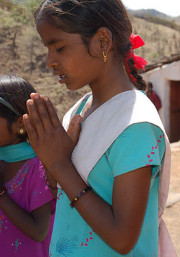
Children's Bible Clubs are
introduced in a community
through a 10-day program.
(Image courtesy of MNI)

India (MNN) ― While believers were gathered at his home singing worship songs, a mob of Hindu extremists brutally attacked Raju,* a church leader trained by Grand Rapids, Michigan-based Mission India.

Dave Stravers with Mission India said about 20 men broke into Raju's home wielding clubs. Radicals destroyed things in the home and then turned their rage to Raju. When his 12-year-old daughter asked the extremists why they were attacking her father, they began to beat her, too.

"Persecution is a growing reality in India," said Stravers. After violently attacking Raju and his family, extremists proceeded to drag the believer and his wife to a nearby Hindu temple.

"They smeared vermillion--which is like a finger-paint--on their foreheads and pushed their heads down…and forced them to worship the idols in the temple," Stravers explained.

"This is a pretty typical thing; it happens quite often in India," he added.

Last month, the Evangelical Fellowship of India observed weekly attacks on Christians. Hindu extremists throughout India threatened and beat believers, often accusing them of "forcible conversions."

Could this escalating violence lead to another Orissa-like situation?

"That possibility is always there, yes," Stravers admitted. "It's impossible to predict when that might happen or where, but it's always a possibility.

"In the meantime, you have these local acts of aggression that happen every week, and many cases every day. This is happening all over India."

One of Mission India's partners believes that a non-Christian relative may have told the attackers about Raju's worship group. Raju and his family are currently in hiding. Stravers said a similar pattern takes place in India whenever believers face persecution: they lie low for a few weeks until the chaos dies down, and then resume their work quietly.

"After a few weeks, people realize that these Christians aren't a threat and that they're actually bringing good to the communities," explained Stravers. "Ideally, Raju will go back to his ministry, and the church will start worshipping again."
Ask God to protect this believer and his family.

"We need to pray that they will take courage, that they will receive comfort and support from other believers," stated Stravers. Pray also that the Gospel would continue moving forward in India.

"India is right on the frontier of what God is doing to make the Great Commission the Great Completion in our day."

Stravers said India is hungry for God's Word. For one dollar, you can send a child to Mission India's Children's Bible Club. Many families learn about the Gospel through their children who attend these clubs.