Wednesday, March 14, 2012

Turkey's justice moves forward...slowly

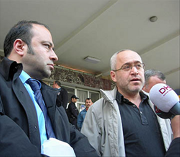
Plaintiff lawyers Erdal Dogan (left)
 and Orhan Kemal Cengiz on the
steps of the Malatya courthouse.
 (Photo by Compass Direct News)
 
Turkey (MNN) ― Compass Direct News says the suspects arrested in Turkey's 2007 Zirve Publishing House murder case were before the court last week telling their story once more.  

The original case stems from the brutal murders of three people (Necati Aydin and Ugur Yüksel and Christian German national Tilmann Geske) who sold Christian literature in a publishing house in the eastern province of Malatya.   

IN Network USA president Rody Rodeheaver explains, "There were several young men who were caught red-handed in this situation. But there has always been the feeling that the people who wielded the knives were not the people who really were behind this."

The arrested are accused of having masterminded and instigated the April murders as part of Ergenekon's plan to lay the groundwork for a military takeover. Rodeheaver says that led to more investigation which uncovered the dark underbelly of Turkey. "They felt that it was a shadowy group called 'Ergenekon' which is a terrorist group at the highest levels of the Turkish military; their goal is to undermine the Turkish government and to keep them out of the European union."

The reason the  judges of the Third Criminal Court of Malatya wanted to hear the testimony was so they could prepare another part of the case that links the suspects to the masterminds. So far, that's been a tough call. Rodeheaver says, "There is a concern on the part of the Christian church that an indictment will not really go deep enough because the lead prosecutor and the head judge were taken off the case, and there's always been a fear that this was the starting of a cover-up."

An indictment of the masterminds behind the murders is expected on April 9 if it process true justice. The trial hearings for the murders of the three Christians continued slowly last year amid advances in investigations and the replacement of key personnel--a move some think was intended to slow justice even more.

Compass Direct says while there were 20 suspects arrested in connection to last year's investigation connecting Ergenekon and Malatya, only seven of them are still in custody--five of whom are in the military. Their report goes on to say evidence garnered from a CD which surfaced was enough to connect the country's agenda, the Malatya murders, and fees for the slayings.

IN Network doesn't have a direct link to the case, but what effects one part of the body affects them all, says Rodeheaver. "If I had any message for the Christian community around the world, it would be to pray that this case would actually do what it was really intended to do -- and that would be to find those who were guilty of these crimes."

IN Network faces both the scrutiny of terrorist groups and the threat of violence. These can be very distracting, Rodeheaver admits. "There have been some spikes in some places trying to intimidate Christians: threats, assassination plots, things like that. But this is a pretty normal lifestyle for the Christians who live in this kind of environment."

Last December, an Al Qaeda plot targeting churches came to light. At the same time, Ergenekon threatened to assassinate IN Network's country director.

While the incidents are unnerving, they won't stop the outreach. Church Planting and Evangelism are carried out by a small church that was planted in Istanbul, through personal visits, discipling church members, and building them up in their faith.

The I.N. Network in Turkey also works with Internet Evangelism -- a "door-opening" forum to chat with those who do not know Christ. A new constitution is in the works, so there is some hope for believers, especially with the advocacy that's come into play with the Greek Prelate.

Turkey is poised for change, notes Rodeheaver. "Anything that changes in Turkey will change because the people of God are praying. Turkey is a very pivotal place in terms of assisting the Christian church to be the church all over the world."

78-year-old woman arrested in Iran

(Photo by Kok Yeo) 
Iran (MNN) ― A 78-year-old Christian woman was recently arrested in Iran, reports the Voice of the Martyrs, Canada.

The elderly woman, a member of the Church of Saint Luke in Esfahan, was held by police for three days. After several inquiries by church leaders, the woman was allowed to return home.

A reason has yet to be given her arrest. Apostasy seems an unlikely charge, reports VOM, since the woman was born into a Christian family and did not, therefore, convert to Christianity from another religion.

The idea of arresting a 78-year-old for no apparent reason is troubling, but the real concern may lie in the woman's church affiliation. It now appears that established churches are being targeted by authorities, not just house churches, notes VOM.

The ministry reports that "the tightening of Iran's oppressive grip against the Christian community in Esfahan has reached new levels since the official media reported the discovery of a truckload of Bibles on its way to the city."
Iran is fifth on the Open Doors World Watch List for the persecuted church.
Pray for Iran. Pray that no charges would be brought against this woman, and p
ray that her random arrest would not deter believers from shining Christ to others. Pray that the Gospel would continue to break through to Iranians as it has been doing under oppression.

Tuesday, March 13, 2012

Pakistani Woman Charged with ‘Blasphemy’ for Refusing Islam


Relatives who became Muslims try to force her to renounce Christian faith.
A young mother has been falsely accused of “blaspheming” Muhammad, the prophet of Islam, because she rebuffed attempts by relatives who had converted to Islam to force her to renounce her Christian faith, family members said.


Police in Khichiwala, Bahawalnagar district, in Punjab Province, charged 26-year-old Shamim Bibi, mother of a 5-month-old girl and resident of the village Chak No. 170/7R Colony, in the Fort Abbas area, under Section 295-C of Pakistan’s “blasphemy” statutes after neighbors accused her of uttering remarks against Muhammad. She was arrested on Feb. 28.


Speaking ill of Muhammad in Pakistan is punishable by life imprisonment or death under Pakistan’s internationally condemned blasphemy laws.


The young woman’s brother, Ilyas Masih, and her brother-in-law, Shahbaz Masih, told Compass that she had been wrongly accused because she had resisted pressure to convert to Islam four days before her arrest.


“Nazeeran, sister of Shamim’s husband Bashir Masih, and her nephew Nadeem and niece Bella accepted Islam on Feb. 24 and called on her to do the same,” Masih said. “She refused, telling them that she was satisfied with Christianity and did not want to convert.”


He said the newly-converted Muslims persisted in trying to force her to convert, but she resisted.


“Shamim told them that she had complete faith in a living God, and that there was no reason for her to start ‘worshiping graves,’” Masih said.


That remark was not the one deemed “blasphemous.” Rather, on Feb. 27 her neighbors accused her of making derogatory remarks – as yet unknown – on a separate occasion about Muhammad while in her courtyard.


Ansar Ali Shah, a local prayer leader in Chak 170/7R Colony, claimed that Shamim Bibi’s neighbors, Hamad Ahmed Hashmi and Abdul Qayyum, told him and other Muslims that they had heard the Christian woman making derogatory remarks about Muhammad in her courtyard, according to the First Information Report (FIR No. 30/12) registered by the Khichiwala police station. But there is no indication in the FIR of what, exactly, Shamim Bibi was alleged to have said.


As word of the allegation spread, a large crowd of villagers besieged her house and demanded “severe punishment for the infidel,” claiming she had hurt their religious sentiments, sources said.


Shahbaz Masih, her brother-in-law, told Compass that Qayyum, one of the two men named in the FIR as witnesses, has denied hearing anything from Shamim Bibi that supports the charge.


“Qayyum told police that he wasn’t even present in his house at the time of the alleged incident and had come to know about it from Hamad, the other witness,” Shahbaz Masih said.


Hamad Ahmed Hashmi, a motorized-rickshaw driver, also was not present at his house at 3 p.m., the time of the alleged remark, Shahbaz Masih said, based on information gathered from Shamim Bibi’s neighborhood.


“Hamad transports schoolchildren and could not have been in his house at the time of the incident, as it was just after school closing hours,” he said.


Bahawalnagar Superintendent of Police Investigation Irfan Ullah acknowledged that one of the two witnesses had admitted to not being present at the alleged “crime” scene at the time of the alleged remark.


“Qayyum told us that he hadn’t witnessed the incident and his name had been included in the FIR by the locals, but still that does not prove that Shamim did not commit blasphemy,” Ullah told Compass by phone. “The other witness is standing by his claim, and she has produced nothing so far which can prove her innocence.”


He vehemently denied that police had caved in to pressure from local Muslims and had registered a case in undue haste.


“I visited the village twice, and so far nothing has come up that suggests that the people have accused Shamim wrongly,” Ullah said. “We registered a case against her on the directions of the district police officer.”


Bahawalnagar District Police Officer Salman Ali Khan could not be reached for comment.


Shamim Bibi’s family and her infant daughter, meantime, may have to wait for a long time for her return. While no one has been executed for blasphemy in Pakistan, most are freed on appeal after suffering for years under appalling prison conditions.


Vigilantes have killed at least 10 people accused of blasphemy, rights groups estimate.


Section 295-C of Pakistan’s blasphemy law states: “Whoever by words, either spoken or written or by visible representation, or by any imputation, innuendo, or insinuation, directly or indirectly, defiles the sacred name of the Holy Prophet Mohammed (PBUH) shall be punished with death, or imprisonment for life, and shall also be liable to fine.”


END

Iraqi Teenagers Stoned to Death for Western Dress and ‘emo’ Haircuts

By Michael Ireland
Senior International Correspondent, ASSIST News Service


BAGHDAD, IRAQ (ANS) -- Religious extremists in Baghdad have stoned to death at least 90 Iraqi teenagers with "emo" appearances in the past month after an inflammatory interior ministry statement dubbed it "devil worshiping," activists said.

An online article published March 9 at http://english.al-akhbar.com  says that  Iraq's Moral Police released a chilling statement on the interior ministry's website condemning the "emo phenomenon" among Iraqi youth, disturbingly declaring its intent to "eliminate" the trend.

"The 'Emo phenomenon' or devil worshiping is being followed by the Moral Police who have the approval to eliminate [the phenomenon] as soon as possible since it's detrimentally affecting the society and becoming a danger," the statement read.

"They wear strange, tight clothes that have pictures on them such as skulls and use stationary that are shaped as skulls. They also wear rings on their noses and tongues, and do other strange activities," it continued.

The website says that religious extremists caught onto the interior ministry statement, and have been harassing and killing teenagers with "strange" or "emo" appearances.

“A group of armed men dressed in civilian clothing led dozens of teenagers to secluded areas a few days ago, stoned them to death, and then disposed their bodies in garbage dumpsters across the capital,” according to activists.

The armed men are said to belong to “one of the most extremist religious groups” in Iraq, the website stated.

“First they throw concrete blocks at the boy's arms, then at his legs, then the final blow is to his head, and if he is not dead then, they start all over again,” one person who managed to escape told the Al-Akhbar website.

The website goes on to say that Iraq's moral police was granted approval by the Ministry of Education to enter Baghdad schools and pinpoint students with such appearances, according to the interior ministry's statement.

The exact death toll remains unclear, but Hana al-Bayaty of Brussels Tribunal, an NGO dealing with Iraqi issues, said the current figure ranges "between 90 and 100," the website said.
"What's most disturbing about this is that they're so young," she said.

According to the web report, Al-Bayaty said the killings appear to have been carried out by extremist Shia militias in mostly poor Shia neighborhoods and said she suspected "there's complicity of the Ministry of Interior in the killings."

Photos of the victims were released on Facebook, causing panic and fear among Iraqi students, the website said.

The web report said a young man with long hair expressed alarm at the government-ordained harassment of teenagers with Western appearances.

“I have long hair but that doesn't mean I'm an Emo. I'm not less of a man if I have long hair. Let's not say that if I have long hair, I'm a homosexual, but I have long hair because this is my style, this is me," he told Iraq's Al-Sharqiya television network.

Safiyyah al-Suhail, an Iraqi MP, said on Thursday that "some students have been recently arrested because they were wearing American jeans or had Western haircuts."

The web report explained that the interior ministry has not disclosed the number of teenage victims, but released a follow-up statement on Thursday warning extremists "not to step on public freedom of Iraqis."

News of the gruesome deaths drew a stern reaction from Iraq's prominent Shia cleric, Grand Ayatollah Ali al-Sistani, who criticized the stoning of the young men as "an act of terrorism."

The Director of the Moral Police of the Interior Ministry released a statement, saying "The 'Emo phenomenon' or devil worshiping is being followed by the Moral Police who have the approval to eliminate [the phenomenon] as soon as possible since it's detrimentally affecting the society and becoming a danger."

The website further explained that 'Emo' comes from the English word 'emotional' and the phenomenon is popular among teenagers not only in Iraq, but in most societies. They use their appearances and movements as a method to express their emotions and embody their will and their view of life in their behavior.

Colonel Mushtaq Taleb al-Mahemdawi said: "The Emo Phenomenon was discovered a while back by members of our force in Baghdad. A report has been made and given to the Ministry of Interior to receive an approval to carry on with the investigation and to know how to eliminate the phenomenon."

He added: "The Ministry of Interior took this situation very seriously and received an approval from the Ministry of Education to set a plan under my full supervision and to allow us to enter schools in the capital."

"There are some cases of the spread of this phenomenon specifically among schools in Baghdad, but we are facing great difficulty in the lack of women on the force who would allow us to carry the investigation more accurately since the phenomenon is more popular among girls between the ages of 14 and 18."

"They wear strange, tight clothes that have pictures on them such as skulls and use stationary (sic) that are shaped as skulls. They also wear rings on their noses and tongues, and do other strange activities."


** Michael Ireland is the Senior International Correspondent for ANS. He is an international British freelance journalist who was formerly a reporter with a London (United Kingdom) newspaper and has been a frequent contributor to UCB UK, a British Christian radio station. While in the UK, Michael traveled to Canada and the United States, Albania,Yugoslavia, Holland, Germany,and Czechoslovakia. He has reported for ANS from Jamaica, Mexico, Nicaragua, Israel, Jordan, China,and Russia. Michael's volunteer involvement with ASSIST News Service is a sponsored ministry department -- 'Michael Ireland Media Missionary' (MIMM) -- of A.C.T. International of P.O.Box 1649, Brentwood, TN 37024-1649, at: Artists in Christian Testimony (A.C.T.) International where you can make a donation online under 'Donate' tab, then look for 'Michael Ireland Media Missionary' under 'Donation Category' to support his stated mission of 'Truth Through Christian Journalism.' Michael is a member in good standing of the National Writers Union, Society of Professional Journalists, Religion Newswriters Association, Evangelical Press Association and International Press Association. If you have a news or feature story idea for Michael, please contact him at: ANS Senior International Reporter

** You may republish this story with proper attribution.

Monday, March 12, 2012

Another Church in Jos, Nigeria Hit by Suicide Bombing


At least three dead in blast by suspected Islamic terrorists.
Two weeks after a suicide bomb attack by the Islamist sect Boko Haram during a church service here left at least three Christians dead, a similar blast during a Catholic Mass today killed at least three people.


As in the Feb. 26 bomb blast outside the church walls of the Church of Christ in Nigeria service, security personnel action apparently forced the suspected Islamic extremists approaching St. Finbar’s Catholic Church in Rayfield, an affluent area of Jos, to detonate their bomb before their car reached the sanctuary where worship was taking place, eyewitnesses said.


At Jos University Teaching Hospital, 14 people were reportedly receiving treatment for wounds following today’s explosion, which damaged the church’s roof, windows and a portion of a fence surrounding its compound. Others received treatment and were released.


Damian Babang, 26, a parishioner at the church, told Compass that he had just completed a reading during the service when he heard the explosion.


“The next thing I saw was the ceiling of the church falling on us and cries of people struggling to get out of the church,” he said. “Many people are injured, and many have died. I cannot say how many died or injured, but I saw dead bodies being carried away, as well as the injured.”


Babang, visibly traumatized as he spoke inside the church building, said he did not understand why churches have become targets of Muslim terrorists.


Retaliatory attacks by Christian youths reportedly took at least seven other lives today.


The Rev. Emmanuel Kundum told Compass that he had concluded the second Mass and left the third service to be conducted by another priest when he heard the explosion at 10:30 a.m.


“On getting outside, I saw members of our church rushing out from the church too – many were injured and others were dead,” Kundum told Compass.


The priest said he was unsure of the number of people killed, as both the dead and the injured were evacuated to various hospitals in Jos by workers of National Emergency Management Agency (NEMA) and the Red Cross Society. At press time NEMA reported three bodies at the site, but it was not clear if those included the suicide bombers.


“It is very difficult for us to say how many of our parishioners that were either killed or injured,” Kundum said. “NEMA officials removed the dead and the injured to hospitals in the city. We are waiting for them to provide us with the details after calm is restored.”


St. Finbar’s is one of the largest Catholic parishes in Jos, with an average attendance of more than 3,000 worshippers each Sunday.


Jos, often described as a religious fault line between the north and the south, has been the site of numerous large-scale and isolated incidents of violence containing a religious component.


Suspected Islamic extremists detonated a bomb outside a church building in Suleja, Niger state, on Feb. 19, two months after Boko Haram Islamists killed 44 Christians and blinded seven in a Christmas Day church bombing in nearby Madalla. The Feb. 19 blast injured at five Christians.


Nigeria’s population of more than 158.2 million is divided between Christians, who make up 51.3 percent of the population and live mainly in the south, and Muslims, who account for 45 percent of the population and live mainly in the north. The percentages may be less, however, as those practicing indigenous religions may be as high as 10 percent of the total population, according to Operation World.


Boko Haram, the name given to the Islamic extremist group officially called Jama’atu Ahlis Sunna Lidda’awati Wal-Jihad – “The People Committed to the Propagation of the Prophet’s Teachings and Jihad” – seeks to impose a strict version of sharia (Islamic law) on Nigeria. The name Boko Haram translates loosely as “Western education is forbidden.”


END


Egyptian Court Sentences Priest to Six Months for Excess Church Height

By Jeremy Reynalds
Senior Correspondent for ASSIST News Service


EGYPT (ANS) -- A court in Edfu has sentenced Rev. Makarios Bolous, pastor of St. George's Church in the village of Elmarinab, Edfu, in the Aswan province, to six months prison and a fine of 300 pounds for violations in the height of the church building.

According to a story by Mary Abdelmassih for the Assyrian International News agency (AINA), the court also ordered the removal of the excess height.

AINA said the church had received a license from the Governor of Aswan and was still under construction, but it was torched by a Muslim mob on Sept. 30 2011. Construction workers had started removing the excess height before the torching of the church.

“Since then no work has been done to it. We are not allowed to pray there or come near it by order of the authorities,” said Father Salib el-Deek of the Coptic Diocese of Edfu.

AINA said he added they had proof that the church applied several times to the police to remove the excess height, which it had started doing before the torching of the church, but were not granted permission. The police records were not allowed by the court as evidence.

AINA said the church lawyer also presented documents showing that Bolous is not the one who is responsible for the removal of the excess height, but the architect and the building contractor. 

However, AINA said, the court refused to take this into consideration and Bolous was convicted.

AINA reported that el-Deek also said that Bolous is not allowed to go inside the village by the village Muslims, and the government has done nothing about this.

AINA said Field Marshall Tantawi, head of the Supreme Council of the Armed Forces, had given orders to the governor of Aswan to rebuild the church at the expense of the government.

“He even told this to Pope Shenouda personally and was mentioned in all papers,” AINA reported el-Deek said. “But the governor did nothing about it.”

AINA said the church will appeal the ruling.

For more information about AINA go to www.aina.org


Jeremy Reynalds is Senior Correspondent for the ASSIST News Service, a freelance writer and also the founder and CEO of Joy Junction, New Mexico's largest emergency homeless shelter, http://www.joyjunction.org He has a master's degree in communication from the University of New Mexico, and a Ph.D. in intercultural education from Biola University in Los Angeles. His newest book is "Homeless in the City."


Additional details on "Homeless in the City" are available athttp://www.homelessinthecity.com. Reynalds lives in Albuquerque, New Mexico. For more information contact: Jeremy Reynalds at jeremyreynalds@comcast.net.

** You may republish this story with proper attribution.