Thursday, December 29, 2011

Report warns unrest could spread in Congo

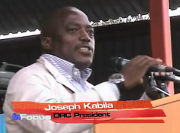
(In Focus screen grab from Congo protest)

Congo-Kinshasa (MNN) ―The electoral commission in the Democratic Republic of Congo has called for backup.
In the chaos following the presidential and parliamentary vote, they're waiting for help from the United States and Britain before resuming the  ballot count in the parliamentary elections.  

Accusations of ballot-rigging have plagued the presidential election, and with roughly 19 000 candidates vying for one of the 500 seats in the National Assembly, the commission is taking no chances. The results of the parliamentary polls are due to be announced on January 13.

A cloud of doubt remains over the announced results from the presidential election. Both the European Union and the U.S. State Department have also expressed severe reservations about the vote's legitimacy, although the country's Supreme Court validated the results.

With that green light, Joseph Kabila was sworn in for another term in office as president of DR Congo eight days ago. In his first week in office, he's faced a public relations nightmare. A Human Rights Watch report lays blame for the deaths of at least 24 people on Congolese security forces. 

Even as he reportedly promised to safeguard national unity, tanks were to prevent protests. Meanwhile, Opposition leader Etienne Tshisekedi maintains he won the poll and had himself sworn in December 23. As a result, there were concerns that post-election violence could spread.

Although the region is one of the biggest and oldest fields for Grace Ministries International, Sam Vinton says so far, they've not been disrupted. "I think that in the Eastern Congo area, where we work from the main cities, I've heard of no real conflict. We've had no communications of any adverse effect on our ministries."

As for the warning of spreading violence, Vinton says it's unlikely to spread to the area where they're working. "A lot of the people in the area where most of our churches are located were probably pro-president (Kabila). But I think in the area of central Congo, where the main opposition is located, I can see that area being in torment and a lot of trouble."

The upheaval has had very little negative impact on their latest evangelistic outreach. In fact,  "It's just amazing how the response continues. We've run out of the 'Book of Hope,' and yet we're showing the DVD of the 'GodMan' and also working in the actual schools. The last report is that close to 4000 students have trusted Christ as their Savior."

4,000 more students coming to Christ, needing discipleship, and a local church body. The GMI team is scrambling to keep up with the demand, because they've run out of everything, and they're trying to get the local churches ready for the onslaught of new believers.

God's hand is all over this project which started with a goal of hoping to see 1000 accept Christ. A year down the road, God has answered beyond their wildest imaginations. "The responsiveness of the students is a remarkable thing when we look back a number of years when it wasn't there. We're pushing forward. We have a team of nine men who are doing this work, and we're just trying to get more funding so that we can keep them going."

It's clear that despite the bullhorns of the rallies and the political jockeying going on, that the voice being heard loudest is the Still Small One.   

Muslim Extremists in Uganda Throw Acid on Bishop

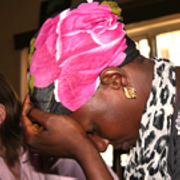
Muslim extremists threw acid on Bishop Umar
 Mulinde outside his church near Kampala.
{Photo: Compass Direct)

Burns threaten eyesight of church leader who opposed Islamic courts.
Islamic extremists threw acid on a church leader on Christmas Eve shortly after a seven-day revival at his church, leaving him with severe burns that have blinded one eye and threaten sight in the other.


Bishop Umar Mulinde, 37, a sheikh (Islamic teacher) before his conversion to Christianity, was attacked on Saturday night (Dec. 24) outside his Gospel Life Church International building in Namasuba, about 10 kilometers (six miles) outside of Kampala. From his hospital bed in Kampala, he told Compass that he was on his way back to the site for a party with the entire congregation and hundreds of new converts to Christianity when a man who claimed to be a Christian approached him.


“I heard him say in a loud voice, ‘Pastor, pastor,’ and as I made a turn and looked at him, he poured the liquid onto my face as others poured more liquid on my back and then fled away shouting, ‘Allahu akbar[God is greater],’” Mulinde said, still visibly traumatized two days after the assault.


A neighbor and church members rushed him to a hospital in the Mengo area of Kampala, and he was then transferred to International Hospital Kampala.


“I have to continue fighting this pain – it is too much,” Mulinde said. “My entire body is in pain. Most of the night I miss sleep.”


His face, neck and arms bore deep black scars from the acid, and his lips were swollen.


“The burn caused by the acid is so severe that there is an urgent need for specialized treatment,” said area Christian Musa Baluku Symutsangira. “I suggest that he be flown outside the country as soon as possible; otherwise Mulinde might lose both of his eyes, coupled with the spread of the burns. The burns seemed to spread and go very deep. He might need some plastic surgery.”


A doctor told Compass that acid burns cover about 30 percent of his face and has cost him sight in one eye.


“We are doing all we can to save his other remaining eye and to contain the acid from spreading to other parts of the body,” the doctor said.


Mulinde’s shirt, tie and suit were in tatters after the attack.


Mulinde said his father, Id Wasswa, was a local prayer leader or imam.


“I was born into a Muslim family, and although I decided to become a Christian, I have been financially assisting many Muslims, as well as my relatives who are Muslims,” he said. “I have been conducting a peaceful evangelism campaign.”


Mulinde said Muslim extremists opposed to his conversion from Islam and his outspoken opposition ofsharia (Islamic law) courts in Uganda, known in East Africa as Kadhi courts, attacked him. On Oct. 15, area Muslim leaders declared a fatwa against him demanding his death.


“I have been receiving several threats for a long time, and this last one is the worst of all,” Mulinde said. “I have bore the marks of Jesus.”


Mulinde is known for debates locally and internationally in which he often challenges Muslims regarding their religion. His extensive knowledge and quotation of the Quran in his preaching has won him enemies and friends. Often criticizing Islam, he has relied on police protection during revival campaigns throughout Uganda.


“Mulinde poses a big threat to those who cannot take the challenge as he engages the Muslims in debate,” said Dr. Joseph Serwadda, an area church leader.


A church guard who was away on the day of the attack said he felt responsible.


“I feel bad,” he said. “I feel I have failed in my duty as a guard.”


Mulinde is married and has six children ages 14, 12, 8, 6 and twins who are 3.


Police have reportedly arrested one suspect, whom they have declined to name. A divisional commander at Katwa police station identified only as Kateebe would say only that an investigation was underway.


The hospital charges 350,000 Uganda shillings (US$140 dollars) per day, a steep amount in Uganda.


“We appeal for our brothers and sisters wherever they are to assist the life of Bishop Umar Mulinde,” said Symutsangira.


Several Attacks
Mulinde, who lives and pastors in Namasuba outside of Kampala, in April led religious leaders in petitioning the Ugandan Parliament to refrain from amending the constitution to introduce Kadhi courts.


He collected 360,000 signatures from former Muslims who have converted to Christianity, he said, and managed to temporarily stop parliament from proposing the constitutional change. When Compass met with Mulinde in November, however, he said there was new momentum to revive the Kadhi courts issue.


In May he was attacked by suspected Muslim extremists after a series of campaigns against Kadhi courts in Namasuba. After presenting his case against the Kadhi courts, he narrowly escaped a kidnap attempt when his vehicle was blocked at eight kilometers (five miles) outside of Kampala at Ndege, two kilometers from his home in Namasuba. Muslim extremists jumped out of the vehicle and shot at the fleeing Mulinde but missed him. He reported the case at the Katwa police station.


Mulinde has faced several injuries and attacks from Muslims since his conversion to Christianity in 1993, including having stones thrown at him after debates in 1998 and 2002.


After Kenya maintained Kadhi courts in its new constitution last year, the attorney general of Uganda wanted to insert Kadhi courts – which presumably would deal only with marriage and family issues for Muslims – into the Ugandan constitution. But Mulinde argued that there would be two judicial systems governing one country.


“If Muslims who convert to Christianity are facing persecution from the Muslims now, then what will be their fate when the Kadhi courts are entrenched in the constitution?” he said.


When Mulinde converted from Islam to Christianity, his family drove him away with clubs and machetes. Since then, he has suffered numerous life-threatening attacks. In 1995 at Mbiji, he was attacked with clubs but managed to escape. In 1998 he was attacked at Kangulomila near Jinja town. In 2000 in Masaka, Muslims bribed the area district commissioner to declare Mulinde’s meetings illegal; Muslims stormed into one of the meetings and dragged him out, beating him till he lost consciousness. Police saved him.


In 2001 in Busia, while addressing another meeting, a Muslim extremist narrowly missed killing him with a sword. In 1994, he survived a gun attack at Natete, near Kampala, when a bullet narrowly missed him. He said that as he fell into muddy waters, his Muslim attackers, thinking they had killed him, said, “Allah akbar.”


Because of the threats against him – in October Muslim extremists sent him text messages threatening to assassinate him – Mulinde had relocated to another area in Uganda.


He has vowed to continue fighting for the rights of the former Muslims haunted by radical Islamists.


END


Tuesday, December 27, 2011

Deadly Nigeria Bomb Attacks Condemned by World Leaders

By Jeremy Reynalds
Senior Correspondent for ASSIST News Service


Damage after the explosion at St Theresa
 Catholic church at Madalla 
(Photo via SkyNEWS website).

LONDON (ANS) -- There has been widespread condemnation in the international community of a series of Christmas Day bomb attacks in Nigeria that killed almost 40 people.

The White House said the attacks were “senseless violence,” and the British foreign secretary called them “cowardly.”

According to a story by the British Broadcasting Corporation (BBC), militant Islamist group Boko Haram said it carried out the attacks.

A blast outside a church near the capital Abuja claimed 35 lives, while a police officer died in the city of Jos and four people were killed in Damaturu.

The BBC reported Nigerian President Goodluck Jonathan said the attacks were “an unwarranted affront on our collective safety and freedom.”

He added, “Nigerians must stand as one to condemn them.”

“Solidarity”
The BBC reported the White House said initial investigation showed the attacks were “terrorist acts,” and pledged to help Nigeria bring those responsible to justice.

Spokesman Jay Carney said, “We condemn this senseless violence and tragic loss of life on Christmas Day. We offer our sincere condolences to the Nigerian people, and especially those who lost family and loved ones.”

The BBC said French President Nicolas Sarkozy expressed “solidarity in (Nigeria's)fight against terrorism.”

German Foreign Minister Guido Westerwelle said, “Even on Christmas Day, the world is not spared from cowardice and the fear of terrorism.”

According to the BBC UK Foreign Secretary William Hague said, “These are cowardly attacks on families gathered in peace and prayer to celebrate a day which symbolizes harmony and goodwill towards others. I offer my condolences to the bereaved and injured.”

Israel said it would send medical aid to Nigeria, and that it “condemned in the strongest terms these attacks carried out on Christmas Day.”

The BBC reported the Vatican said attacking a church was “blind hatred” seeking to “arouse and feed even more hatred and confusion.”

President Jonathan, who is a Christian, said “I want to reassure all Nigerians that the government will not relent in its determination to bring to justice all the perpetrators.”

Angry Crowds

The BBC said the first attack, outside St Theresa's Church in Madalla, near Abuja, killed 35 and wounded more than 50.

The church and surrounding homes were badly damaged.

The BBC said Father Christopher Barde told AFP news agency the blast occurred as the Christmas morning service was ending.

“It was really terrible,” he said. “Some (wounded) people ran towards me (saying), ‘Father anoint me.’”

The BBC said crowds grew angry over the attack and the slow response of the emergency services.

According to the BBC Reuters reported that thousands of youth erected roadblocks on the road from the capital to the largely Muslim north, and were tackled by security forces firing tear gas.

In Jos, a blast close to the Mountain of Fire and Miracles Church was followed by gunfire that left one officer dead, government spokesman Pam Ayuba told the Associated Press.

The BBC said two explosive devices found in a nearby building were disarmed as military were deployed to the site.

In Damaturu, in the north-east, there were two explosions. One was a suicide car bomb attack on a convoy of the State Security Service. BBC correspondents reported that four people were killed there, including the suicide bomber.

There was also an explosion in the nearby town of Gadaka.

Damaturu and Gadaka are both in Yobe state, which has been the epicenter of violence between security forces and Boko Haram militants. The BBC said more than 60 people have died in fighting there this week.

The BBC said a spokesman for Boko Haram, Abul-Qaqa, told local media it carried out the bomb attacks.

Boko Haram, which means “Western education is forbidden,” wants the imposition of Sharia law.

The BBC said the group carried out an Aug. 2011 suicide attack on the UN headquarters in Abuja, in which more than 20 people were killed.

It was also responsible for a string of bomb blasts in Jos on Christmas Eve 2010.


Jeremy Reynalds is Senior Correspondent for the ASSIST News Service, a freelance writer and also the founder and CEO of Joy Junction, New Mexico's largest emergency homeless shelter, http://www.joyjunction.org He has a master's degree in communication from the University of New Mexico, and a Ph.D. in intercultural education from Biola University in Los Angeles. His newest book is "Homeless in the City."


Additional details on "Homeless in the City" are available athttp://www.homelessinthecity.com. Reynalds lives in Albuquerque, New Mexico. For more information contact: Jeremy Reynalds at jeremyreynalds@comcast.net.

** You may republish this story with proper attribution.

Kid's curriculum loses the fluff

(Photo courtesy of Kids of Courage)

USA (MNN) ― This isn’t your typical, everyday Sunday school lesson. No fluff or watering-down can be found in this latest Vacation Bible School curriculum.

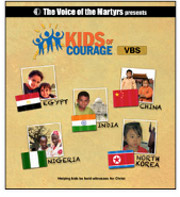
The Voice of the Martyrs just came out with their Kids of Courage curriculum, a challenging series that presents the reality of persecution, forgiveness, and what being strong in your faith really means.

A VOM worker who helped prepare the curriculum says, “A lot of kids can learn about persecution without going into graphic detail. They can learn that we can trust God when we are having problems, and we can even praise Him.”
The curriculum comes with over 50 stories from countries like China, Egypt, India, Nigeria and North Korea where Christians are persecuted daily for their faith.

It also takes care of group leaders by providing crafts and skits for them to use. There’s enough material for leaders to choose which stories and activities are age-appropriate for the group they are teaching.

“Leaders and teachers have said they have wanted to teach children about persecution but they didn’t know how to do it in an age-appropriate way,” says VOM staff member. “They like it when the kids are able to study the same thing as the adults. We have stories that are current about kids their age that are happening right now. Everything in the curriculum is country related or persecution related.”

Some churches have already taken the curriculum and adapted it into a youth program or teaching series. The Kids of Courage curriculum is only $45 and can be purchased atwww.kidsofcouragevbs.com.

Youth Pastor William Thompson states, “As a youth minister, I tend to stay away from lessons that are watered down. In today’s world, I think people need reality rather than fantasy. We enjoyed the curriculum so much, we are going to use it during our Wednesday night youth program so that even more kids learn about the persecuted church and how to be a kid of courage!”

Nigeria fears more Church attacks likely

(Cover photo by Associated
 Press /Sunday Aghaeze)

Nigeria (MNN) ― The Islamist group Boko Haram has claimed responsibility for a number of sophisticated attacks. The group has strong links to al-Qaeda and has been growing quickly in the nine years since its inception. 

Jerry Dykstra, spokesman forOpen Doors USA, says, "We've known that the situation in Nigeria has deteriorated this past year." Recent attacks prove they're intent on making good their threats to push for a caliphate (a government established in Islam) in Nigeria.

This year, bomb attacks ripped through three churches in central Nigeria on Christmas Day, killing over two dozen people. Investigators say the blast at one house of worship near the capital city, Abuja, struck as the service was ending and worshippers were filing out. 

On Christmas Eve last year, a series of bomb blasts around Jos killed 32 people and wounded more than 70 others.  
What's disconcerting about the attacks is that they're showing the militants have gone from sporadic bursts to planning designed to create the most fear and chaos among Christians.   Dykstra explains, "As a result of them being more organized, we've seen more frequent attacks, (that has been underreported, I believe)  and more coordinated, more sophisticated and even going into the South."

Nigerian leaders have been openly criticized by opponents for their slow response to the growing security threats. 

Dykstra notes that the picture emerging bears a chilling resemblance to Iraq's remnant church. "According to people living in the country, the response of the government has been too slow. It looks like what happened in Iraq, where the churches were attacked, and the government did not protect any of those churches. Christians in Iraq fled."

Boko Haram's attacks risk reopening old wounds between the mostly-Muslim north and largely-Christian south. Church leaders in the most vulnerable areas are afraid they're being left to fend for themselves, a conclusion that Dykstra thinks will take the form of more violence against believers in 2012.

The terror they've created and their connection with al-Qaeda seems to have emboldened the Boko Haram. "What they want is really Sharia law all across Nigeria, and they want some of their members released from jail. I think it does not bode well for next year because there could be a civil war in Nigeria, and that could have tremendous repercussions."

Civil war would mean a significant disruption for church planters and others doing Gospel work. Pray for their partners.

 "Nigeria is such a key country for Christians throughout all of Africa. They send out hundreds of thousands of missionaries," Dykstra notes, adding that regardless of what happens in the days ahead, "Open Doors is involved with supporting Christians in crisis situations like this, giving holistic community development, also distributing Bibles and training up leaders."

Chinese Christian attorney receives sentence

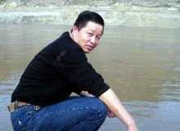
Gao Zhisheng receives a
 prison sentence in China.

China (MNN) ― Gao Zhisheng, the Christian human rights lawyer in China, has been given a three-year prison sentence for "violating the terms of his probation," despite having been missing since April 2010.

According to Christian Solidarity Worldwide's Web site, news of the sentence was reported in Chinese State Media on Friday 16 December. The sentence relates to his 2006 probationary sentence (three years' imprisonment and five years' probation) for "subversion of state power" that is due to expire next week. Gao has not yet appeared in public. There are concerns that he has been severely tortured while missing, as has happened in prior detention. Gao's brother in China and his wife in the U.S. have not been informed formally about Gao's return to prison. There has been no news of his whereabouts, condition, or health since April 2010, and Chinese authorities have repeatedly avoided questions from the international community about his case.

The prominent self-taught lawyer--twice-nominated for the Nobel Peace Prize--first went missing on 4 February 2009. 

Following a brief reappearance in March 2010, Gao went missing again on 20 April as he traveled home to Beijing after visiting relatives in Xinjiang province. He reported being subject to severe torture in detention, and there are grave concerns for his health and well-being. Gao's wife and two children fled from China and are now living in the U.S.

Gao, who was once named one of China's Top Ten Lawyers by the Ministry of Justice, attracted attention from authorities for defending cases of religious persecution, including house church leaders and Falun Gong practitioners. In 2007 he wrote an open letter to U.S. Congress highlighting the use of torture by Chinese authorities.

Mervyn Thomas, Chief Executive of Christian Solidarity Worldwide (CSW), said, "CSW calls upon the Chinese government to release Gao Zhisheng immediately. It is inconceivable that a man who has gone missing at the hands of the authorities could have violated the terms of his probation, and we ask the international community to express their support for Gao in the strongest terms. His disappearance represents a grave denial of rights to a Chinese citizen who has dared to speak up about injustice."

Christian Solidarity Worldwide (CSW) is a Christian organization working for religious freedom through advocacy and human rights, in the pursuit of justice.