Skillet to Lead Winter Jam 2012's All-Star Lineup: "Christian music's largest annual tour announced its 2012 artist and city lineup Monday in Nashville.
Grammy-nominated alternative rockers Skillet will headline the Winter Jam Tour Spectacular, which kicks off in Charleston, W.V., on Jan. 6."
Read more...
“The same sufferings are experienced by your brotherhood in the world” (1 Peter 5).
Tuesday, October 25, 2011
Indonesian Church Denied Site as New Bill Threatens Freedoms
Religious Tolerance Bill’ would only entrench discrimination, critics say.
By Sarah Page
DUBLIN, October 25 (Compass Direct News) – Members of a church in Bogor, West Java, are determined to continue meeting outside their sealed building each Sunday until they are granted freedom to worship inside it, despite a ban on street meetings issued by the local mayor.
“The church will never give up meeting together,” a local source who preferred to remain unnamed said of the Indonesian Christian Church (Gereja Kristen Indonesia, or GKI), in the Yasmin area of Bogor.
The ban on street meetings forced church members to worship at an alternative location on Sunday (Oct. 23).
Amid the stand-off, religious freedom for groups such as the Yasmin church would be dramatically reduced under a “Religious Tolerance Bill” under consideration by the Ministry of Religious Affairs, critics of the proposal say. A constitutional debate is raging in Indonesia over the bill.
On Oct. 9,Yasmin church members and police officers clashed on the street in front of the sealed church building over the Christians’ right to meet there. According to local media reports, West Java police are now investigating complaints filed by both sides; a police chief has accused church members of knocking him unconscious, while the church has countersued police for disrupting its service.
In defiance of a Supreme Court order early this year affirming Yasmin’s constitutional right to freedom of worship, Bogor Mayor Diani Budianto canceled the church’s worship permit, locked and sealed their church building and banned church members from meeting on the street (see www.compassdirect.org, “Mayor in Indonesia Again Balks at Granting Church Permit,” Aug. 15). The permit had been hard-earned; under terms of a 2006 Joint Ministerial Decree, all churches must meet strict criteria to qualify for a church worship permit, including proof of at least 90 church members, signatures of approval from at least 60 local residents, and approval from village officials and a local interfaith forum.
Yasmin church officials have since refused offers from local authorities to relocate to another building, citing the case of the Batak Christian Protestant Church in Bekasi, West Java, evicted from their previous premises and now denied a building permit.
Rights Experts Condemn Bill
Following a sharp rise in similar conflicts over the past two years, the Religious Affairs Ministry is considering the Religious Tolerance Bill, first proposed by the Ministry in 2003 and revived in February following the brutal murder of three members of the Ahmadiyah sect. The group has often been targeted by Islamic radicals for its claim that Muhammad was not the last prophet of Islam.
Religious Affairs Minister Suryadharma Ali, Home Affairs Minister Gamawan Fauzi and Coordinating Minister for People’s Welfare Agung Laksono met last week and announced their joint endorsement of the bill to local media.
Bonar Tigor Naipospos, deputy chairman of the Setara Institute for Peace and Democracy, said the bill will simply legitimize existing discriminatory regulations in the 1965 Anti-Blasphemy Law as well as those in the 2006 Joint Ministerial Decree. The decree has contributed to many conflicts, including the current clash in Bogor. The new bill places more stringent limits on proselytizing, constructing places of worship and religious education, according to The Jakarta Globe.
Elaine Pearson of Human Rights Watch fears that the law – proposed by the same ministry that has called for a complete ban on Ahmadiyah – will further entrench discrimination against religious minorities.
Dr. Musda Mulia, chair of the Indonesian Conference on Religion and Peace, told The Jakarta Post that many articles in this bill are not compatible with the principles of democracy, pluralism and human rights. Rather than limiting religious activities, the government should ensure that all religions receive equal treatment, he added.
The success or failure of the bill rests on the terminology, Fajar Riza Ul Haq, executive director of the Maarif Institute, told the Globe. “They should have drafted a religious freedom bill instead of this one,” he said.
Faith Out of Focus
A European Union delegation is holding a two-day seminar to discuss the conflicts, another local source told Compass on Monday.
“But only moderate Muslims are attending,” he said. “If members of the Front Pembela Islam [Islamic Defenders Front, or FPI] and other radical groups had joined in, I’m sure the discussion would have been more helpful.”
One participant who attended yesterday told Compass that speakers did not address violence against Christians at all; rather, they emphasized “organizing and maintaining inter-religious dialogue.”
Organized jointly by the European Union Delegation to Indonesia and Brunei and Nahdlatul Ulam, one of Indonesia’s largest Muslim organizations, the seminar sought to “explore the contribution made by faith organizations to the fulfillment of human rights and the challenges in balancing respect for freedom of religion with other human rights, including the freedom of expression,” according to a press release on the E.U. delegation’s website.
“We must [ensure] … that the legitimate assertion of religious belief is reconciled with broader human rights concerns,” Julian Wilson, head of the delegation, wrote in the release.
Moderates Urge Government to Act
Moderates of all faiths, however, are frustrated by the government’s failure to address these issues.
“I think Yasmin church will just have to stand firm, despite the risk of being roughed up by the police,” the source close to the church said. “As we’ve seen in previous cases, it may take one or more casualties, drawing unwanted media attention locally and internationally, before the government moves in more seriously to protect the Christians.”
Moderates were particularly annoyed at the government’s failure to address forced church closures.
“As usual, the president sits by and does absolutely nothing, while the mayor of Bogor ignores the Supreme Court rulings and suffers no consequences,” one online reader commented at the foot of a Jakarta Post story about Yasmin church on Oct. 11.
Local authorities often adopt regulations or bylaws that are at odds with Indonesia’s constitution (see www.compassdirect.org, “Christians Call for Rejection of Sharia-Inspired Bills,” Aug. 19, 2009). Rahmat Effendi, acting mayor of Bekasi in West Java, recently banned the Ahmadiyah from “any activity that may be interpreted as an effort to spread its beliefs.”
The ban – faithful to Indonesia’s 1965 Anti-Blasphemy Law but contrary to constitutional guarantees of religious freedom – came into effect on Oct. 13. Ahmadis in Bekasi have since met under strict police surveillance.
Based on these inconsistencies and the apparent bias in application of existing laws, many Indonesians doubt that the new bill will improve conditions for religious minorities.
“Look at the rising mob crime and violence, the irrational sentencing in the February murders of three Ahmadis, the hate rhetoric in Bogor and the real Islamic violence towards anyone who is not a fundamentalist,” a reader identified as Dr. Dez commented on a Jakarta Globe story posted yesterday. “These issues are all inter-related. The bill will drive a further wedge into divided communities, resulting in more violence. Then the new Intelligence Bill will allow victims to be detained as a threat to security.
“Please have a conscience and speak out,” he added. “You are not just safeguarding groups like the Ahmadi, but your children too.”
END
'New' Libya to be ruled by Islamic law, polygamy permitted – NTC | World | RIA Novosti
'New' Libya to be ruled by Islamic law, polygamy permitted – NTC | World | RIA Novosti: "Islamic sharia law will prevail in liberated Libya and any existing laws that contradict it will be abolished, National Transitional Council leader Mustafa Abdel Jalil said on Monday."
Read more...
Read more...
Location:
Libya
Christian Mother of Five in Nigeria Killed
Soldiers containing inter-religious youth fighting shoot her in her home.
By Obed Minchakpu
BAUCHI, Nigeria, October 24 (Compass Direct News) – Nigerian soldiers summoned to stop inter-religious fighting between Muslim and Christian youths last week shot and killed a Christian mother of five in the Yelwa area of Bauchi city, according to family and church sources.
Soldiers were called in to restore calm following fighting that broke out at a high school soccer match on Thursday (Oct. 20), and later three Muslim soldiers shot and killed Charity Augustine Agbo and a Christian boy. The circumstances leading to the shooting of the boy, who is unrelated to Agbo, were not immediately known, and his name was not disclosed.
“There was not any justifiable reason for the soldiers to have shot the woman,” said the Rev. Lawi Pokti, chairman of the Christian Association of Nigeria (CAN), Bauchi State.
Pokti confirmed the shooting of the boy, who was initially reported as having been killed, and said he had been resuscitated in a hospital.
Augustine Agbo, husband of the murdered woman, told reporters that three soldiers shot his wife after storming their house on Lagos Street in the Yelwa area of the city.
“Three soldiers arrived in a Hilux vehicle with siren blaring, scaring us and forcing us to run into our houses,” he reportedly said. “When we all ran inside, we saw these three soldiers coming to our house; then we locked the outside gate, but the soldiers followed us and broke the glass door and forced the door open and shot my wife twice on the chest.”
Agbo reported the shooting to the Army commander in Bauchi, and his soldiers later came to his house to take his wife to an area clinic owned by the Church of Christ in Nigeria, he reportedly said.
“After they left, the situation became worse, forcing us to take her to the ATBU Teaching Hospital, where she later died,” he told reporters.
The inter-religious violence erupted during a soccer game at the Baba Tanko Secondary School in Kagadama, a part of the Yelwa area, and then spread to other parts of Bauchi city. Other Muslims reportedly joined Muslim students from the school, attacked Christians and set their homes ablaze.
The Baba Tanko Secondary School is known as a hotbed of Islamic extremism, with Christian sources saying that most religious conflicts in Bauchi have been triggered by Muslim students at the school. In 2007, Muslim students along with other Muslims attacked Christians, killing dozens of them and destroying Christian-owned homes.
Mohammed Majeed Ali, assistant commissioner of police with the Bauchi State Police Command, confirmed the outbreak of the religious violence; he told Compass that the crisis has been contained.
For more than a decade, Christians in Bauchi state have been under pressure from Muslim extremists who have destroyed Christian worship places and killed Christians, said Pokti of CAN. Earlier this year, the Rev. Ishaku Kadah and his wife were abducted and killed, as was pastor Irimiya Maigida.
“I want to make it categorically clear that enough is enough, because despite the fact that the Christian community has constantly remained peaceful, it has become a target for these extremist Muslims even when there is peace,” he said.
Pokti faulted the government for being slow to prosecute Muslim extremists.
“Because of lack of pro-active measures by the government to ensure peace in Christian areas in the state, Christians are being killed by Muslim extremists, and none of them has been brought to book,” he said. “The lukewarm attitude of the Nigerian government to problems of persecution facing Christians has made it easy for Muslim extremists to attack Christians and get away with such crimes.”
END
**********
Copyright 2011 Compass Direct News
Church Faces Increasing Hostility in Sudan
Constructing worship buildings more difficult since secession of South Sudan.
Special to Compass Direct News
KHARTOUM, Sudan, October 24 (Compass Direct News) – Emboldened by government calls for a Sudan based on Islamic law since the secession of South Sudan, Muslims long opposed to a church near Khartoum have attacked Christians trying to finish constructing their building, sources said.
The Sudanese Church of Christ (SCOC) congregation in Omdurman West, across the Nile River from Khartoum, has continued to meet for Sunday worship in a building without a roof in spite of opposition from area Muslims and local authorities, the sources told Compass. Claiming that Christianity was no longer an accepted religion in the country, Muslims in the Hay al Sawra, Block 29 area of Omdurman West on Aug. 5 attacked SCOC members who were constructing the church building, the sources said.
“We do not want any presence of churches in our area,” shouted members of the mob as they threw stones at the Christians, the sources said.
Muslims in the north, where an estimated 1 million Christians still live following the secession of South Sudan on July 9, fear the potential influence of the church, they said.
“They want to reduce or restrict the number of churches, so that they can put more pressure on believers,” said a church leader on condition of anonymity.
The SCOC has been trying to erect a church building on the site since it obtained the land in 1997, but both government officials and area Muslim residents have used delay tactics to prevent it, according to a Christian who lives in the area. The SCOC in that area of Omdurman is still trying to get permission from the Islamic government in Khartoum to construct the new church building, Christian sources in Khartoum said.
Muslims and local “popular committees” – responsible for issuing residence certificates necessary for obtaining citizenship or an ID card, with authority to strike down proposals for erecting church buildings – assert that no church is necessary because there are no Christians there. But there are many Christians living in the area, sources said.
The government-appointed members of the popular committees tend to consist of radical Muslims who monitor Christian activities in neighborhoods so they can report them to security authorities, Christian sources told Compass. Previously, area Christians were upset to learn that the popular committees had divided another piece of land they hoped to obtain into two lots – one designated for a mosque, and the other for a Muslim school, sources said.
“We have already raised our objection over the way we are being treated in regards to obtaining permission to build this church,” said a church leader who wished to remain unnamed.
The church had filed a complaint with the Ministry of Guidance and Religious Endowments, which last month informed the SCOC that officials will investigate the matter, though they gave no time frame.
Meantime, the congregation finds that rain or whirling dust makes worship difficult, members said.
“I think we have much experience in how difficult it is to obtain permission for new church buildings in this country,” said a Christian leader who requested anonymity.
All religious groups must obtain permits from the Ministry of Guidance and Social Endowments, the state ministry of construction and planning and the local planning office before constructing new houses of worship, according to the U.S. Department of State’s 2010 International Religious Freedom Report.
Earlier this month, Sudan President Omar al-Bashir again asserted that the government has decided that Sudan will have a strictly Islamic identity. Al-Bashir, wanted by the International Criminal Court for crimes against humanity in Darfur, made the statement to leaders of his party in Khartoum on Oct. 12.
Last December, one month before South Sudan’s vote for independence, Al-Bashir declared that if the south seceded as expected, Sudan would amend its constitution to make sharia(Islamic law) the only source of law and Arabic the official language.
END
**********
Copyright 2011 Compass Direct News
Monday, October 24, 2011
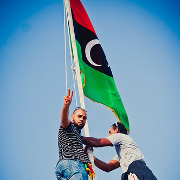
Who will run the new Libya now?
Mission Network News: "Libya (MNN) ― With Libya united to topple Muammar Gaddafi, the question upon his death is: Whose revolution was it?
There were multiple heavily-armed militias fighting together to remove the regime, and now that the smoke is clearing, they've laid claim on a territory and cause."
Read more...
There were multiple heavily-armed militias fighting together to remove the regime, and now that the smoke is clearing, they've laid claim on a territory and cause."
Read more...
Labels:
bibles,
gaddafi,
gospel,
libya,
open doors,
persecution,
religious freedom
Location:
Libya
Subscribe to:
Posts (Atom)