Showing posts with label salafi. Show all posts

Monday, December 3, 2012

Crisis tests Egyptian constitution

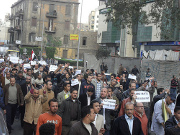
Tahrir Square, November 2012
(Cover photo by Moud Barthez. Story photo courtesy Open Doors USA.)

Egypt (MNN) ― Egypt has a new draft constitution, but it didn't come about the way people hoped. 

On Friday, in a 16-hour vote, Islamists approved the charter without the participation of liberal and Christian members. The move essentially pre-empted a court ruling that could dissolve the constituent assembly, but it also inflamed the conflict between the opposition and President Mohammed Morsi.

The draft still faces a national vote in the next 30 days. If it remains unchanged, human rights experts say Muslim clerics could bring restrictions on freedom of speech, women's rights, and other liberties. 

Secular and Christian leaders complained that hardline Islamists were determined to draft a constitution heavily influenced by Sharia law. In frustration, at least 20 members of the constitutional assembly had resigned in protest by early November. 

Without dissenting opinion, the Islamists included what they wanted. By the time the vote rolled around, television footage of Parliament's chamber showed that of the 85 members in attendance, not a single Christian was present and there were only four women, all Islamists. Many of the men wore beards, the hallmark of Muslim conservatives.
It is against this backdrop that the new Coptic Pope Anba Tawadros, takes up the leadership staff. 

His is a term where Christians have faced increasing pressured since the January 2011 revolution that deposed President Hosni Mubarak. There's been a corresponding rise in anti-Christian violence, and Christians now wonder what their role is. Todd Nettleton, a spokesman for the Voice of the Martyrs USA, says, "Christians in Egypt are concerned because the government really seems to be moving against them, and there are not a lot of positive signs where they would feel protected or they would feel like there's going to be more freedom for Christians in Egypt; it seems like it's going in the other direction."

Pope Tawadros immediately made it clear that his focus was not the political arena. Nettleton explains, "He has talked about focusing on the Church and Christianity rather than focusing on what the government is doing. We'll see what that means to him over the coming weeks and months as we see how he responds." 

However, with no input from the Christian community in the country's constitution, people are looking to Pope Tawadros for guidance since he's the voice and face of the Coptic Church in Egypt. Given what's at stake, says Nettleton, expectations are high. "They hope that he will be a voice that says ‘Christians have a place in Egyptian society. Christians deserve protection.They deserve the freedom to worship without fear for their lives'." 

That begs another question: will the pope change his approach given the circumstances unfolding in Egypt over the last 10 days? What will be his level of representation on behalf of the Christians in front of the state? The pursuit of a secular state would benefit Christians more than a religious one, since that's the direction they're headed in now. 

Concerns over the lack of representation in the draft constitution surface as the reality of religious freedom issues emerges. Nettleton notes, across all age groups in the Egyptian Church, "The biggest concern is probably what the place of the Christians is going to be in Egyptian society under the new government. Are they going to be a protected minority that is allowed to exist and allowed to worship and allowed to meet together? Or are they going to be pressured to disappear?"

Pope Tawadros is expected to continue encouraging Christians to step by themselves into the political arena and take things in their own hands. To do that, he will need to stop doing it for them. This will be a time for growth amongst followers of Christ in Egypt. 

Although the news of the charter was dismaying, it's not even close to the final chapter. In fact, it may be the beginning of a new one. Hardship is a unique crucible for the Gospel. Nettleton sums it up this way: "They [Christians] can be an incredible witness for Christ because the ability to forgive and the ability to love those who are persecuting us: there is not a human explanation for that. It can only be a supernatural explanation that God and the Holy Spirit have empowered us to be able to live that way."

Tuesday, October 2, 2012

Nigerian seminary attacked; broader aim revealed

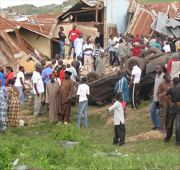
File footage of past attacks on churches in Nigeria (Courtesy Compass Direct)

Nigeria (MNN) ― A bomb blast and gunfire shook an area around a seminary in northern Nigeria on Sunday, leaving two dead. 

It was not immediately clear who was behind the blast in the city of Zaria, but extremist group Boko Haram has been blamed for hundreds of deaths as part of its insurgency in northern and central Nigeria.

Investigators said the blast was the result of an improvised explosive device. The targeted area included the school as well as the worship center.

Sound like a familiar story? In this case, it involved the Salafi, students who are studying Sunni Islam. Todd Nettleton, spokesman for Voice of the Martyrs USA, explains what this might mean. "I think it goes to show the nature of Boko Haram, that they have a very narrow vision of what Islam is and what it should be, and they want all Nigerians to fall within that very narrow vision." Nettleton goes on to say that reports indicated "the Salafist cleric who runs this Islamic boarding school has been at odds with Boko Haram in the past. It seems like that is a strong possibility of a Boko Haram attack in Nigeria." 

The violence came a day ahead of commemorations marking 52 years of Nigerian independence. However, says Nettleton, "They celebrate independence, but I think there's a real threat to their independence that is growing in northern Nigeria among Boko Haram."
 
Nigeria's north has been hit by scores of deadly attacks attributed to Boko Haram. In the last two years, their rebellion has cost 1,400 people their lives. 

While Boko Haram has claimed to be fighting for the creation of a state in Nigeria's north, Nettleton warns: don't be fooled. "They talk about wanting an independent state that would be run according to their vision of what true Islam is, but their demands have changed over time, as well."

The lines have gotten muddied on what Boko Haram actually wants. The name of the group is generally translated as "Western education is sinful," but in Hausa it literally means "book forbidden." The founders of the group believed Islam had been corrupted by Westernization, especially education and Christianity. They also rejected the legitimacy of the state and of Muslim traditional rulers. 

What they wanted, explains Nettleton, was a Sharia state governed by orthodoxy. "Obviously, Christians fall outside of that. We've seen attacks on churches, we've seen attacks on Christian institutions, but this shows that even if they [Boko Haram] think fellow Muslims are outside of what they call the ‘true teaching of Islam,' they will attack them as well."

The battle for Nigeria's soul intensifies. While Islamic terrorists rely on weapons and fear, Nettleton says Christians need to trust in God's love and eternal promises. That's also one of the challenges for the church in Northern Nigeria: the issue of fear. "Just imagine when you wake up Sunday morning and are deciding, ‘Should we go to church or not?' If you add in the threat that ‘maybe our church will be bombed while we're there this morning,' you imagine the sense of fear and the sense of concern that that would raise." 

That's what standing in solidarity would mean, Nettleton adds. "We can pray with them against that spirit of fear, and against that spirit of intimidation. I think the second issue then becomes: 'How are we going to respond to those who attack us? How are we going to respond to the Muslims around us?' There is obviously a place for evangelism; there's a place for sharing." 

The bigger issue is how to respond to the violence of the insurgents and "the issue of forgiveness, the issue of loving those who society would say are our enemies. That's a difficult thing, and that's another thing that we can pray for our Nigerian brothers and sisters, for them to be able to do that with God's help."

Ask God to protect them and help them as they seek to respond in love and prayer for their Muslim attackers. Pray for the attackers, that God's mercy and grace might pierce through the hardness of these hearts so opposed to His name. Ask God to send peace to Nigeria. 


Wednesday, May 2, 2012

Egypt's elections loom; future uncertain for Christians

Mission Network News: "Egypt (MNN) ― The disharmony between Egypt's military government and the Islamists continues to spread.

Parliament suspended sessions for a week to protest the lack of transition by the ruling military. Seated three months ago, this branch of government wants to form a Cabinet to replace the one appointed by the country's military rulers late last year."

Read more...

Wednesday, January 25, 2012

As Egypt marks one year since revolution, Christians look past surface tension to real need

Photo by Ramy Raoof,
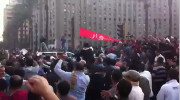
 Demonstrators heading to Tahrir
 Square in January 2011

Egypt (IMB/MNN) ― Egypt's new lower house of parliament just held its first session two days ago, after completing an historic election that put Islamic groups in the legislative lead.

A year ago, Cairo was in turmoil as thousands of angry protesters clashed with government soldiers and tanks.
While the square seems calm, there's an energy that leads Christian worker to note the region's volatility.

Lucy Hamilton (not her real name), with the Southern Baptist International Mission Board says the Arab Spring was the manifestation of the tension in the region. "In Egypt at least, there's a revolution attitude of ‘I can do what I want' because people are disillusioned and desperate, and the police force is unable to keep up with petty crime problems."

The changes in Egypt haven't been as deep as many expected, but they have still made a region-wide impact, says Nik Ripken (not his real name), who has served 25 years with the International Mission Board and is an expert on the persecuted church in Muslim contexts.

"I believe that the Arab Spring and what has happened in Egypt has begun to redefine the Arab if not the entire Muslim world," Ripken says. "What has happened to Mubarak has so terrified the leaders of countries like Yemen and Syria,  and of course we saw what played out in Libya -- that no dictator or leader is now willing to participate in a peaceful transition to a more democratic or less corrupt form of government."

The people seem to want something as different as possible from the leadership they've had, Ripken notes, adding that this may mean a more Islamic form of government.

Because Egyptian people don't feel like they have gotten the jobs, economic improvement, new opportunities or respect, not much has changed in their view. Proving Ripken's point, the winners of the elections came from the Muslim Brotherhood and the ultra-conservative Salafi al-Nour party.


But with this, much like Tahrir Square on its peaceful days, things may not be exactly as they appear, says Ripken. "This is not necessarily a bad thing from a believer's point of view, because having conversations concerning faith and religion are more important for us than conversations about government and corruption." Ripken continues, "Often it is in the most conservative of Muslim hearts that we are finding God appearing to them in dreams and visions and sending them on a spiritual pilgrimage that can last for years, where they secretly read the Bible many times and have quiet discussions with followers of Jesus Christ."

Hamilton says a sense of hopelessness in the government can bring them to Christ, too.

"We hear that many are turning to the One whose Kingdom is just and merciful and has no end," she says. "The church in Egypt also seems to be waking up as never before. It is great to watch Him use His church in the work of revolutionizing hearts."


In the light of this, Ripken says, "We want to pray that we will take every opportunity we can to feed the hungry, clothe the naked, give that cold cup of water in Jesus' name. We must pray for the absence of fear for both believers in country and those from the West who are seeking to meet the needs of both the body and soul inside these countries." 

Pray that people will have access to the Gospel through any means possible. Ripken concludes with this thought: "Now we have time to prepare the next generation for going to people groups and countries that have experienced massive change."