Tuesday, March 6, 2012

Raids, Threats and Warnings in Belarus for Religious Meetings

By Jeremy Reynalds
Senior Correspondent for ASSIST News Service


Police chase anti-communist protestor

BELARUS (ANS) -- On the same Sunday in January, police and local officials visited three worship services in villages in different parts of Belarus, issuing threats and warnings over what they claimed were unauthorized meetings. Court proceedings against two of their pastors might follow.

Forum 18 News Service reported that in February, police in the capital Minsk launched a mass raid on a cultural meeting being held in a pastor's home. All were meetings organised by local congregations of the Pentecostal Church.

Three Jehovah Witness communities which have been unable to gain mandatory state registration suffered raids during meetings for worship in the last quarter of 2011.

Forum 18 said Belarus imposes strict controls on exercising freedom of religion or belief without state permission. All unregistered activity is banned under the highly restrictive 2002 Religion Law, while activity by registered religious communities away from their legal address is similarly illegal.

Raid

Forum 18 said police raided a meeting to discuss historical and cultural issues in Minsk on the evening of Feb. 8. About 34 members of several Minsk Protestant churches – including Grace Church and the Church of Jesus Christ - and a small number of students who did not belong to any church were detained.

An hour after the meeting started in the house of Antoni Bokun, Pastor of John the Baptist Pentecostal Church, OMON special riot police officers – some in masks - broke in through the windows and ordered all the 55 people present, including children, to gather in one room.

Forum 18 said police explained to the detained that a police hotline had received a call informing them of a secret drug laboratory in the Pastor's house. Thirty four participants were taken to a police station, but were released two hours later without any explanation and without any official record being drawn up. (Drawing up such a record is a legal requirement.)

Dmitry Fedoruk, a Pentecostal who took part in the meeting, expressed his doubts to Forum 18 that it was a raid in search of drugs, as the officers were unarmed, and did not have forensic investigators and sniffer dogs with them to search for drugs. Without presenting identification, officers took out cameras and started to videotape.

Another member of John the Baptist Church, Boris Goretsky, told Forum 18 that besides intimidation, the purpose of the raid was to get more information about the meetings and the people who attend them.

“Though it was not a religious meeting, this one had a symbolic topic: we were to discuss a book by Belarusian writer Franciszek Alachnowicz about the punitive Soviet system,” Pastor Bokun told Forum 18. The next discussion in the series is to cover a “long expected event,” publishing the Bible in Belarusian.

“The only thing they wanted was to arrest everyone..”

John the Baptist Pentecostal Church has faced pressure in the past. Bokun was fined and detained for three days in 2007 for religious activities without state permission.

Asked if he connected the raid with his previous issues, Bokun said that the intruders gave no reason for such connection.

“We were not asked any questions and nobody answered ours,” Bokun said. “It seemed that the only thing they wanted was to arrest everyone, take passport details and then release us.”

He added that it was just like in Soviet times, when police were waiting at the door of the church taking passport details of those attending worship.

Dmitry Fedoruk, who was among those detained, told Forum 18 that at the police station those detained had a chance to pray and sing.

“The policemen were at first at a loss, then pretended that they didn't care, and finally started to feel nervous,” Bokun said. He added that many of Minsk's senior police officers were present, but none of them were able to explain to the detained church members what was going on.

Forum 18 reached the head of Moscow District Police Station, Nikolai Nazarov. He declined comment.

Complaints at police action

Sergey Khomich, Bishop of the Pentecostal Union to which John the Baptist Church belongs, said that he was shocked by the police actions.

“The meeting was within the bounds of the Church's Statute and no law was violated,” he told Forum 18. The day prior he submitted a written complaint to Aleksandr Barsukov, the head of Minsk City Police.

A formal official reply, signed by the Head of Minsk Security Police Yury Sorokin and seen by Forum 18, informed Bishop Khomich that his complaint would be not considered because he had not attached documents confirming his position. Despite this, the letter was addressed to him as Bishop of the Pentecostal Union at his Church's address.

Forum 18 said when the news organization called the Minsk City Police, the person who answered the phone refused to transfer the call to Colonel Barsukov. Forum 18 repeatedly called the Police Press Service, but each time the telephone went unanswered.

Threats, warnings

Forum 18 said three Pentecostal pastors faced problems in January for leading religious worship, which the authorities regarded as illegal. At least two of them received verbal official warnings and were required to sign official records.

On Jan. 8 in the village of Ogarevichi in Brest Region, local officials and a local police officer attended Sunday worship led by Pastor Vasili Raptsevich.

Forum 18 said two days later, Raptsevich was ordered to the police station in Gantsevichi where the Pentecostal community is registered. There he was told that he had violated the law by conducting a religious service away from its legal address without permission from the Regional Executive Committee. Ogarevichi is about four miles from Gantsevichi.

“In Ogarevichi there are about ten disabled believers who can't walk without crutches and we have been visiting them regularly for many years,” Raptsevich told Forum 18.

In 2011 the Gantsevichi Pentecostal community bought a house in the village to make it easier for the disabled church members to pray together.

“At the police station they threatened to take away the church's registration if I don't stop violating the law,” Raptsevich told Forum 18.

Though he denied all the charges - insisting that since the church bought the house it could use it for religious purposes - he was made to sign an official record. He was told that he would be summoned to court later.

Forum 18 did reach local police officer Andrei Bukato, who had taken part in the raid, but he declined comment.

Forum 18 said when Raptsevich later talked with the Deputy Head of Gantsevichi Regional Executive Committee Nikolai Volynets, he told the pastor either to apply for permission or visit the believers individually in their homes. He insisted that Raptsevich and the church had violated the law.

Volynets acknowledged to Forum 18 that Raptsevich had been warned, but explained, “It's not a question of prohibiting, but of keeping all the formalities.”

Forum 18 said on Jan. 8 in the village of Lasitsk, 28 miles from Pinsk, the authorities also attended the congregation's Sunday service.

Officials issued Pastor Anton Yatskevich with an official warning.

“There are a lot of people with different problems who need help, and as Lasitsk village is too far from Pinsk we come ourselves,” Yatskevich told Forum 18. He said that the Lasitsk congregation has fewer than twenty members, not enough to register a community.

However, Yatskevich wouldn’t blame the authorities for checking on the church's services. He said, “They get complaints from Orthodox believers and have to respond.”

Forum 18 twice called the village council, but the phone was not answered.

Also on Jan. 8, Pentecostal Pastor Viktor Kokhovets was given an official warning for leading Sunday worship in the village of Kovnyatin in Pinsk Region, the Bishop's Assistant in the Brest and Pinsk regions Fyodor Suvorov told Forum 18.

Forum 18 said the news service repeatedly called the head of the village council Konstantin Shlyazhko to find out why Khokhovets had been warned for leading religious worship, but the telephone went unanswered.

Forum 18 said police officers told Raptsevich that he would face a court hearing. However, it is unclear if that will be the case.The Bishop's assistant told Forum 18 that Kokhovets simply received a warning and no court procedures are expected “unless there are further violations.”

For a personal commentary by Antoni Bokun, Pastor of a Pentecostal Church in Minsk, on Belarusian citizens' struggle to reclaim their history as a land of religious freedom, see F18News May 22 2008www.forum18.org/Archive.php?article_id=1131.

For more background information see Forum 18's Belarus religious freedom survey atwww.forum18.org/Archive.php?article_id=1311.


Jeremy Reynalds is Senior Correspondent for the ASSIST News Service, a freelance writer and also the founder and CEO of Joy Junction, New Mexico's largest emergency homeless shelter, http://www.joyjunction.org He has a master's degree in communication from the University of New Mexico, and a Ph.D. in intercultural education from Biola University in Los Angeles. His newest book is "Homeless in the City."


Additional details on "Homeless in the City" are available athttp://www.homelessinthecity.com. Reynalds lives in Albuquerque, New Mexico. For more information contact: Jeremy Reynalds at jeremyreynalds@comcast.net.

** You may republish this story with proper attribution.

Several Christian converts arrested in raid on Iranian house church

By Michael Ireland
Senior International Correspondent, ASSIST News Service


TEHRAN, IRAN (ANS) -- Thirteen Christian converts have been arrested following an attack by security authorities on a house church in Iran. Three of them are being held in custody at an unknown location, according to Mohabat News (www.mohabatnews.com ) .

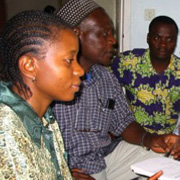
Three of the arrested Kermanshah House Church Christians. (Photo courtesy Mohabat News).
The news agency says that February 21, 2012, at 7 in the evening, security authorities raided a home dedicated to be used a house church and seized all thirteen gathered there for worship. To date, no precise news is available regarding some of these detainees.

Mohabat News says that during this incident, security authorities who were wearing plain clothes transferred these Christians to an unknown location while insulting and abusing them.

The authorities also invaded and thoroughly searched the detainees' homes and confiscated some of their personal belongings.

Numerous Christian converts have already been arrested in various cities in their house church gatherings, homes or workplaces by order of judicial and security authorities of the Islamic Republic of Iran, as a result of the continued anti-Christian wave in Iran during past months.

Now, in addition to Ahwaz, Shiraz, Esfahan and Tehran, this on-going wave has reached the city Kermanshah, 526 KMs west of Tehran, in the western part of Iran.

A knowledgeable source told Mohabat News that the Christian detainees may have been transferred to a building in Hafezieh Junction in Kermanshah or 22-Bahman Street which is known as the location of security and intelligence forces.

The source said that nine of these detainees (their names are not given due to security reasons) were released the next day after their photos were taken, their details and fingerprints recorded and they signed a disclaimer stating they would not attend any Christian gatherings.

Mohabat News also received word that Ms. Azadeh Sharifi was released on February 28 after enduring 8 days in custody. As yet, no detailed information has been received regarding the way she was released.

Three other detainees, Mehdi Chaghakaboudi, Mojtaba Baba-Karami and Shirin Ghanbari, however, are still being held. Some of the named Christians had also been arrested by security authorities before.

The source also stated that on February 28, Ms. Shirin Ghanbari and Mojtaba Baba-Karami were permitted to have a brief contact with their families telling them that they are in a good health. However, it seems that they were prevented by prison authorities from giving any additional information or details on their situation.

Mohahbat News further says that Masoud Delijani, a Christian convert resident of Kermanshah and a member of a house church, was sentenced to three years in prison by the Revolutionary Court of Kermanshah for the charges of having faith in Christianity, holding illegal house church gatherings, evangelizing Muslims and action against national security. He is currently being held in Deizal-Abad prison in Kermanshah to serve his sentence.

Prior to this, on January 2, 2010, the official Pentecostal church of Assyrians in Kermanshah was also closed by the order of the judicial and security authorities for spreading Christianity among Farsi-speaking Muslims and for preaching the gospel. Security authorities also arrested the pastor of the church, Wilson Isavi on February 2, 2010. He was temporarily released on bail after 54 days in Dastgerd prison in Esfahan.

Mohabat News states: “With the growth in the number of Iranian converts to Christianity in recent years, and the increased pressure by the Islamic government on Christians, especially Christian converts, the Islamic Republic is seeking to stop the growth of house churches in Iran by any means.

“The Islamic Republic considers the growth of Christianity as a religious threat against its national security and is greatly concerned about the spread of the truth of the gospel among the people.”


** Michael Ireland is the Senior International Correspondent for ANS. He is an international British freelance journalist who was formerly a reporter with a London (United Kingdom) newspaper and has been a frequent contributor to UCB UK, a British Christian radio station. While in the UK, Michael traveled to Canada and the United States, Albania,Yugoslavia, Holland, Germany,and Czechoslovakia. He has reported for ANS from Jamaica, Mexico, Nicaragua, Israel, Jordan, China,and Russia. Michael's volunteer involvement with ASSIST News Service is a sponsored ministry department -- 'Michael Ireland Media Missionary' (MIMM) -- of A.C.T. International of P.O.Box 1649, Brentwood, TN 37024-1649, at: Artists in Christian Testimony (A.C.T.) International where you can make a donation online under 'Donate' tab, then look for 'Michael Ireland Media Missionary' under 'Donation Category' to support his stated mission of 'Truth Through Christian Journalism.' Michael is a member in good standing of the National Writers Union, Society of Professional Journalists, Religion Newswriters Association, Evangelical Press Association and International Press Association. If you have a news or feature story idea for Michael, please contact him at: ANS Senior International Reporter

** You may republish this story with proper attribution.

Rick Warren Doublespeak

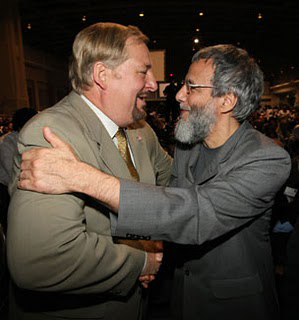
Rick Warren with Cat Stevens

MADISON, Wisc., March 5, 2012 /Christian Newswire/ -- Rick Warren issued a response to the Orange County Register's article "Rick Warren Builds Bridge to Muslims." In his response, Warren said editor Jim Hinch misinterpreted him. In the article, Hinch said Warren was "proposing a set of theological principles that includes acknowledging that Christians and Muslims worship the same God."
 
Jim Hinch must have read "A Common Word Between Us and You" that Warren signed in 2007. He signed the document with the late John Stott, Brian McLaren, Robert Schuller, Leith Anderson (NAE President), David Neff (Christianity Today), Richard Cizik (former NAE VP), and Bill Hybels (Willow Creek).
 
The document called for peace between Muslims and Christians. It pushed a common understanding between both faiths based on the Koran commandment, "O People of the Scripture! come to a common word as between us and you: that we worship none but God."
 
This document was an attempt to apologize for the supposed mistreatment of Muslims around the world. Christians should not have signed this document because Allah and the Judeo-Christian God are not the same. Christians believe Jesus Christ is the Son of God, the second person of the Trinity.
 
Muslims deny this doctrine as they believe Jesus was only a prophet and not God. Rick Warren's response to the Orange County Register's article clarified that he believes the doctrine of the Trinity and that Jesus is the Son of God.
 
The problem that we have is that he has a case of doublespeak. Warren denies the Orange County Register article's contents, but the document he signed "A Common Word Between Us and You" says differently.
 
Steve McConkey, leader of BigWorldWatch.com, says "A person should not say one thing one time and another thing later and then blame the reporter. Also, it gets old as he vilifies his critics as being Pharisees and not reaching out. He knows nothing about us. I minister to more foreign people here at the University of Wisconsin in a week than most people meet in a year."
 
Steve McConkey is the leader of BigWorldWatch.com, a brand new site that will cover news to discern the times. BigWorldWatch.com will take over the news section of 4WindsUSA.com. 4WindsUSA.com will continue to provide track and field news, athletes testimonies, and apologetics. BigWorldWatch.com will be totally independent of 4WindsUSA.com.

Bible Translation Center moves forward despite Boko Haram concerns

Cameroon (MNN) ― Boko Haram's efforts to rid Nigeria of Christians has also raised concerns in neighboring Cameroon.

There are reports from Cameroon's Muslim leaders that religious extremism could be gaining a foothold.

According to the Cameroon Association of Imams, there are some mosques that have allowed the Boko Haram to preach. Boko Haram is a jihadist terrorist organization based in northeast Nigeria.  

It seems that the concern is serious enough that Muslim leaders may look at regulating religious groups in an effort to keep Boko Haram's extremism out of Cameroon.

At the same time, Wycliffe Associates, an international organization that involves people in the acceleration of Bible translation efforts, is moving forward on plans to build a new Bible translation center in Cameroon.

Bruce Smith, president and CEO of Wycliffe Associates says, "There is a lot of concern about what might happen, but so far, it's been peaceful. We're obviously concerned that the translations would be able to move forward without interruption. We'd certainly request people to pray." 

The region is strategic to unreached people groups. Smith explains, "It's a place where there are so many different languages--about 300 in Nigeria and about another 100 in Cameroon--that are still without one verse of Scripture. We are convinced that the best solution for the instability and the concerns that have arisen there is that God's Word go forward in a language that they can understand."

The project has been a long time in the planning, made even longer by unexpected delays. "The main holdup has actually been that the government has been thinking about building a football (soccer) stadium, and recently the approval came through to start the construction project for the training center. So we're moving ahead with it now, along with our partner, the Cameroonian Bible Translation Association."

The idea is to move the training closer to the actual language work itself. The current Bamenda Translation Training Center is actually a tiny, old, three-bedroom house and three other houses spread out over four separate properties. A new Bible translation training center would provide a more efficient space which would help facilitate the more than 40 language projects that are currently underway in Cameroon.   

Now that the last obstacle has been cleared away, Wycliffe Associates wants to waste no more time getting a  training center in Bamenda built. They're raising the first $50,000 to launch. "We're actually going to begin immediately. We have a construction superintendent assigned; we've got materials being ordered at this time. We've got volunteers, professional construction people from the United States who are going to assist with the local laborers."

Once the work teams make it to the site, Smith says, "We expect that they'll be finished in about a year, at least with the initial phase, and then maybe continuing beyond that with some additional buildings."

Why the rush? "The need for Scripture is so great in Cameroon that there are many more communities, many more people desperate for hope," says Smith. "We have a window of opportunity now to provide national translators the resources needed to accelerate translation efforts and reach the remaining language groups."

Wycliffe Associates involves people in accelerating the work of Bible translation through their time, talents, and treasure. Because millions of people around the world are still waiting to read the Scriptures in the language of their heart, Wycliffe Associates is working as quickly as they can to translate every verse of the Bible into every tongue to change every heart.

The organization partners with nationals, mother-tongue translators, staff, volunteers, and supporters to direct and fund these efforts, as well as provide logistics, networking, and technical support. Through a growing global network, Wycliffe Associates is striving to overcome local limitations of time and resources to achieve the goal of beginning the translation of God's Word in every remaining language that needs it by 2025.

Chinese church sees dozens come to Christ, in China

Erik Burklin in China to help train
 Christian leaders.

China (MNN) ― Ministry reports out of China are mixed. Some report ministry is more open than it's ever been before. Other groups say Christians are oppressed more than ever. We know both are true. We've told you about stories of house churches being closed down and Christians arrested. However, here's a story not at all like that one.

President of China Partners Eric Burklin just returned from China. He says one registered church pastor is seeing many turn to Christ through hotel outreach "by renting a ballroom at a local hotel, and then having each church member bring a non-Christian friend or family member to this special event. They have dancing, plays, and music. At the end, he preached an evangelistic message, and 60 accepted Christ."

Burklin says pastors are using avenues outside the local church to introduce people to Christ. This pastor says he's baptized more than 200 new believers.

Many people wonder if this is illegal. Burklin did, too. "I asked this pastor very specifically, 'Isn't this illegal?' He said, 'Well, we didn't ask authorities ahead of time. We just did it. We figured that if they weren't going to say anything, we were just going to do it.'"

China Partner provides training to church leaders in the country. Burklin says the leaders are asking for something controversial -- youth training. It's illegal to evangelize children under 18. "They would have to figure out how they could legally do that. The government is very concerned about not forcing anybody under 18 to make a decision in any religious direction."

Despite that, China Partners is raising money for this new ministry push. Burklin says it's important, especially since many young people who are in their late teens and early 20's are interested in knowing about God. He says a conversation with a 22-year-old university graduate at McDonalds in China proves this. "This conversation at McDonalds turned into a day-long witnessing [event], because the next day we invited her to come to church where we were doing our training. And she did show up."

If you'd like to help China Partner with youth ministry training in China, click here. 

Islamists in Egypt Use Rumors to Attack Christians


Salafis attack in one village, while officials in another overturn evictions.
Tensions remain high in an Egyptian village where as many as 5,000 mostly Salafi Muslims went on a rampage over a false rumor that a church was holding a girl against her will in order to convert her back to Christianity.


Dismissing media reports of 20,000 rioting Muslims, sources told Compass that between 2,000 and 5,000 hard-line Muslims, most of them from the Salafi movement, last month harassed Christian villagers in Meet Bahsar in the Nile Delta, attacked a church building in a misguided effort to “save” the girl, damaged a priest’s house and then destroyed his car.


The 14-year-old girl’s father, an ethnic Copt who converted to Islam, had stirred them up on the mistaken notions that his daughter had converted to Islam and that Christians had kidnapped her, the church priest told Compass.


“Things are partly calmer now, and parishioners still go to church but they are a bit hesitant,” said the Rev. Gerges Gamil of the Church of the Virgin Mary. “Some things got broken in my house, because they threw rocks and stones at the house, and my car was destroyed, but thankfully no one in my family was hurt.”


The girl, 14, was not in the church building. It was unclear if her father was merely mistaken about her location or intentionally misled villagers.


The attack mainly by Salafists, an extremist movement that patterns its belief and practices on the first three generations of Muslims, happened on the evening of Feb. 12. Skirmishes in Meet Bahsar lasted for two days, with Muslim villagers threatening to kidnap Coptic girls in retaliation for the alleged kidnapping.


Some media reported that the rioters knocked down a wall surrounding the church, but priests speaking on behalf of the parish said the wall was already being demolished.


The events that led to the attack involved a family dispute.


The girl’s father, Khalil Ibrahiem Mouhamed Abd Allah, converted to Islam in 2009, and then divorced his Christian wife and married a Muslim woman. Abd Allah claimed that his daughter converted to Islam in October of last year. In February, the girl got engaged to a Muslim man in her father’s village, but shortly after the engagement she ran away.


“She got engaged to a Muslim man called Ahmed Abdallah, but she was still in touch with some Christians, and after the engagement she disappeared,” Abd Allah told local media. “So, I immediately thought that the Christians kidnapped her.”


By contrast, the girl reportedly said her father treated her poorly and that she never converted to Islam. She confirmed the engagement but said that ultimately she couldn’t continue with it because the groom-to-be was Muslim.


The girl was able to make it to Cairo, but after finding out about the attacks and the reports that she was being held against her will, she contacted police. Her location was not publicly known at press time, but she has reportedly asked not to be returned to her father or mother.


Egyptian newspapers have reported that she was either in state care or the custody of an uncle. She reportedly said she went to Cairo to stay with an uncle.


The Salafi movement is made up of extremely conservative Muslims increasingly known for their vitriolic rhetoric and attacks against churches in Egypt. The Salafis have used rumors of kidnappings or relationships between Christians and Muslims to incite other attacks against Christians. In May 2011, an attack in downtown Cairo left 12 people dead and at least one church building in ruins.


More recently, in January Salafists terrorized Christians of a village in northern Egypt after an unsubstantiated rumor spread about a video recording of a Coptic man having sex with a Muslim woman. The Muslims in Sharbat, near Alexandria, rioted and then forced numerous Christians to abandon their property in informal but binding “reconciliation councils,” though a parliamentary commission overturned the council decision last month, and most of the evicted Christian families have returned home.


Human rights activists say such councils are unjust and are often a guise to force members of the Coptic minority to relinquish their rights.


END